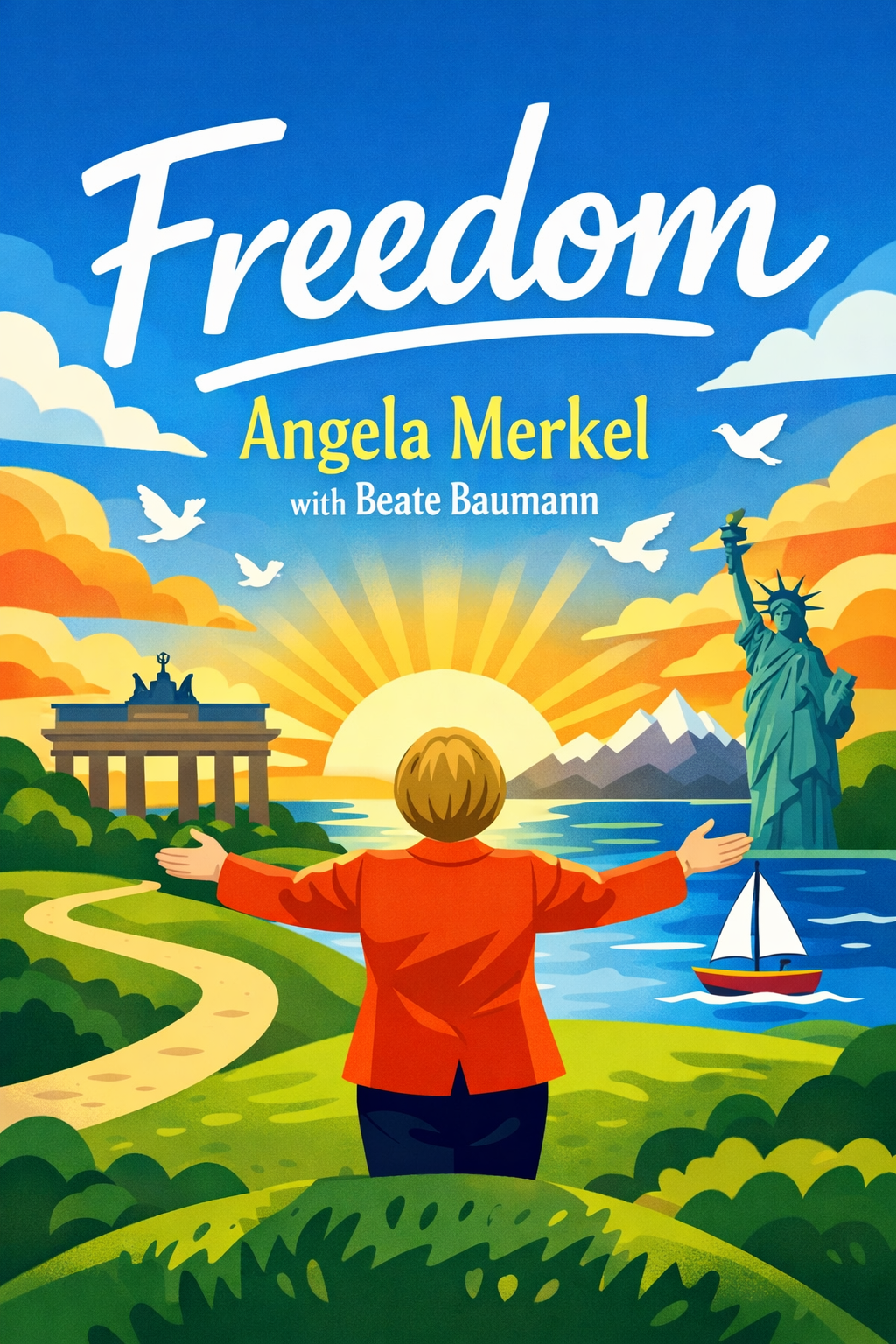
Description
The story of Angela Merkel is a profound narrative of navigating constraints and seizing freedom, set against the backdrop of a divided century. Born in Hamburg in 1954, her life was immediately shaped by division when her family moved to East Germany just weeks later. Her father, a Protestant pastor, established their home within the Waldhof, a church-run complex that functioned as an alternative microcosm within the conformist German Democratic Republic. This environment provided a sheltered haven where open conversation was possible, but it also marked young Angela as an outsider. From an early age, she learned the vital skill of compartmentalization—speaking freely at home while maintaining a cautious silence in public. This dual existence fostered a relentless drive to excel academically, a necessity for someone deemed politically unreliable by the state. Her stellar grades, however, did not grant her true choice; barred from preferred fields, she turned to physics, viewing the natural sciences as a realm where objective truth might offer a refuge from ideology.
Her university years in Leipzig were a study in making the best of a limited world. She embraced student life, organizing parties and traveling where her GDR passport allowed, all while enduring compulsory ideological training. A strategic marriage to fellow student Ulrich Merkel offered a practical hope of future co-location, a small act of defiance against state control of careers. After graduation, her professional life in Berlin at the Central Institute for Physical Chemistry was gray and monotonous, a stark contrast to her student days. The omnipresent Wall was a daily reminder of the system’s barriers. Yet, even here, she cultivated a private sphere of intellectual discussion and personal resilience, famously avoiding Stasi recruitment by feigning naive indiscretion. Her personal life evolved with a separation and an audacious “occupation” of an empty apartment, demonstrating a pragmatic will to carve out a space for herself. Meeting her second husband, Joachim Sauer, and renovating a dilapidated house became a productive distraction, a project of creation amidst the stagnation of the planned economy.
The fall of the Berlin Wall in 1989 unleashed a transformative sense of relief and, crucially, possibility. The oppressive structures that had dictated her life’s boundaries vanished overnight. For Merkel, this newfound freedom was not an invitation to retreat but a call to participate. She immersed herself in the chaotic, exhilarating process of rebuilding, eventually finding a political home in the new party Demokratischer Aufbruch. Her rise was characterized by a combination of competence and being in the right place at the right time, such as becoming press spokesperson due to a scheduling conflict. She thrived in the turbulence, her analytical mind suited to the monumental tasks of reunification. Elected to the Bundestag in 1990, she was soon tapped by Chancellor Helmut Kohl, who saw in her a valuable symbol of East German integration and female representation. As Minister for Women and Youth, she navigated contentious issues like abortion law, learning the art of slow, incremental progress. Later, as Environment Minister, she managed fraught challenges like nuclear waste transport, developing a steely resilience against public criticism.
Merkel’s ascent to the chancellorship was accelerated by a party crisis, proving her mettle as a calm and strategic operator. Her leadership, however, was immediately tested by global firestorms. The 2008 financial crisis demanded a response that balanced German economic orthodoxy with the need to prevent European collapse. Her cautious, data-driven approach defined her style: a relentless pursuit of pragmatic solutions over ideological fervor. This was perhaps most vividly displayed during the 2015 refugee crisis. Her decisive declaration, “We can do it,” was a monumental humanitarian and political gamble, embodying a conviction in both German capacity and a moral duty. It cemented her image as a central pillar of European stability while igniting fierce domestic and international debate.
On the world stage, she engaged with a shifting cast of powerful figures, from Putin to Obama to Trump. Her relationships were often transactional and coolly professional, grounded in a deep understanding of power dynamics and a commitment to multilateralism. The final and unexpected test of her tenure was the COVID-19 pandemic. Facing a novel, invisible threat, she leveraged her scientific background to communicate complex data with clarity and empathy, urging national solidarity with the simple, powerful phrase, “This is serious.” Her handling of the crisis saw a resurgence in public trust, a testament to her methodical and evidence-based governance in a time of fear.
Her departure from office in 2021 was characteristically undramatic, closing a chapter defined not by charismatic revolution but by consistent, adaptive stewardship. Her story is not one of radical transformation but of gradual, determined evolution—from a physicist constrained by a dictatorship to a global leader navigating an era of perpetual crisis. It is a testament to the power of analytical thinking, pragmatic resilience, and the quiet, steadfast application of freedom once it is finally won.