Description
In this fascinating journey through the annals of human irrationality, we uncover a startling truth: our ancestors were not so different from us. The book presents a panoramic view of collective madness, where logic is abandoned and emotion becomes the currency of the public square. At its heart, it is a study of the repeating patterns that emerge when individuals surrender their critical thinking to the intoxicating power of the crowd. From the auction houses of Amsterdam to the royal courts of Europe, the same psychological forces appear again and again, dressed in the fashion of the era but fundamentally unchanged.
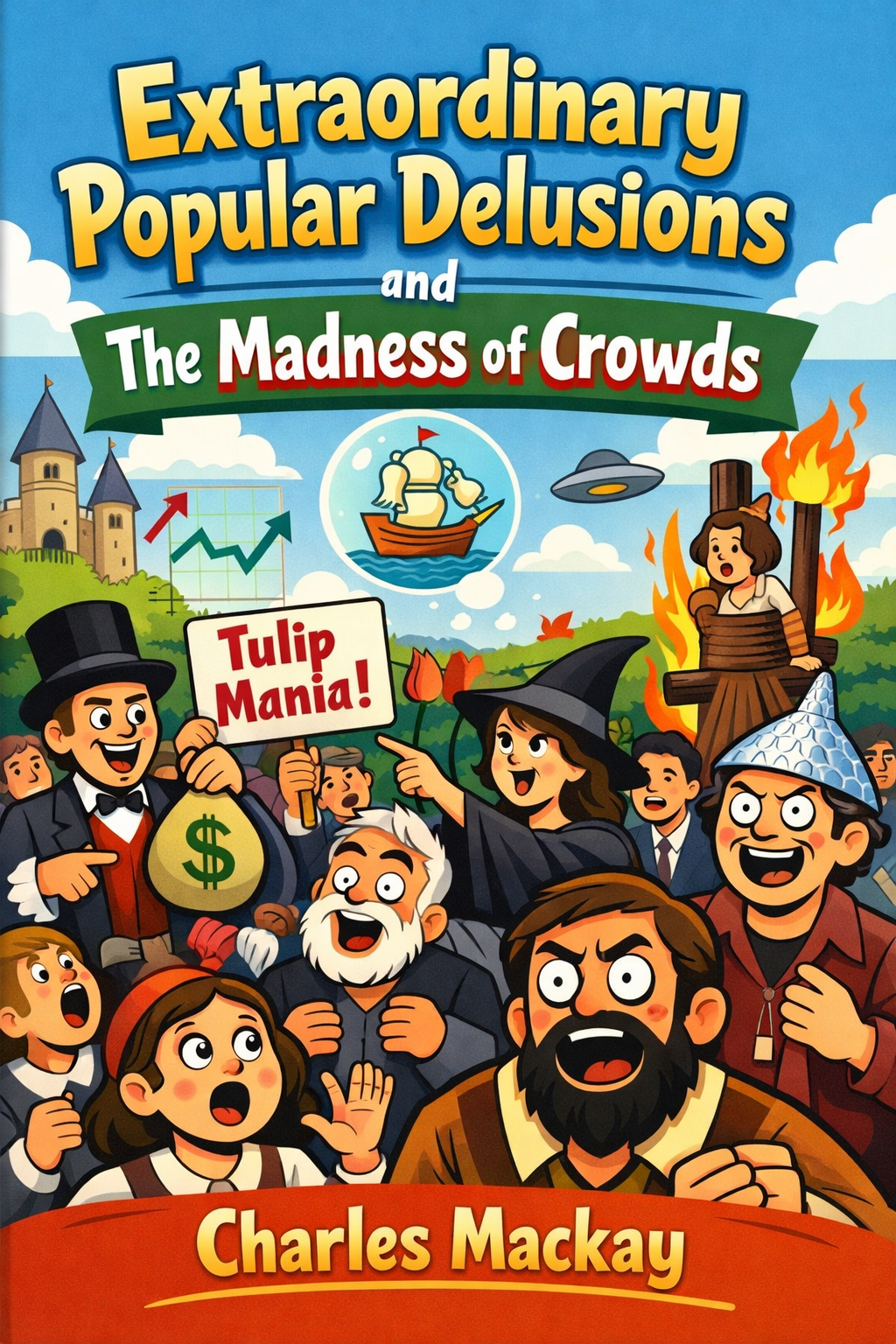
The narrative begins with one of history’s most iconic financial bubbles: the Dutch Tulip Mania. In the 1630s, the humble tulip bulb transformed from a botanical curiosity into a speculative asset of dizzying value. At the frenzy’s peak, a single rare bulb could command a price equivalent to a grand Amsterdam townhouse. Craftsmen sold their tools, farmers their land, all to secure a piece of the floral fortune. The mania created its own reality, where value was detached from any inherent worth and based solely on the belief that someone else would pay more tomorrow. The inevitable crash was catastrophic, ruining many and leaving behind a powerful lesson about the seductive nature of get-rich-quick stories. This pattern, the author reveals, is not a relic but a template. It reappeared in the South Sea Bubble of 1720, where a company with illusory prospects captivated a nation, including the brilliant Isaac Newton, who lost a fortune. The echo of this pattern resonates in every modern speculative frenzy, from Beanie Babies to digital assets, proving that the psychology of greed and the fear of missing out are timeless drivers of human action.
Beyond finance, the exploration delves into the world of alchemy and pseudoscience, where the desire for miraculous solutions opens the door to elaborate deception. For centuries, charismatic figures promised kings and commoners alike the secrets of transmuting base metals into gold or concocting elixirs for eternal health. These “scientists” mastered the art of plausible showmanship, using basic chemical tricks and psychological manipulation to sustain hope and secure patronage. The Holy Roman Emperor Rudolf II funded hundreds of such charlatans, while figures like Giuseppe Borri swindled multiple European courts with the same empty promises. This chapter exposes a profound human vulnerability: our willingness to believe in shortcuts to wealth and health is often stronger than our commitment to evidence. The modern parallels are clear in the markets for miracle cures, fad diets, and other products that prey on hope and exploit the gaps in mainstream knowledge, wrapping themselves in the language of science while offering fantasy.
The analysis then turns to a different kind of contagion: the social hysteria of hauntings and urban legends. Here, belief shapes reality in a more visceral way. The book recounts tales like the Capuchin monks of Orleans, who fabricated a ghostly haunting to secure a better monastery, and the London neighborhood thrown into panic by a simple sheet-clad prankster. These episodes demonstrate that a story, once believed by a critical mass, generates tangible consequences—plummeting property values, changed behaviors, and community-wide fear. The phenomenon shows how the human mind, seeking patterns and explanations for the unexplained, often prefers a thrilling supernatural narrative to a mundane truth. This instinct, amplified by social transmission, allows fictional creations to leap from imagination into shared reality, sometimes with tragic results, proving that the line between collective fantasy and concrete experience is perilously thin.
Perhaps the most sobering examination is that of moral panics and persecutions, epitomized by the witch trials that swept Europe and America. In an atmosphere of fear—from bad harvests to disease—societies sought scapegoats, often targeting the marginalized and the different. The machinery of justice itself became twisted to serve the hysteria, accepting spectral evidence and employing torture to extract confessions that confirmed the crowd’s darkest suspicions. The case of North Berwick, Scotland, where dozens were accused of conspiring with the devil to sink the king’s ships, illustrates how a single accusation could unravel into a web of terror, fueled by authority figures like King James VI. This pattern of projecting societal anxieties onto a vilified group, and the subsequent suspension of rational inquiry and mercy, stands as a grave warning. It reveals how easily civilized structures can collapse when infected by the virus of collective fear and the human need to assign blame.
Finally, the lens focuses on the metropolis itself as a catalyst for peculiar manias. The book details curious fads that seized entire cities, from the obsessive pursuit of rare pineapples in Victorian London to bizarre investment schemes centered on seemingly worthless commodities. In the dense, interconnected environment of the city, ideas spread with viral speed, and the desire to participate in the latest trend can override individual judgment. The urban crowd creates its own momentum, where the very act of mass participation lends credibility to the absurd. This metropolitan madness underscores a central theme: humans are profoundly social creatures, and our need to belong, to be part of the “in” group, can compel us to embrace beliefs and behaviors we would otherwise reject.
Through these vivid historical portraits, the book constructs a powerful framework for understanding not just the past, but the present. It argues that the specific object of mania—be it a tulip, a ghost story, or a stock certificate—is almost incidental. The constant is the human psychology underneath: our capacity for contagious belief, our vulnerability to stories that promise transformation, and our tendency to find safety in the crowd, even when it is marching toward a cliff. By studying these extraordinary popular delusions, we are not merely entertained by the follies of our forebears; we are equipped with a mirror to recognize the same impulses in our own time. The madness of crowds is a recurring feature of the human story, and this timeless work remains an essential guide to spotting its early symptoms before we are swept away by the next wave.