Description
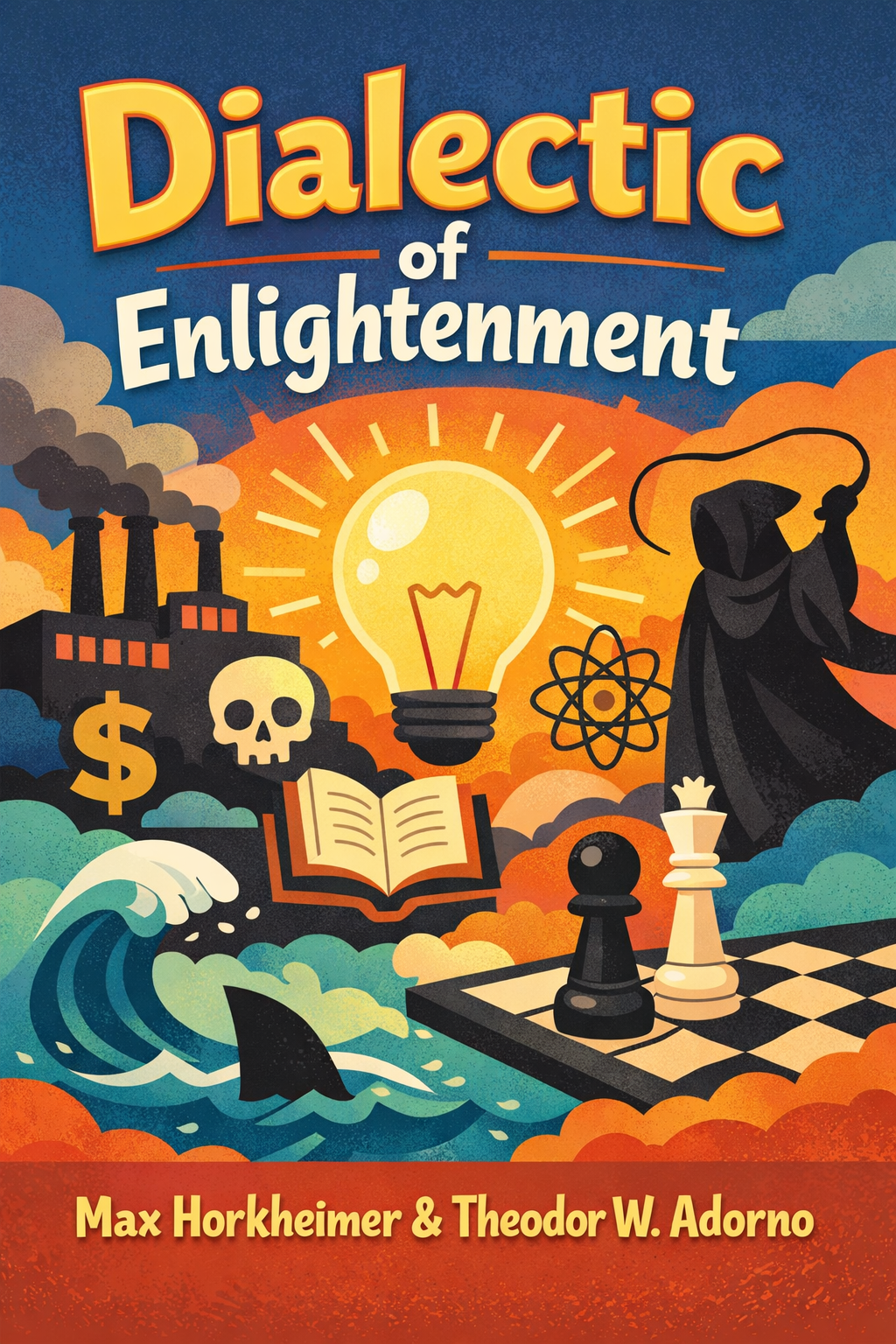
Written amidst the devastation of World War II, Theodor Adorno and Max Horkheimer’s seminal work presents a profound and unsettling critique of the modern world’s foundations. Their central argument is that the Enlightenment, the great 18th-century movement that championed reason, science, and individual liberty as the path to human emancipation, has catastrophically turned against itself. Instead of creating a world of freedom, its core principles have mutated into a new, more insidious form of mythology that enforces domination, not liberation. This is the “dialectic” of the title: the process by which an idea generates its own opposite. The very tools designed to dispel superstition and fear have become instruments for a more totalizing control, both over nature and over human beings.
The authors contend that the Enlightenment sought to master nature through reason, rejecting all that was mysterious or non-quantifiable. This “instrumental reason” reduces everything—objects, people, ideas—to mere means to an end, stripping the world of intrinsic meaning and value. In this framework, something is only “true” or “good” if it is useful for domination and control. This logic, they argue, did not simply fade away but became the bedrock of modern society. It finds its ultimate expression in the horrors of 20th-century totalitarianism, where bureaucratic, scientific rationality was employed to administer genocide, but it is equally present in the smooth, pervasive workings of capitalism and its culture industry.
The “culture industry”—Adorno and Horkheimer’s term for mass-produced film, music, and advertising—is not benign entertainment. It is a primary engine of this new mythology. By manufacturing standardized desires and promising false satisfactions, it pacifies the population, training them to conform and consume rather than to critique or imagine alternatives. The illusion of choice masks a profound uniformity, where individuality itself becomes a marketed style. This system seamlessly integrates people into the economic order, ensuring their compliance not through overt force, but through the colonization of their inner lives and leisure time.
This leads to a crucial concept: the introversion of sacrifice. In ancient myths, sacrifice was a communal ritual, an offering to external gods to ensure prosperity. In the modern age, sacrifice has been internalized. Individuals now perpetually sacrifice their own time, freedom, and authentic happiness on the altar of the economic system. We sacrifice our present for a future career, our passions for practical skills, our leisure for consumption. This self-imposed discipline is framed as “virtue”—hard work, perseverance, delayed gratification—but it ultimately serves to maintain the very structures that dominate us. The system persuades us to willingly offer up our own humanity, believing it is for our own good.
A devastating consequence of this dialectic is the erosion of objective truth and genuine experience. When instrumental reason reigns, facts become subservient to power and utility. Thought itself is reduced to a technical skill, losing its capacity for critical negation—the ability to say “this is wrong” and to conceive of something fundamentally different. Art and philosophy, which should be realms of resistance, are either absorbed by the culture industry as commodities or rendered impotent. The result is a flattened world where the distinction between truth and falsehood, between profound art and empty kitsch, becomes dangerously blurred.
Ultimately, *Dialectic of Enlightenment* is not a rejection of reason, but a desperate attempt to save it from itself. It is a warning that reason, divorced from ethical reflection and cut off from its emancipatory purpose, becomes irrational. The book ends not with a blueprint for a better world, but with a call for a kind of thinking that resists the totalizing grip of the system. It advocates for a negative critique, one that persistently exposes contradictions and refuses to be reconciled with a world where freedom has become a new form of mythic fate. The work stands as a challenging, pessimistic, yet essential diagnosis of why the modern age, for all its technological marvels, so often feels spiritually barren and politically perilous.