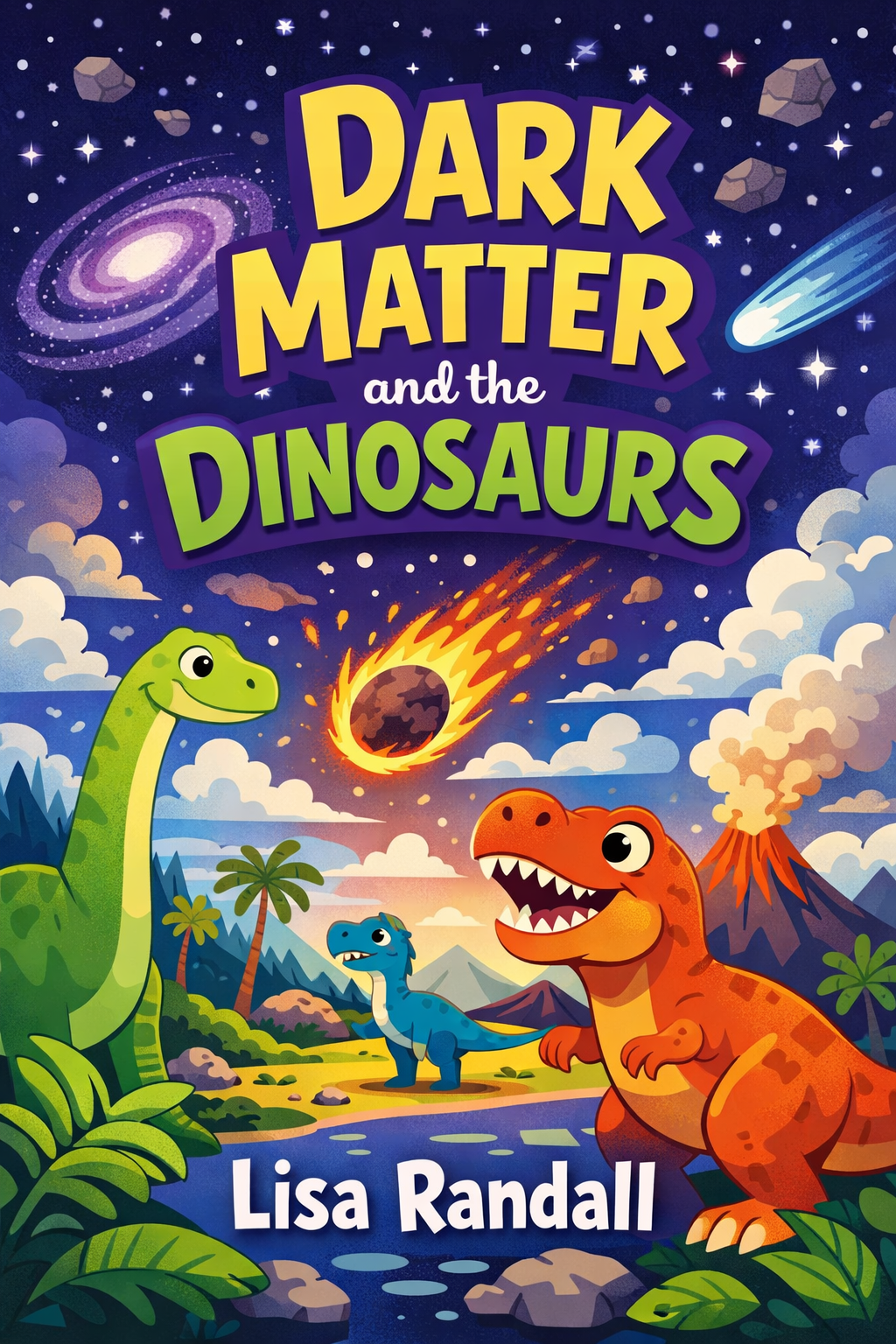
Description
Our planet’s story is written in the layers of rock and the craters scattered across its surface, a narrative where the most dramatic chapters often arrive from the depths of space. For decades, the prevailing theory for the demise of the dinosaurs has centered on a colossal impact from an asteroid or comet. But this explanation begs a deeper, more profound question: why? What cosmic mechanics could send such a destructive force on a collision course with Earth at that precise moment in geological time? This exploration ventures beyond the immediate cataclysm to weave together two of science’s greatest puzzles: the enigmatic nature of dark matter and the extinction of the dinosaurs, proposing a breathtaking link between the architecture of the universe and the fate of life on our world.
To understand this potential connection, we must first grasp the invisible scaffolding of the cosmos. Dark matter is a substance that does not interact with light, making it completely undetectable to our eyes and telescopes. Yet, we know it exists because of its profound gravitational influence. It comprises the vast majority of matter in the universe, acting as the hidden skeleton upon which galaxies form and spin. Without the gravitational pull of dark matter, the universe would lack the structure needed for stars, solar systems, and planets to coalesce. Its presence was essential in drawing together the gas and dust that eventually formed our Sun and the disc of material that became the planets, including Earth. This mysterious substance is not a passive backdrop; it is an active, dominant player in the cosmic order.
Earth itself is a product of a violent, chaotic early solar system, a period marked by relentless bombardment from space rocks known as meteoroids. These impacts were not merely destructive events; they were also delivery services. They brought to Earth vital materials like water, carbon, and even amino acids—the fundamental building blocks of proteins and DNA. Some scientists theorize that the seeds of life, or at least the crucial ingredients for it, may have arrived on these celestial carriers. The fossil record intriguingly shows surges in biological complexity following some of these ancient bombardment periods, suggesting that these extraterrestrial events may have played a catalytic role in the evolution of life, even as they periodically reset it.
Among the various objects that travel through our solar system, comets hold a special place. Originating from the distant, frozen Oort cloud at the very edge of the Sun’s gravitational influence, these icy bodies are pristine relics from the solar system’s birth. When perturbed from their stable orbits and drawn inward toward the Sun, they heat up, developing magnificent glowing tails. The impactor that ended the Cretaceous period, wiping out the dinosaurs and three-quarters of all plant and animal species, is widely believed to have been such a comet. The evidence, discovered in a layer of iridium-rich clay found globally, points to a cataclysm of unimaginable scale, leaving a crater over 100 miles wide near what is now Chicxulub, Mexico.
The investigation into this event led to a startling pattern. Geological evidence suggests that mass extinction events are not entirely random; they may occur with a rough periodicity, approximately every 26 to 30 million years. This regularity demands a cyclical astronomical trigger. One compelling explanation involves our solar system’s journey through the Milky Way galaxy. As our Sun orbits the galactic center, it does not move on a flat plane but oscillates up and down through the dense galactic disk. Some scientists hypothesize that every 30 million years or so, this oscillation brings the solar system close enough to the dense mid-plane of the galaxy for its gravitational tide to disrupt the Oort cloud, sending a shower of comets hurtling inward, with the potential for one to strike Earth.
This is where dark matter re-enters the story with a provocative twist. The author presents a fascinating and speculative theory: what if the galaxy’s dark matter is not smoothly distributed? What if it, too, is concentrated in a thin disk aligned with the visible galactic plane? As the solar system oscillates through this dense dark matter disk every 32 million years, the additional gravitational interaction could be the precise trigger that disturbs the Oort cloud, initiating a comet shower. In this scenario, dark matter—the unseen architect of the universe—could directly influence the biological destiny of planets by orchestrating periodic celestial bombardments.
The theory elegantly ties the largest scales of cosmology to the most pivotal moments in Earth’s biological history. It proposes that the same invisible force responsible for gathering galaxies may also, through a subtle and indirect gravitational nudge, have been responsible for clearing the evolutionary stage 66 million years ago, making way for the rise of mammals and, ultimately, humans. This narrative does not offer a definitive answer, but a stunning synthesis of cosmology, astrophysics, and paleontology. It challenges us to see Earth not as an isolated world, but as a participant in a grand, dynamic, and sometimes dangerous cosmic dance, where the invisible hand of dark matter may have written one of the most crucial chapters in the story of life.