Description
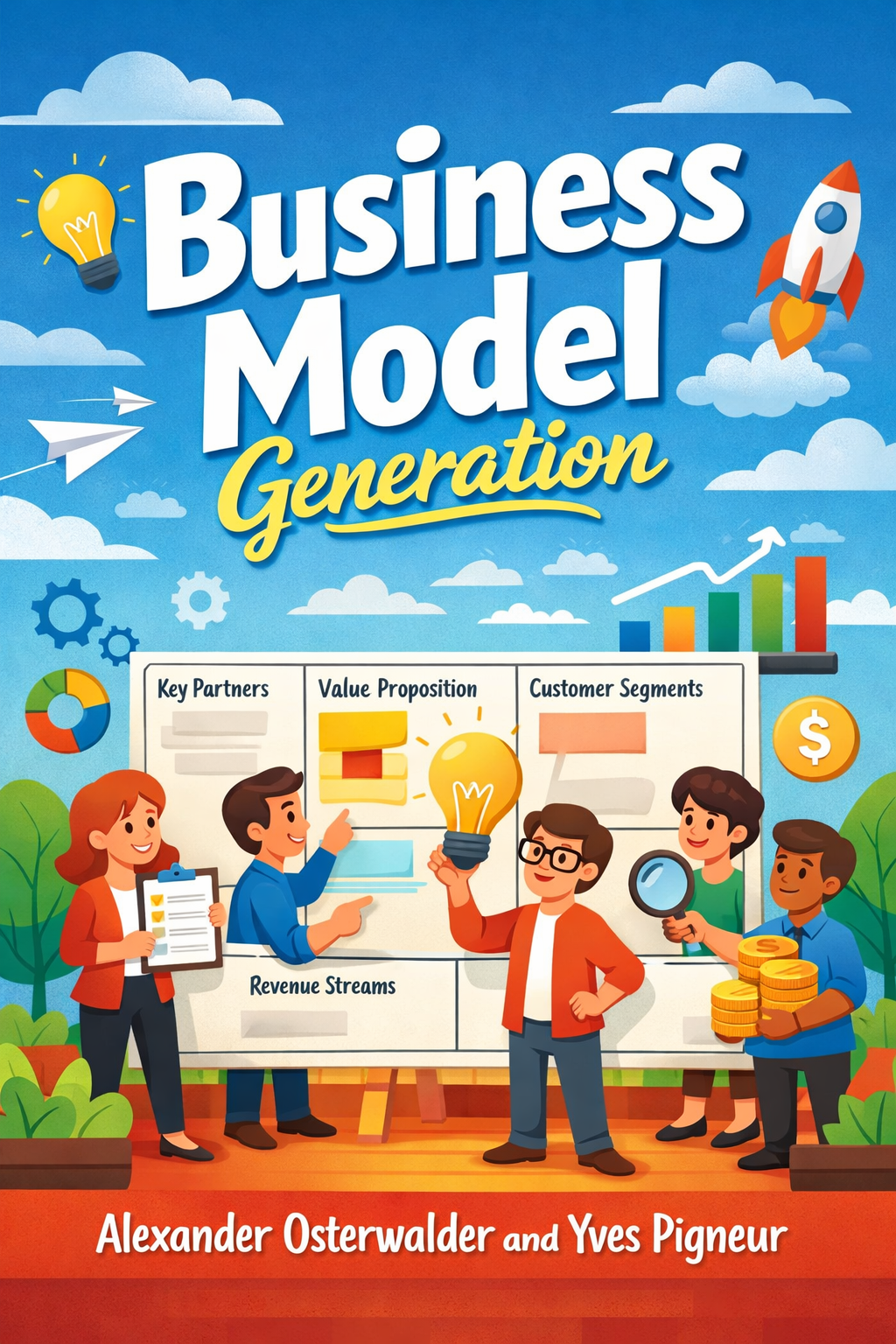
At its core, every enterprise, from a tiny startup to a global corporation, operates on a business model—a system for creating, delivering, and capturing value. This book provides a powerful, visual framework for making sense of this system, stripping away complexity to reveal the essential components that determine success or failure. The methodology centers on the Business Model Canvas, a strategic management template that allows teams to sketch out, discuss, and redesign how they do business on a single, coherent page.
The canvas is built upon nine fundamental building blocks that together provide a complete picture of an organization’s logic. It begins with Customer Segments, defining the different groups of people or organizations a business aims to reach and serve. A business must ask who its most important customers are and whether it serves a mass market, a niche, a segmented group, or a multi-sided platform. Next, Value Propositions articulate the bundle of products and services that create value for a specific Customer Segment. This block seeks to solve customer problems or satisfy needs, whether through novelty, performance, customization, design, brand status, price, cost reduction, risk reduction, accessibility, or convenience.
Channels describe how a company communicates with and reaches its Customer Segments to deliver its Value Proposition. This encompasses awareness, evaluation, purchase, delivery, and after-sales support, and can include owned channels like a sales force or website, partner channels like distributors, or a hybrid. Customer Relationships outlines the types of relationships a company establishes with specific Customer Segments, which may range from personal assistance and dedicated support to self-service, automated services, communities, or co-creation. Revenue Streams represent the cash a company generates from each Customer Segment, answering what each segment is truly willing to pay for. Revenue can come from asset sales, usage fees, subscription fees, lending/renting/leasing, licensing, brokerage fees, or advertising.
On the operational side, Key Resources describes the most important assets required to make a business model work. These can be physical, financial, intellectual, or human. Key Activities are the most important things a company must do to make its model function, such as production, problem-solving, or platform/network maintenance. Key Partnerships outlines the network of suppliers and partners that complement the model, including strategic alliances, co-opetition, joint ventures, or buyer-supplier relationships. Finally, Cost Structure details all costs incurred to operate the model, which can be cost-driven (focused on minimizing expenses) or value-driven (focused on creating premium value), and covers fixed and variable costs, economies of scale, and scope.
The book is not merely a static description of these blocks; it is a manual for action. It guides readers through the process of design, encouraging a mindset of innovation and iteration. Techniques like customer empathy mapping—exploring what customers think, feel, see, hear, and do—help to uncover deep insights that fuel value proposition design. The practice of prototyping with the canvas allows for the exploration of multiple models, testing assumptions, and adapting strategies in a low-risk environment. Storytelling and scenario planning are presented as creative tools to envision how a business model plays out in the real world, imagining the customer’s journey and the business’s response to future trends or disruptions.
Furthermore, the text explores patterns from a wide array of contemporary and classic business models, providing a library of inspiration. It examines models like Unbundling, the Long Tail, Multi-Sided Platforms, FREE as a business model, and Open Innovation. By analyzing companies as diverse as Google, Apple, Gillette, and Skype, it demonstrates how the recombination of the nine building blocks can lead to revolutionary market positions and resilient competitive advantages. The ultimate message is that business model generation is a dynamic, creative, and collaborative discipline—a foundational skill for anyone looking to build, transform, or simply understand a successful enterprise in today’s complex economic landscape.