Description
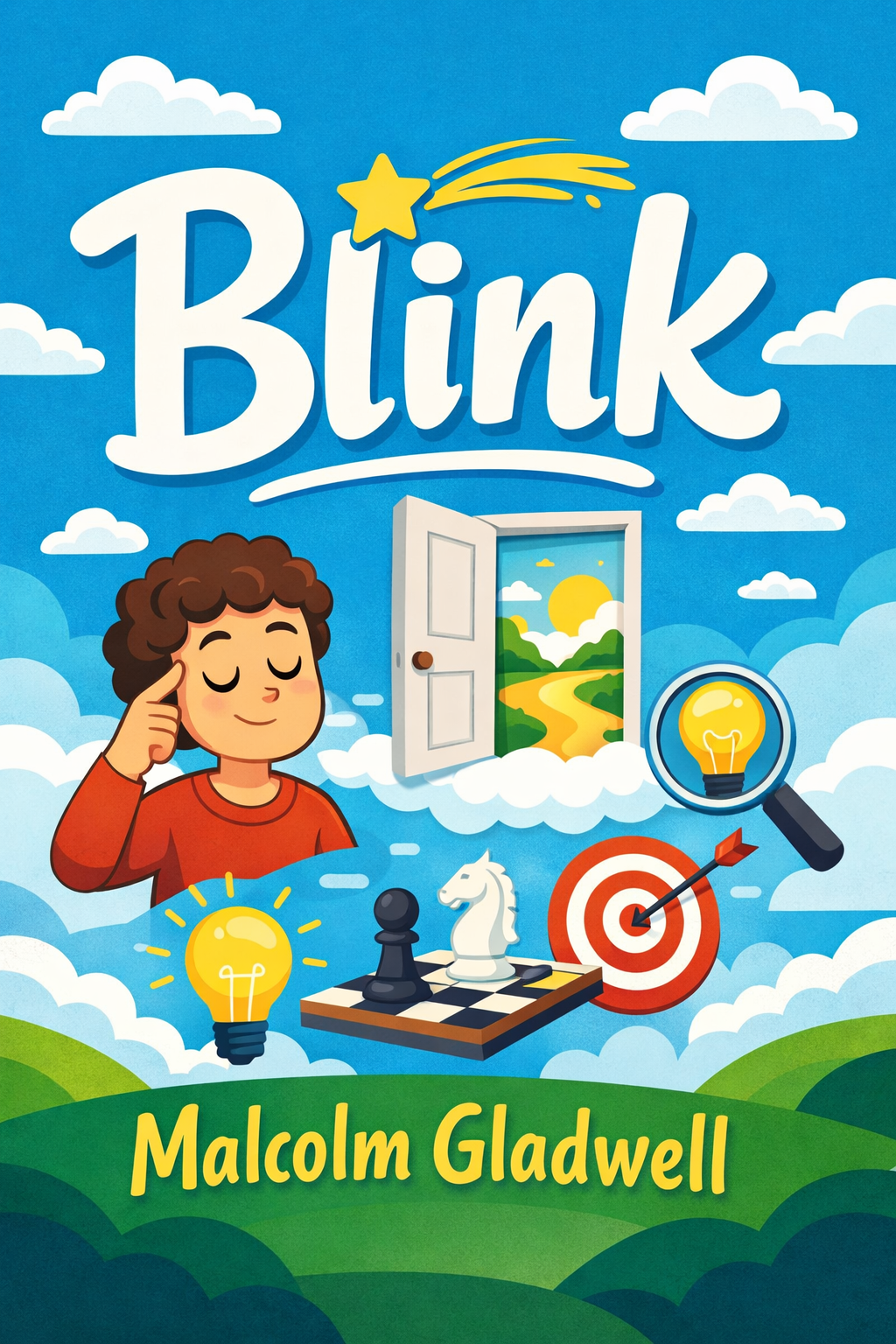
Within the first few seconds of meeting a stranger, viewing a work of art, or facing a complex situation, your mind reaches a series of conclusions. This book delves into the fascinating world of these instantaneous judgments, the thin-slicing of experience where our unconscious mind processes a staggering amount of information in the blink of an eye. It argues that this rapid cognition is not a magical trick but a sophisticated and powerful form of thinking, one that can be both remarkably insightful and dangerously flawed. The narrative builds a compelling case that we are not helpless passengers in this process; we can train and understand this adaptive unconscious to harness its power while guarding against its pitfalls.
The journey begins by challenging the deep-seated cultural assumption that good decision-making is always deliberate, conscious, and methodical. We often believe that more information and more time inevitably lead to better choices. However, through a series of captivating stories—from an art historian who instantly senses a forgery to a marriage expert predicting divorce from a brief conversation—the book demonstrates that the mind can find patterns in situations and behavior based on very narrow slices of experience. Our unconscious is a giant pattern-matching machine, sorting through our lifetime of knowledge, memories, and experiences to arrive at a conclusion long before our conscious mind has even begun to articulate the question.
This unconscious processing is not infallible. The book carefully examines the conditions under which these snap judgments go awry. Stress, time pressure, and information overload can send our adaptive unconscious into a panic, leading to disastrous errors in judgment. More insidiously, our snap judgments are vulnerable to the hidden biases and stereotypes we all carry, often operating completely below the level of our awareness. A police officer’s tragic mistake, rooted in subconscious racial profiling, serves as a sobering example of how thin-slicing, when poisoned by prejudice, can have fatal consequences. The book makes it clear that the goal is not to blindly trust every gut feeling, but to learn to distinguish the valuable insights from the dangerous prejudices.
A crucial distinction is drawn between the kind of intuitive expertise developed through deep, immersive practice and the shallow, prejudice-laden hunches of the uninformed. The seasoned firefighter who suddenly orders his crew out of a burning house just before the floor collapses isn’t operating on a whim; he is unconsciously recognizing a pattern of clues—the quiet of the fire, the heat under his feet—that his years of experience have coded into his mind. His intuition is educated. Similarly, a master tennis coach can sense a double fault before the ball is struck, reading the microscopic tells in a player’s posture. This form of rapid cognition is a hard-won skill, the compression of expertise into an instantaneous read.
So, how do we improve this powerful tool? The book suggests that we must become detectives of our own decisions. Since we cannot directly open the locked door of our unconscious, we must learn to read its outputs carefully. This involves creating structures and environments that allow our intuition to work at its best. For experts, it might mean simplifying information streams to avoid overload. For all of us, it involves a rigorous honesty about our biases and the implementation of strategies to minimize their influence, such as blind auditions for musicians. We can also learn to manage our first impressions by controlling our environment—understanding how subtle cues in a room or a person’s demeanor can prime our unconscious in positive or negative ways.
Ultimately, the book presents a new framework for thinking about thinking. It posits that our mind operates on two levels: the conscious, deliberate, and logical mode, and the unconscious, rapid, and intuitive mode. Wisdom lies not in choosing one over the other, but in understanding the strengths and weaknesses of each. There are moments when we must trust the quiet, confident whisper of our trained intuition, and there are moments when we must slow down, interrogate our first impressions, and engage our conscious analysis. By learning when to blink and when to think, we can make better decisions, understand others more deeply, and navigate a complex world with greater skill. It is an invitation to respect the mysterious and powerful force of our adaptive unconscious, not as an enemy of reason, but as its silent, capable partner.