Description
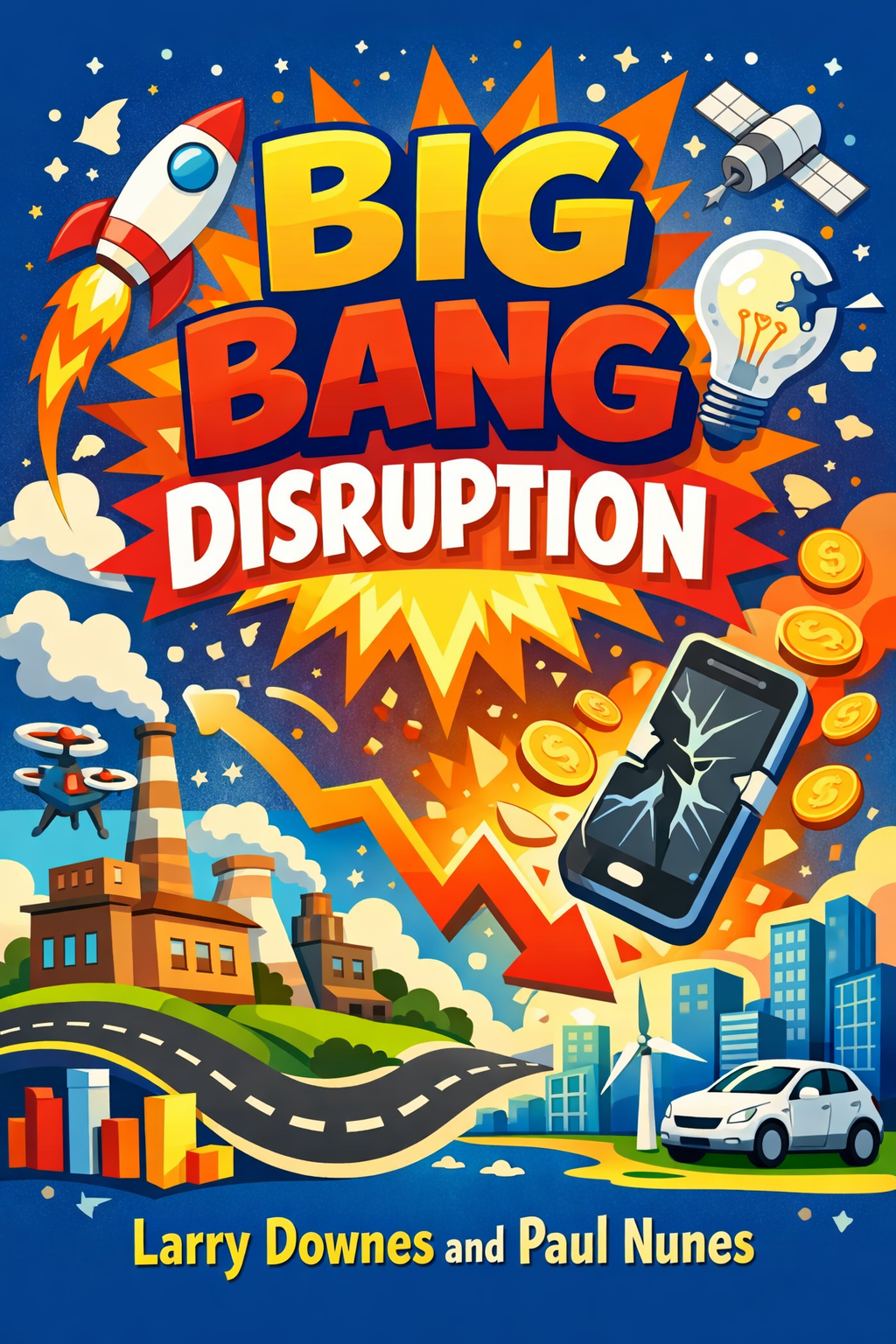
The modern marketplace is no longer a predictable landscape of gradual evolution. It is a universe prone to sudden, violent explosions of innovation that can create and destroy entire industries in a flash. This phenomenon is Big Bang Disruption. Unlike traditional disruptions that pick off a market’s edges, these innovations enter the market fully formed, offering products or services that are simultaneously better, cheaper, and more desirable than anything that existed before. They don’t just compete; they obliterate. Think of how digital photography erased film, how smartphones swallowed standalone cameras, maps, and music players, or how streaming services overturned television and music industries. The source of this explosive power is the convergence of exponential technologies—like cloud computing, ubiquitous sensors, and powerful networks—that make experimentation cheap, information free, and market entry almost effortless.
These disruptors share a common, chaotic DNA. They exhibit an undisciplined strategy, launching into markets without the meticulous planning and analysis of old, because the cost of simply trying is now lower than the cost of studying. They experience unconstrained growth, fueled not by massive marketing budgets but by the free, instant transmission of information and peer recommendations across global networks. They benefit from unencumbered development, using readily available tools and platforms to build, release, and refine products in the open, with users acting as their real-time research and development team. This combination allows them to appear seemingly from nowhere and achieve near-instant dominance.
Every Big Bang Disruption follows a cosmic life cycle, mirroring the universe’s own story. It begins in the Singularity, a period of hidden gestation where signals of change are faint but detectable. Incumbents might feel a vague unease as experimenters tinker with new technologies and business models in the shadows. Then comes the Big Bang itself—the moment of catastrophic success. The disruptor launches, and adoption is not a slow climb but a vertical line. The market is transformed in an instant, leaving established players shell-shocked and scrambling. This explosive growth cannot last forever, leading to the Big Crunch. The market saturates, growth slows, and value begins to consolidate or evaporate as imitators appear and the initial shockwave dissipates. Finally, the cycle ends in Entropy. The original disruptive product or service loses its defining energy, but its components—its technology, its user base, its data—do not vanish. They become the raw materials for new experiments, feeding fresh ideas and setting the stage for the next Singularity.
To survive and thrive in this volatile environment, businesses must learn to navigate each stage of this cycle. During the Singularity, the key is vigilant preparation. Seek out truth-tellers—visionaries and tinkerers at the fringes of your industry who see the potential of emerging technologies. Master the art of timing by observing early failures and learning from them, entering the market not first, but right. Embrace cheap, rapid experimentation to explore possibilities without betting the company. When the Big Bang hits, the rules change instantly. Companies must brace for catastrophic success, scaling operations at a dizzying pace to seize winner-take-all markets. They must also create “bullet time”—the organizational ability to make rapid, decisive moves while everything around them seems to be moving at light speed.
The inevitable Big Crunch requires a different kind of courage. One must anticipate saturation before it happens, harvest value from assets that are peaking, and have the discipline to quit or pivot before decline sets in. Clinging to a fading disruptor is a recipe for oblivion. Finally, in the Entropy stage, the goal is intelligent reinvention. Avoid the black hole of pouring resources into a dead model. Instead, reconfigure the remaining valuable assets—customer relationships, data, technology platforms—and use them as fuel to search for the next potential Singularity. In a world of constant Big Bangs, the only sustainable strategy is perpetual adaptation, viewing every ending not as a failure, but as the necessary precursor to a new beginning.