Description
Sigmund Freud’s “Beyond the Pleasure Principle” stands as a profound and unsettling pivot in his own theoretical landscape. Initially, Freud established the pleasure principle as a foundational force, suggesting that the human psyche is fundamentally geared toward seeking pleasure and avoiding unpleasure. However, in this later work, he confronts a series of human behaviors that this principle cannot satisfactorily explain. He is drawn to phenomena that seem to contradict a simple pursuit of happiness, such as the traumatic nightmares of war veterans, who relentlessly revisit horrific experiences in their dreams, or the puzzling game of a young child who repeatedly throws a treasured toy away only to retrieve it, mastering the anxiety of its disappearance. These repetitions of distress suggest a compulsion that operates beyond, or even against, the pleasure principle.
From these observations, Freud daringly postulates the existence of a second, opposing fundamental drive. He names this the death drive, or *Thanatos*, which exists in constant tension with the life instincts, or *Eros*. It is crucial to understand that Freud is not describing a literal wish to die. Instead, he conceptualizes the death drive as an innate organic urge to return to a state of quiescence, a complete elimination of tension. He traces this back to the most basic principle of all life: the inanimate state from which it emerged. The drive, therefore, is a conservative force that seeks to revert to an earlier condition—ultimately, the stillness of inorganic matter. This is not about destruction for its own sake, but about a profound yearning for the peace of non-existence, a zero point of stimulation and need.
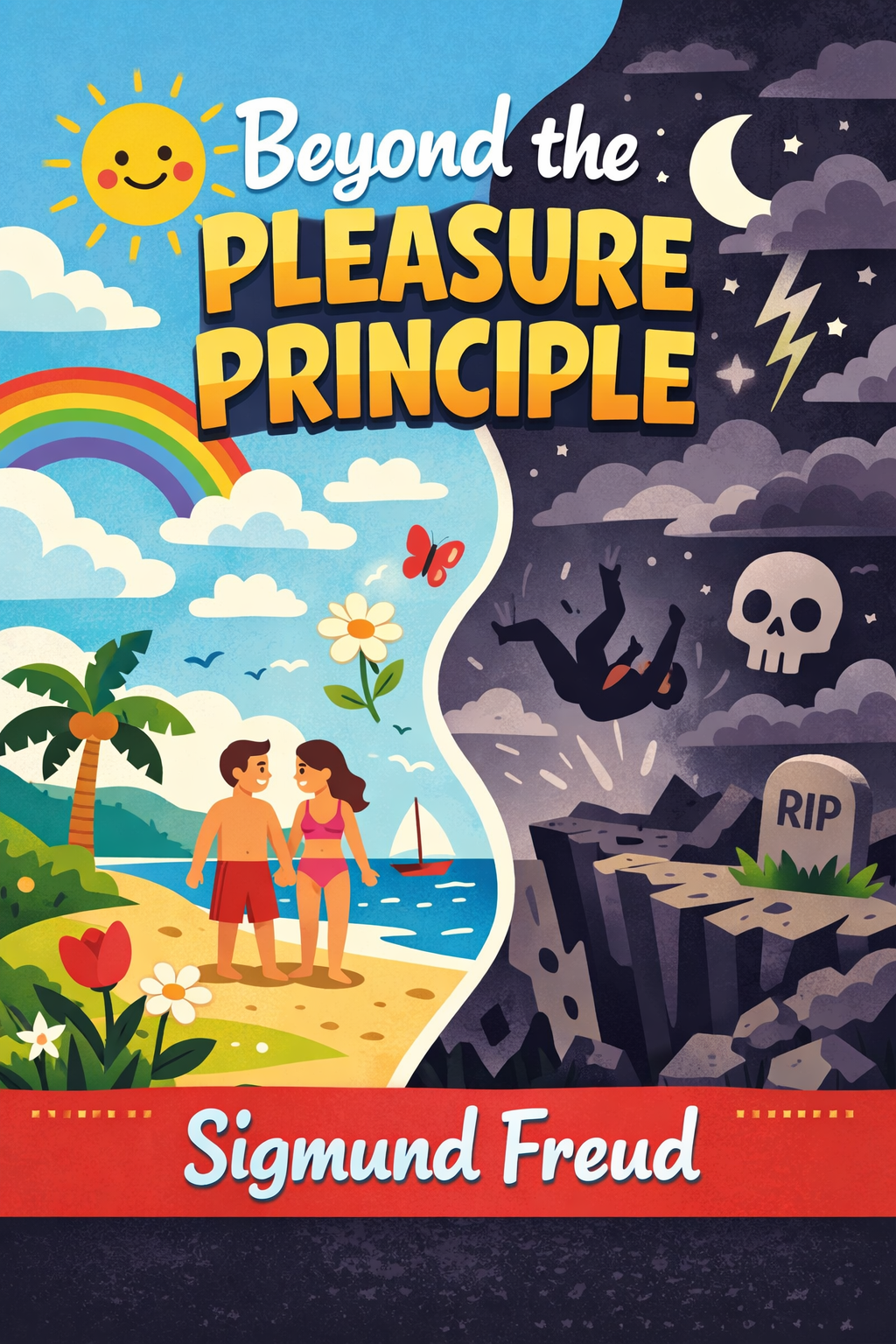
This introduces a radical duality at the heart of human motivation. Our psyche becomes a battlefield where Eros, which encompasses not only sexuality but all forces that seek to preserve, unite, and build complexity, struggles against the pull of Thanatos, which seeks to dissolve bonds, reduce tension, and return to simplicity. Every human action can be seen as a compromise formation between these two mighty currents. The life instincts push us to form relationships, create, and proliferate. The death drive manifests in aggression, self-sabotage, the pull of familiar misery, and the comfort found in rigid routines that minimize the shock of the new. Even our pursuit of pleasure can be interpreted through this lens, as a temporary reduction of the tension caused by desire.
Freud’s theory provides a powerful, if somber, lens for understanding human contradiction. It explains why individuals might cling to painful patterns or why societies exhibit cycles of war and destruction alongside great cultural achievements. The concept of “mastery,” seen in the child’s game, becomes key. By repeating a distressing experience in a controlled setting, the psyche attempts to bind overwhelming stimuli and assert dominance over it, serving the death drive’s aim of reducing tension by making the unpredictable predictable. This framework also recontextualizes aggression, viewing it not merely as a reaction to frustration but as a primary expression of the death drive turned outward.
Ultimately, “Beyond the Pleasure Principle” expands the map of the human condition into darker, more complex territory. It suggests that our lives are not a straightforward journey toward happiness, but a dynamic and often conflicted negotiation between creation and dissolution, connection and separation, the vibrant noise of life and the profound silence of the inorganic state from which we came and to which, on some deep instinctual level, we are perpetually drawn. Freud leaves us with a vision of the individual as a vessel for these eternal, opposing forces, forever playing out an ancient drama between the will to live and the compulsion to return to rest.