Description
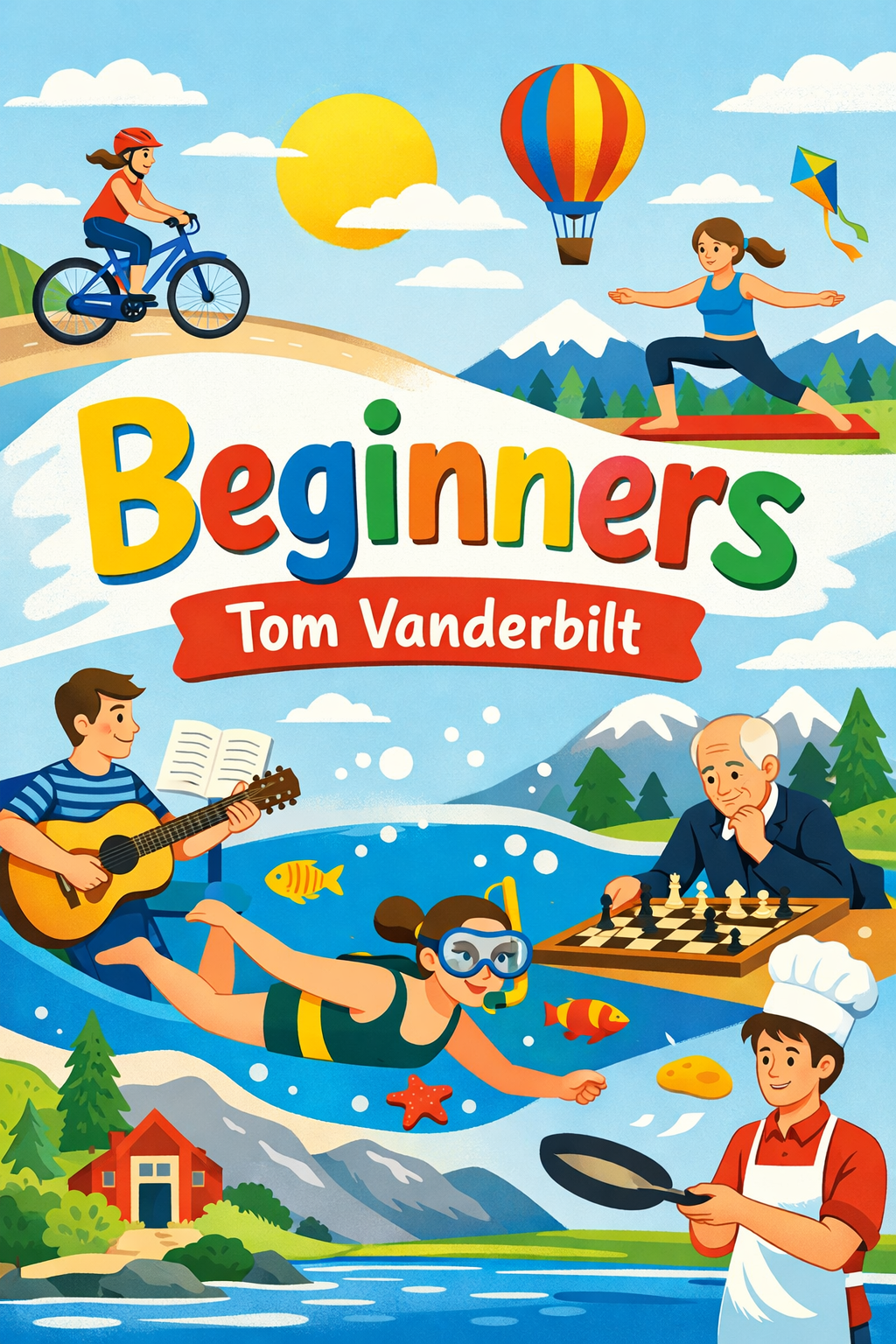
The journey of acquiring new skills is often seen as the domain of the young, yet this perspective overlooks a fundamental truth: our capacity for growth never truly vanishes. This book explores the profound personal and cognitive benefits of embracing the role of a beginner throughout life. It argues that stepping into the unknown to learn something new—whether an art, a sport, or a language—is not just a hobby but a vital practice for keeping the mind agile, engaged, and open. The narrative follows a personal quest for renewal through learning, weaving together insights from neuroscience, psychology, and firsthand experience to dismantle the myth that expertise is reserved for a gifted few or a certain age.
Adulthood often brings a plateau in procedural learning—the kind of knowledge that involves doing rather than just knowing. While we accumulate facts, we fewer often challenge ourselves to build new physical or complex mental skills. This stands in contrast to childhood, a time of relentless and fearless acquisition. Children learn quickly not merely because their brains are more plastic, but because they approach tasks without the fear of failure or the weight of expectation. The good news is that the adult brain retains significant plasticity. Engaging deeply with a new skill, studies show, can enhance overall cognitive function, improving memory and problem-solving abilities in unrelated areas. It is a workout for the mind, building resilience and creating new neural pathways.
Consider the universal yet often intimidating act of singing. Many believe a good voice is a innate gift, but in reality, singing is a motor skill, much like swimming or typing. It involves the precise coordination of breath and minute muscles in the larynx. Beginners often struggle because they are trying to consciously control a process that feels unfamiliar. Learning to sing well involves rethinking the body as an instrument, which can start with simple, sometimes silly-sounding exercises. Progress requires overcoming self-consciousness, particularly the common dislike of one’s own recorded voice, and learning to project with full commitment. The goal is not operatic perfection but the ability to express oneself freely and carry a tune, a skill accessible to nearly everyone with guided practice.
This journey of skill acquisition is profoundly enhanced by community. Learning is, at its heart, a social endeavor. Joining a choir, for instance, transforms a solitary practice into a collective experience. The act of harmonizing with others triggers social bonding, reduces stress, and increases the production of feel-good hormones like oxytocin. Beyond the emotional lift, group settings provide immediate, immersive feedback. You adjust your pitch in real-time to match those around you, accelerating your learning through a phenomenon known as social facilitation, where performance improves in the presence of others. This principle applies from cycling clubs to language exchange groups, highlighting that we often reach higher when we learn together.
Mastering any complex skill, however, follows a non-linear path. Research outlines a progression from novice to expert, with the first major hurdle appearing early. The novice learns context-free rules: the moves of chess pieces, the steps to pop up on a surfboard. The next stage, advanced beginner, requires applying those rules in the messy, unpredictable real world. This is where many falter. A surfer who performs perfectly in calm drills may wipe out on a real wave because the water, wind, and board behave in infinite variations. This frustrating plateau, where initial rapid progress stalls, is where most beginners quit. Pushing through requires accepting that rules are merely a foundation; true skill develops through experience, pattern recognition, and learning from countless small failures.
The pinnacle of skill development is automaticity—when practiced actions become second nature. A seasoned bike rider doesn’t consciously think through every micro-movement to swerve around an obstacle; their body reacts based on deeply ingrained muscle memory. This automation is achieved through deliberate, mindful practice. It’s not mere repetition, but focused effort on refining technique, often by breaking skills into smaller components. This process frees up cognitive resources for higher-order thinking. A chess master sees the board in strategic chunks rather than individual pieces; a musician feels the music rather than counting each note. This transition from conscious effort to intuitive execution is the hallmark of true proficiency.
The book illustrates this with the skill of drawing, which is less about manual dexterity and more about learning to see. Beginners often draw what they think they see—the symbolic idea of a face or a tree—rather than the actual shapes, shadows, and lines before them. Training involves exercises that bypass these mental shortcuts, like drawing a subject upside-down to force the brain to perceive pure form. This fresh perspective, a literal re-seeing of the world, is a metaphor for the beginner’s mind itself: open, attentive, and free from preconception. It is a state that can be cultivated in any field, turning the learning process into a source of continual wonder.
Ultimately, the central, empowering message is that it is never too late to begin. The act of starting something new, with all its attendant vulnerability and clumsiness, is an affirmation of curiosity and a rejection of stagnation. Whether picking up a paintbrush at fifty or learning to swim at seventy, the benefits extend far beyond the skill itself. It fosters humility, resilience, and a deep connection to the ongoing project of being human. Embracing the identity of a perpetual beginner is not an admission of inadequacy, but a courageous commitment to growth, proving that the most rewarding journeys often start with a single, tentative step into the unfamiliar.