Description
The story of Margaret Thatcher is one of improbable ascent and transformative conflict. Her journey began not in the halls of power, but above a grocer’s shop in the provincial town of Grantham. The values instilled here—thrift, self-reliance, and hard work—became the bedrock of her worldview. They stood in stark contrast to the Britain she would later seek to govern, a nation struggling under the weight of economic stagnation, powerful trade unions, and a pervasive sense of decline known as the “British Disease.” The crisis peaked in the “Winter of Discontent” in 1978-79, with strikes paralyzing public services and garbage piling in the streets, creating a national mood of despair that paved the way for a radical solution.
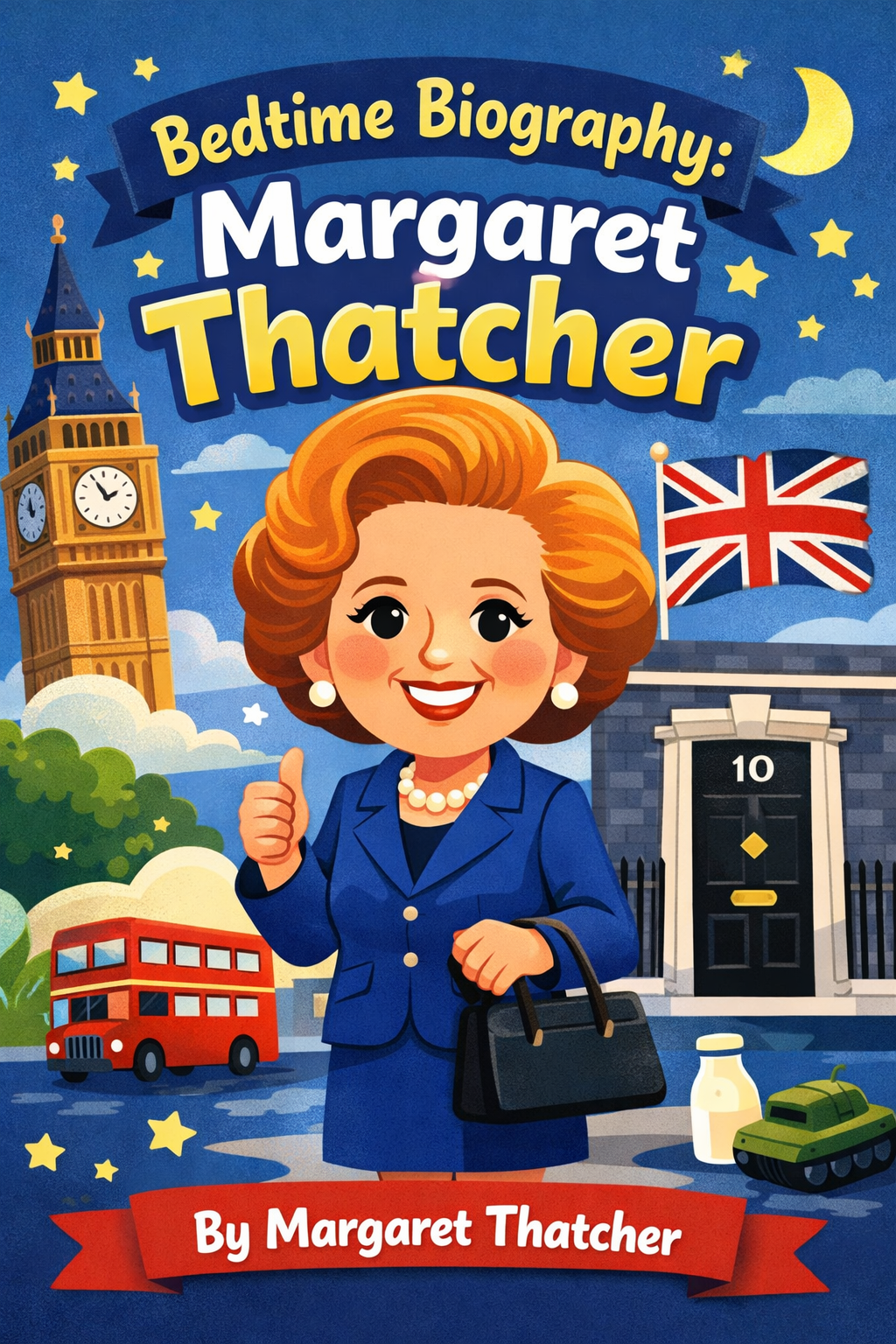
Thatcher’s path to leadership was lined with obstacles. She was a woman in a male-dominated party, a grocer’s daughter amid an aristocratic elite, and a conviction politician labeled a “doctrinaire” radical by her own colleagues. Her political philosophy, crystallized during her Oxford years through thinkers like Friedrich Hayek, viewed the expansive post-war state and its consensus with deep suspicion. She saw socialism, even in its moderate British form, as a road to serfdom that stifled individual initiative. Her early political career, including a controversial stint as Education Secretary where she ended free school milk for older children—earning her the derogatory nickname “Thatcher the Milk Snatcher”—proved she was unafraid of unpopularity if she believed her course was right.
Her moment arrived when the Conservative Party, defeated in 1974 and desperate for a break from the failed policies of the past, turned to her as leader. She promised a fundamental break from the consensus that had seen both major parties accept nationalized industries, strong union influence, and government management of the economy. In 1979, with the country weary of crisis, she became Prime Minister. Her famous quotation from St. Francis upon entering Downing Street—”Where there is discord, may we bring harmony”—was a poignant hope, but the immediate future held far more discord as she embarked on a revolutionary project.
Thatcherism, as it became known, was an economic and moral crusade. Her government moved swiftly to tackle inflation by controlling the money supply and raising interest rates, a painful medicine that led to a deep recession and soaring unemployment in the early 1980s. She began a sweeping program of privatization, selling off state-owned industries like British Telecom and British Gas to the public, aiming to create a “share-owning democracy.” Her most defining battles were with the trade unions, which she viewed as undemocratic obstacles to economic modernization. The climactic confrontation came with the National Union of Mineworkers in 1984-85. Thatcher’s government, having stockpiled coal, refused to yield to the year-long strike, ultimately breaking the union’s power and symbolically ending an era of industrial unrest.
Her vision extended beyond economics to a reassertion of national sovereignty and confidence. The 1982 Falklands War, in which she dispatched a task force to retake the British islands invaded by Argentina, was a pivotal moment. Its success fueled a resurgence of national pride and cemented her reputation as the “Iron Lady,” a leader of unwavering resolve. This resolve was equally applied to the European Community, where she fiercely negotiated for a rebate on Britain’s contributions, famously declaring, “We want our money back!”
The results of her policies were profoundly divisive. Supporters credited her with reviving enterprise, taming inflation, and restoring Britain’s standing in the world. They saw her as having saved the country from managed decline. Detractors saw a society fractured by inequality, with traditional industries and communities devastated, and a new culture of aggressive individualism replacing social solidarity. Her imposition of a Community Charge, or “Poll Tax,” sparked widespread riots and ultimately led to a party revolt. In 1990, after eleven years in power, she was forced to resign.
Margaret Thatcher left a nation irrevocably changed. She dismantled the old post-war settlement and challenged the very role of the state in British life. Her legacy is not one of consensus, but of conviction. She proved that a politician with a clear, uncompromising ideology could reshape a country’s destiny, for better or worse, and in doing so, she remains one of the most significant and controversial figures of the twentieth century. Her story is the story of a revolution, fought not on barricades but in the cabinet room, the coal fields, and the marketplace, and its echoes continue to define British politics today.