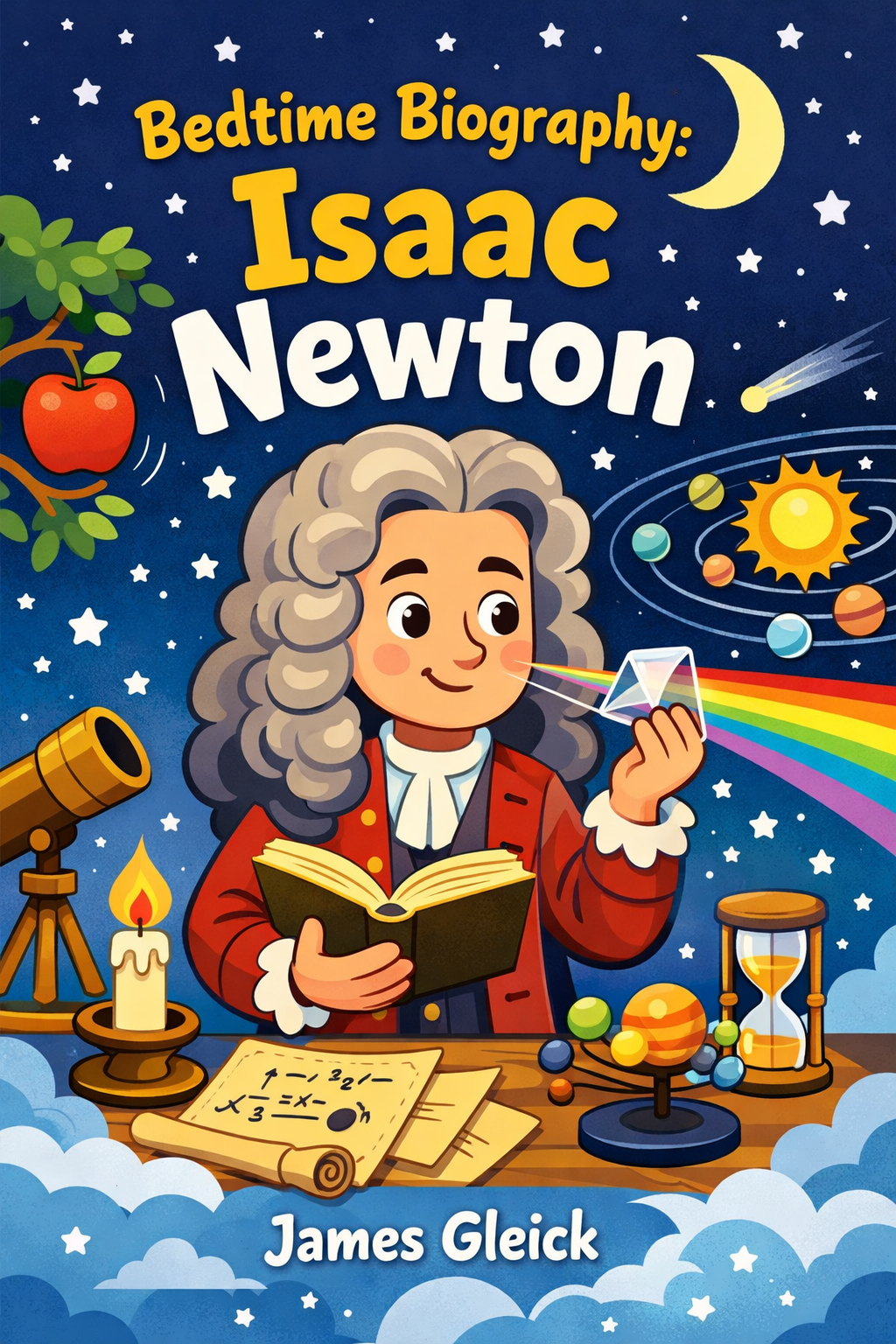
Description
The story of Isaac Newton begins not with a falling apple, but with a fragile and lonely child born into a world of uncertainty. Arriving on Christmas Day in 1642, he never knew his father. Raised by his mother on a quiet Lincolnshire farm, the young Newton was a solitary dreamer, captivated by the mechanics of windmills and the daily journey of the sun across the sky. His innate curiosity was a quiet flame, expressed in homemade sundials and careful observations of the moon. Sent to school in Grantham, he was an unexceptional student in the classical curriculum, yet his mind blazed with applications of the principles he learned, constructing intricate models and gadgets that hinted at the profound intellect lying dormant.
His path seemed destined for the mundane life of a farmer until a perceptive schoolmaster intervened, seeing a potential that Newton’s own family could not. This intervention secured him a place at Cambridge University’s Trinity College, a stark and demanding environment where the young scholar’s true awakening began. Immersed in a curriculum still heavily influenced by Aristotle, Newton encountered the revolutionary ideas of thinkers like Galileo. These new concepts, such as a refined definition of motion, acted as a key, unlocking a more mathematical and rational way of seeing the physical world. It was a thrilling intellectual foundation, but his greatest work was born from isolation, not lecture halls.
When the Great Plague of 1664 shuttered Cambridge, most students dispersed. Newton retreated to his family home and entered a period of intense, concentrated genius. In the quiet of his room, freed from academic routine, he embarked on a breathtaking journey of discovery. He probed the nature of light with prisms and perilous experiments, staring at the sun’s reflection until his vision swam. More significantly, he began the meticulous work that would redefine physics. The popular tale of an apple inspiring gravity in a single moment is a myth; in reality, Newton’s revelation was the product of relentless, systematic study. He spent months rolling objects down slopes, dropping weights, and meticulously recording every observation, convinced that the universe’s chaos hid a beautiful, mathematical order.
By the time he returned to Cambridge, he carried the seeds of a monumental theory. His brilliance was soon recognized, and he ascended to the prestigious Lucasian Professorship, gaining a laboratory and the freedom to pursue his ideas. Here, his practical ingenuity shone with the invention of a revolutionary reflecting telescope, far superior to existing models. This achievement brought him to the attention of London’s Royal Society, the epicenter of British science. However, his entry into this public arena was met not with universal acclaim, but with controversy.
His first major paper, proposing that white light was a composite of colored particles, challenged established thought and provoked immediate hostility. The most vocal and persistent critic was Robert Hooke, an established figure in the Society. Hooke’s dismissals, often branding Newton’s work as mere hypothesis, wounded the sensitive and proud Newton deeply. Stung, he withdrew from public debate, but the criticism forged his methodology. Determined to be unassailable, he dedicated himself to providing irrefutable mathematical proof for his ideas. This rivalry, while personally taxing, became a crucible that hardened the rigor and completeness of his work. He was not alone, however; supporters like the astronomer Edmond Halley provided crucial encouragement, seeing the monumental truth taking shape.
The culmination of this decades-long journey was the *Principia Mathematica*, published in 1687. In this dense, staggering work, Newton presented his three universal laws of motion and the law of universal gravitation. He offered a single, coherent system that could explain the arc of a cannonball and the orbit of the moon with the same elegant equations. He had provided the operating manual for a clockwork universe. Yet, the man behind this cosmic blueprint remained complex and contradictory. He served as Warden of the Royal Mint, applying his fierce intellect to catching counterfeiters, and later presided over the Royal Society itself. In his private life, he plunged into intense studies of alchemy and biblical chronology, pursuits that seemed at odds with his scientific legacy but were, to him, part of the same quest to decode God’s creation.
Isaac Newton’s story is the story of a mind that dared to systematize the heavens. He emerged from solitude and personal turmoil to gift humanity a new lens through which to view reality, establishing a framework of physics that would stand unchallenged for centuries. His life reminds us that monumental discovery is rarely a single moment of inspiration, but more often a long, stubborn, and deeply personal struggle against the unknown, driven by a unique blend of curiosity, rigor, and an unyielding desire to understand.