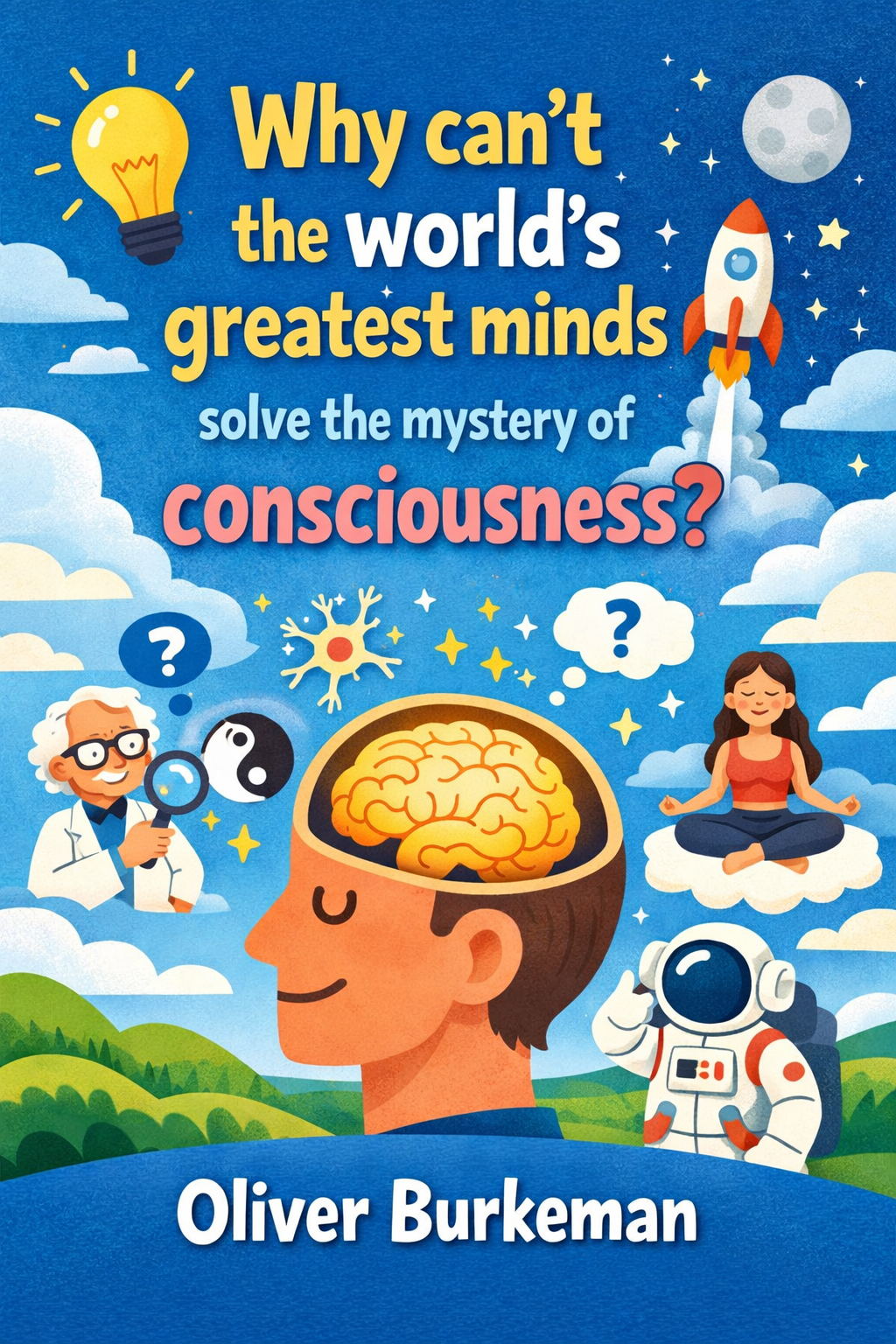
Description
The central question posed by the article is deceptively simple yet profoundly unsettling: why, with all our accumulated knowledge in neuroscience, physics, and philosophy, does the mystery of consciousness remain so stubbornly resistant to a solution? The piece argues that this isn’t a mere gap in our knowledge, but a fundamental chasm in our understanding of reality. While we have made spectacular progress in mapping the brain’s functions—linking specific regions to memory, vision, or emotion—these achievements only circle the core mystery. They explain the mechanics of awareness but fail utterly to address why and how these biological processes give rise to the rich, private, subjective world of experience: the redness of red, the pang of nostalgia, the simple feeling of being.
A primary and formidable obstacle is the problem of definition. Consciousness is something everyone intimately knows from the inside, yet it slips through the fingers of objective description. Is it self-awareness? The integration of information? The capacity for sensation? The article suggests that while these are facets of consciousness, the heart of the puzzle is what philosopher David Chalmers termed “the hard problem.” This is the problem of explaining why any physical process, no matter how complex, should be accompanied by an inner, felt experience. We can perfectly describe the neural fireworks that occur when someone sees a sunset, but we cannot capture or explain the personal, qualitative experience of its beauty. This gap between objective description and subjective reality is the crux of the dilemma.
The relationship between the brain and consciousness is another source of deep confusion. Clearly, the two are intimately linked; alter the brain with chemicals or injury, and you alter the conscious mind. This leads many scientists to believe consciousness is an “emergent property” of complex neural computation, a novel phenomenon that arises from sheer complexity, much like wetness emerges from water molecules. Yet, as the article points out, this explanation feels incomplete. Other systems in nature are immensely complex—global financial markets, the internet, even the human gut’s nervous system—but we do not attribute conscious experience to them. So, what special kind of processing or organization does the brain possess? Furthermore, the subjective nature of experience seems to exist in a different category altogether from the objective, measurable firings of neurons. Two brains might show identical scans while looking at the same object, yet the owners could be having wildly different internal experiences.
In the face of this “hard problem,” some thinkers have proposed truly radical solutions. The article touches on the idea that consciousness might not be a product of the brain at all, but a fundamental feature of the universe, as basic as space, time, or mass. This view, sometimes called panpsychism, suggests that some elemental form of experience exists all the way down to the building blocks of reality, and that complex systems like brains merely amplify or channel it. While this may seem far-fetched, it underscores the depth of the mystery and the willingness of scholars to consider paradigms beyond conventional materialism.
Despite the profound difficulties, the article is not a story of defeat. It highlights significant progress on what Chalmers called the “easy problems” (which are, in fact, extraordinarily difficult): mapping the neural correlates of consciousness, understanding how the brain achieves attention, and studying altered states through meditation or psychedelics. These lines of inquiry are illuminating the conditions necessary for consciousness to appear. Yet, they persistently circle the central, luminous mystery of why it appears at all. The enduring enigma of consciousness, therefore, stands as a humbling reminder of the limits of our current scientific frameworks. It suggests that understanding ourselves may require not just more data, but a potential revolution in our very conception of reality, bridging the seemingly unbridgeable divide between the objective world of matter and the subjective world of mind.
Book Title: Why Can’t the World’s Greatest Minds Solve the Mystery of Consciousness?