Description
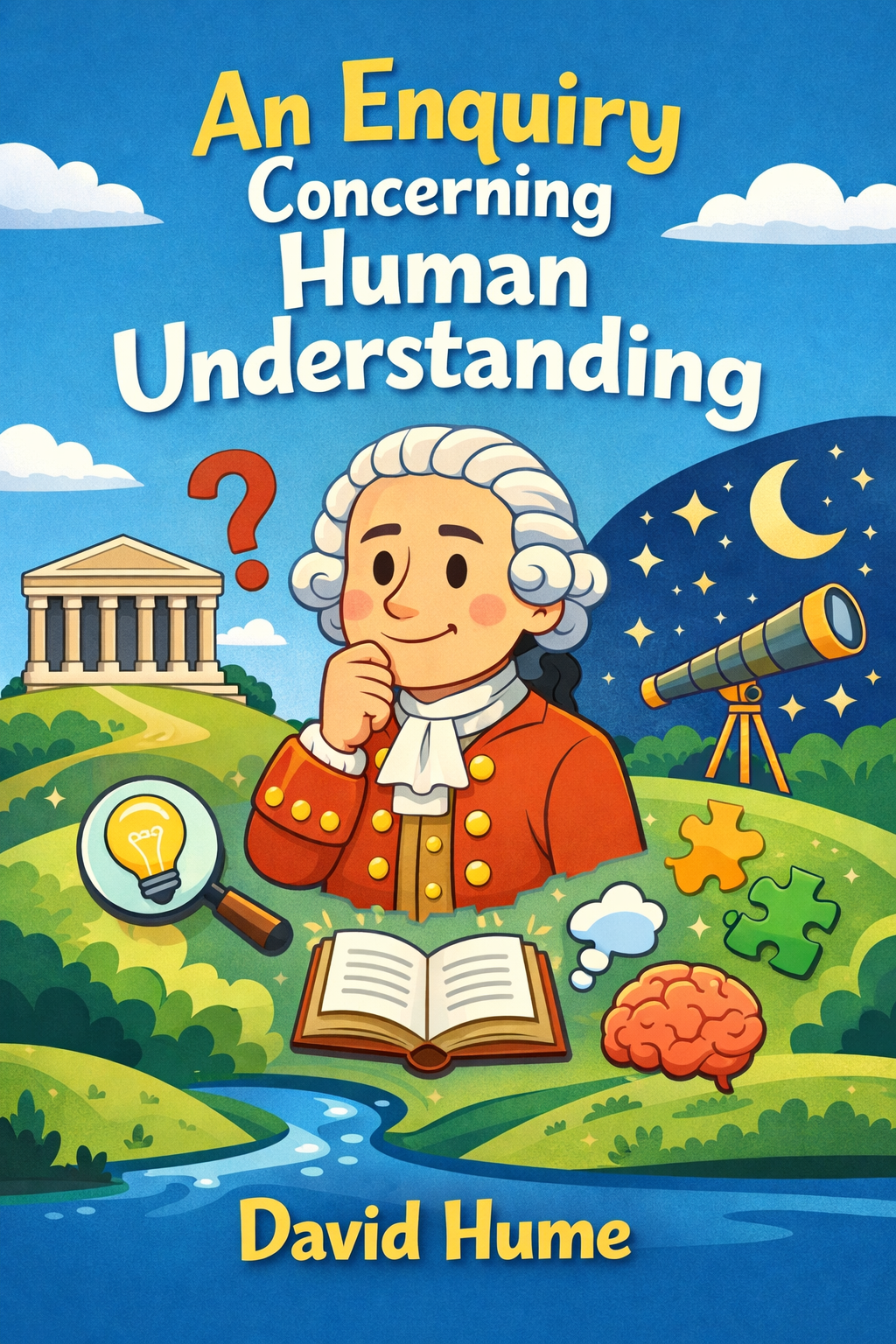
David Hume’s profound inquiry begins by drawing a fundamental distinction between the contents of the human mind. He separates all perceptions into two categories: “Impressions” and “Ideas.” Impressions are the raw, forceful data of our immediate experience—the vivid pain of a burn, the direct sensation of the color red, the surge of anger. Ideas, in contrast, are the faint copies of these impressions, the pale reflections we summon in memory or imagination. This simple but powerful framework leads to a cornerstone of Hume’s philosophy: every genuine idea must ultimately be traceable back to an originating impression. If a term, like “substance” or “necessary connection,” cannot be linked to a specific sensory or emotional impression, it may be empty of real meaning.
With this toolkit, Hume turns his skeptical eye toward the concept of causality, the glue that holds together our understanding of the world. When we say one billiard ball *causes* another to move, what are we actually observing? We see the first ball strike the second, an event we label “cause.” We then see the second ball roll away, an event we label “effect.” We also note that this sequence is one of *contiguity* (the balls touch) and *priority* (the strike comes before the motion). But, Hume insists, we do not observe any necessary force, power, or secret tie binding the two events. Our belief in causation arises not from logical deduction but from custom or habit. After repeatedly seeing event A followed by event B, our mind forms a strong association. The appearance of A creates a feeling of expectation for B. This feeling—this psychological compulsion—is what we mistakenly project onto the world as a law of necessity.
This devastating analysis extends to our most cherished assumptions about knowledge. Hume argues that all reasoning concerning “matters of fact”—that is, everything beyond the abstract relations of ideas found in mathematics and logic—rests on the relation of cause and effect. Since our belief in cause and effect is itself founded on habit and not on rational proof, the entire edifice of empirical knowledge is built on a non-rational foundation. We cannot rationally prove that the sun will rise tomorrow; we only have a deeply ingrained expectation based on past experience. This does not mean we should stop believing the sun will rise, but it reveals the limits of human reason.
Hume applies this rigorous skepticism to other pillars of thought, including the concept of the self. When we introspect, he asks, what impression do we have of a permanent, unchanging “I”? All we ever encounter is a perpetual flux of individual perceptions—a cold sensation, a joy, a sound, a color. We never directly perceive a self that *has* these perceptions. The idea of a continuous personal identity is, therefore, a fiction woven by our memory, which links these successive perceptions and creates the illusion of a unifying thread.
The final sections of the enquiry consider the practical consequences of this philosophical skepticism for life and science. Hume is not a destructive nihilist; he is a naturalist. He acknowledges that we are creatures of instinct and custom, and we cannot live in a state of constant doubt. Nature herself cures us of excessive skepticism by the demands of everyday life. The true value of his philosophy is to chasten dogmatism, curb excessive metaphysical speculation, and establish the experimental method of reasoning as the only sound guide. By tracing ideas back to their experiential roots, we can clear away meaningless jargon and focus our inquiries on what can be genuinely observed and tested.
In the realm of religion and miracles, Hume’s principles lead to famously controversial conclusions. A miracle, defined as a violation of the laws of nature, is by definition the least probable event possible, as it contradicts the uniform experience that establishes those laws. The evidence for a miracle, he argues, must always be weighed against our overwhelming evidence for the consistency of nature. It is always more rational, he concludes, to believe that the witnesses are mistaken or deceiving than that the natural order has been suspended. This is not a proof that miracles cannot happen, but a rule for the balance of probability in historical testimony.
Ultimately, Hume’s work is a celebration of moderate, empirical inquiry. He recommends a kind of intellectual humility, confining our serious investigations to the realms where experience can be our guide. His legacy is the clear, bright light of reason applied to itself, revealing that our deepest convictions about how the world works spring not from divine insight or pure logic, but from the accumulated patterns of our lived experience. The book is less a manual for doubt than a map of the human understanding, charting its true boundaries so we may work more effectively within them.