Description
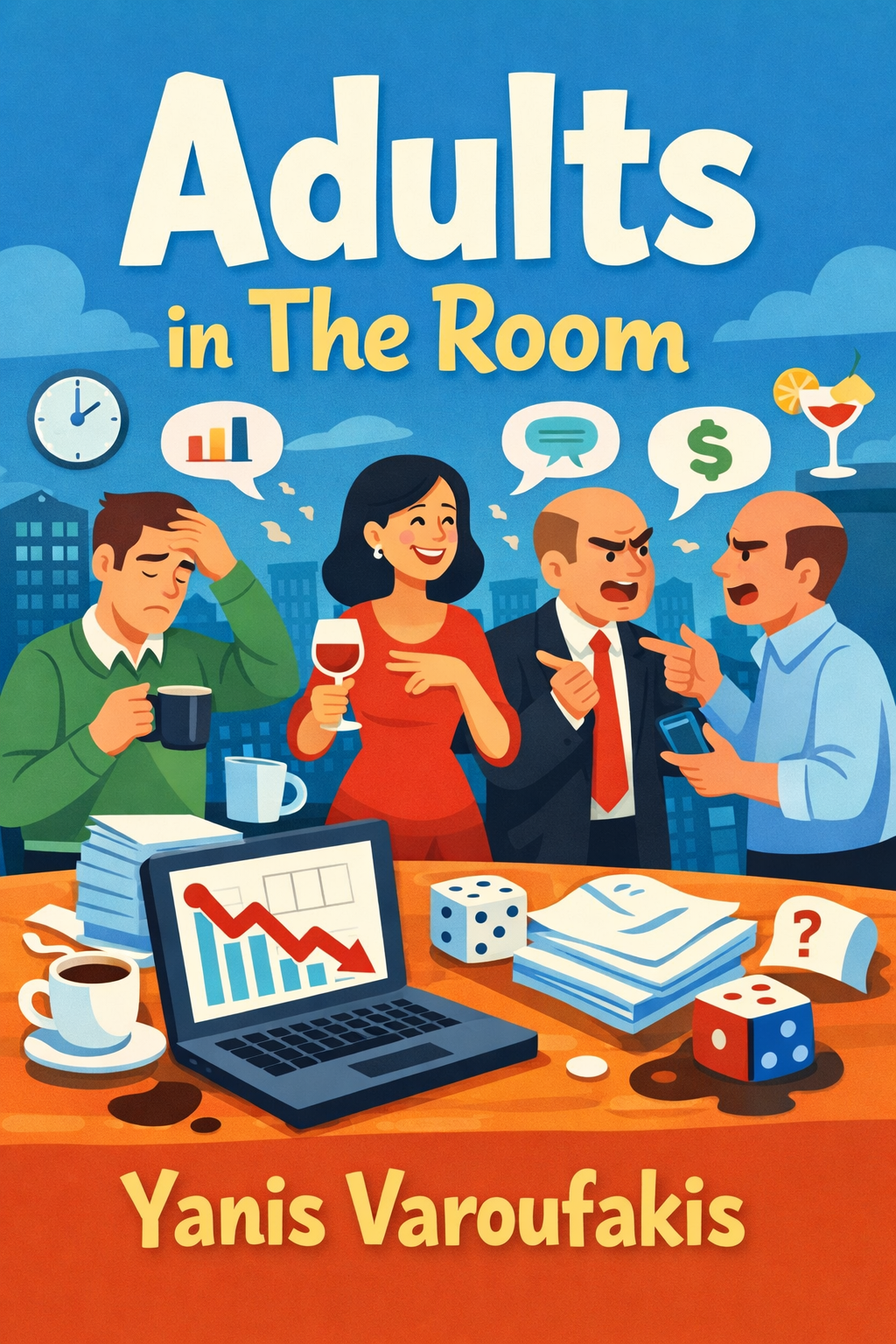
Adults in the Room is a searing, first-person account of the Greek financial crisis from 2015, written by the country’s former Finance Minister, Yanis Varoufakis. It is not a dry economic treatise but a political thriller, a tragic drama, and a damning indictment of modern power structures. The book dismantles the official narrative of the crisis, portraying it not as a necessary rescue of a profligate nation but as a calculated project of control that sacrificed democracy and human dignity at the altar of financial and political interests.
The story begins with Greece already deep in a hole. By 2010, the country was bankrupt, yet European leaders, primarily from Germany and France, engineered a colossal bailout. This loan, however, was not designed to revive the Greek economy. Varoufakis argues it was a cynical maneuver to protect their own banks, which had recklessly lent to Greece. The money flowed directly from European taxpayers to those banks, while Greece was saddled with even more debt. This established a cruel pattern: loans were given not for growth, but to service previous loans, enforced by a triad of institutions known as the troika—the European Commission, the European Central Bank, and the International Monetary Fund.
In 2015, a weary Greek electorate, crushed by years of austerity that had decimated incomes, spiked unemployment, and shuttered public services, voted for change. They brought to power the left-wing Syriza party, with Alexis Tsipras as Prime Minister and Yanis Varoufakis as Finance Minister. Their mandate was clear: end the austerity and renegotiate the debt. Varoufakis entered the European arena with a pragmatic plan for debt restructuring and growth-oriented reforms. What he encountered was a wall of ideological rigidity and bad faith. Behind closed doors, officials would privately admit the austerity program was failing, yet in public, they demanded its intensification. The German Finance Minister, Wolfgang Schäuble, openly preferred Greece’s expulsion from the eurozone. The IMF’s Christine Lagarde conceded the program was unsustainable but insisted on its continuation.
The book vividly describes the psychological and political warfare waged against the Greek government. The European Central Bank strategically engineered bank runs by threatening to cut off liquidity, terrifying ordinary citizens to pressure their leaders. Negotiations were not discussions but ultimatums. The troika’s memorandums were presented as non-negotiable diktats, designed not to create a viable Greek economy but to maintain a state of permanent debt servitude and political submission. Varoufakis portrays a European establishment that was ruthless, secretive, and fundamentally opposed to democratic accountability, operating in closed rooms where the will of millions of voters was rendered irrelevant.
The core tragedy unfolds as Prime Minister Alexis Tsipras, isolated and worn down, begins to buckle under this immense pressure. Despite a historic referendum where the Greek people overwhelmingly rejected the troika’s harsh terms, Tsipras ultimately capitulated. Varoufakis recounts how he was sidelined, and how Tsipras, in direct talks with Chancellor Angela Merkel, abandoned the popular mandate. In a stunning betrayal, the government that was elected to defy austerity signed a third bailout package that imposed even more severe measures than those just rejected by the populace. Tsipras chose to remain within the eurozone at all costs, sacrificing his government’s principles and the sovereignty of his nation.
The aftermath is a landscape of profound disillusionment. The surrender fueled the rise of extremist parties across Europe, proving that when established institutions hollow out democracy, they open the door to populist anger. The Greek crisis became a blueprint for how technocratic elites can override popular will, a lesson observed by political actors worldwide. Adults in the Room is ultimately a warning. It exposes the deep flaws in a European project that prioritizes bank balance sheets over human well-being and reveals the grim reality of modern power: the adults in the room are often the ones most committed to maintaining a broken system, regardless of the human wreckage left in their wake.
Book Title: Adults in The Room