
Description
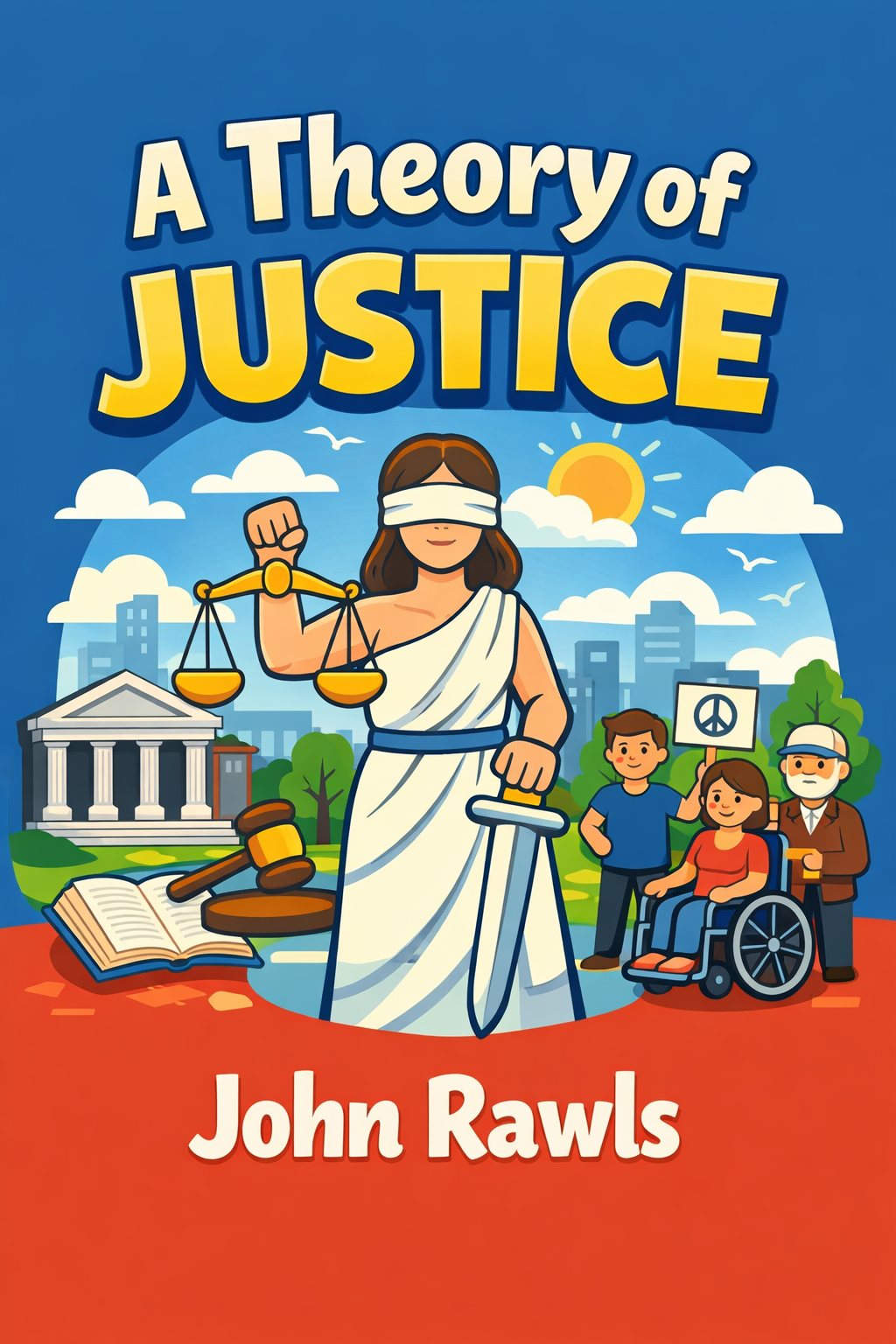
John Rawls’s seminal work, *A Theory of Justice*, seeks to answer one of humanity’s oldest and most pressing questions: what constitutes a fair society? Published in 1971, the book revitalized political philosophy by offering a rigorous new framework for evaluating social institutions. Rawls contends that justice is the primary virtue of social arrangements, much as truth is for systems of thought. His core project is to establish a set of principles for a just basic structure of society—the political constitution, legal system, economy, and social norms—that free and equal citizens could all accept.
To discover these principles, Rawls invites us into a thought experiment he calls the “original position.” Imagine we are tasked with designing the fundamental rules of our society from scratch. Crucially, we must do so from behind a “veil of ignorance.” This mental device strips us of all knowledge about our own specific characteristics. We do not know our future social class, wealth, natural talents, intelligence, race, gender, or even our conception of what makes a good life. We are, however, rational beings who understand basic facts about human psychology, economics, and political sociology. From this impartial and disinterested standpoint, what kind of society would we choose?
Rawls argues that, under these conditions, rational individuals would not gamble on a society that might grant them a privileged position but could just as easily condemn them to a miserable one. Instead, they would adopt a conservative, risk-averse strategy designed to secure acceptable conditions even in the worst-case scenario. This leads to two lexically ordered principles of justice. The first principle guarantees the most extensive basic liberties for all, such as freedom of speech, assembly, and conscience. These liberties must be equal for everyone and cannot be traded for economic gains. The second principle addresses social and economic inequalities. It states that such inequalities are only permissible if they satisfy two conditions: first, they are attached to positions and offices open to all under conditions of fair equality of opportunity; and second, they are to the greatest benefit of the least-advantaged members of society. This second clause is known as the “difference principle.”
The difference principle is the most distinctive and debated element of Rawls’s theory. It does not demand strict equality of outcome. Rawls acknowledges that incentives can drive productivity and innovation, which grows the overall social “pie.” However, any resulting inequality is only justified if the arrangement also improves the absolute position of those at the bottom. A society where the wealthy become vastly richer while the poor stagnate is unjust, even if the poor are not technically worse off. Justice requires that the economic system be structured so that the fortunes of the rich are tied to those of the poor, with inequalities permitted only when they work as part of a scheme that lifts the least fortunate as much as possible.
This framework provides a powerful critique of both laissez-faire libertarianism and strict egalitarian socialism. Rawls rejects unfettered capitalism because it allows morally arbitrary factors—like being born into wealth or possessing scarce talents—to dictate life prospects, creating unacceptable inequalities that do not necessarily benefit the worst-off. He also rejects simple equality of outcome, arguing it could make everyone worse off by destroying incentives and failing to utilize talents for the common good. Instead, he advocates for a “property-owning democracy” or a liberal socialist regime, where capital is widely dispersed and institutions actively ensure fair value for political liberties and genuine opportunity.
Ultimately, *A Theory of Justice* presents justice as fairness. It is a social contract theory that does not rely on a historical event but on a hypothetical agreement made under conditions designed to ensure impartiality. The resulting principles provide a benchmark for critiquing existing societies and a guide for reform. Rawls challenges us to look beyond our personal interests and consider the structure of society from the perspective of its most vulnerable members. A just society, in his view, is not merely one that respects procedural rules but one whose fundamental architecture is arranged to be fair to all, especially those who would otherwise lose out in the natural and social lottery of life.