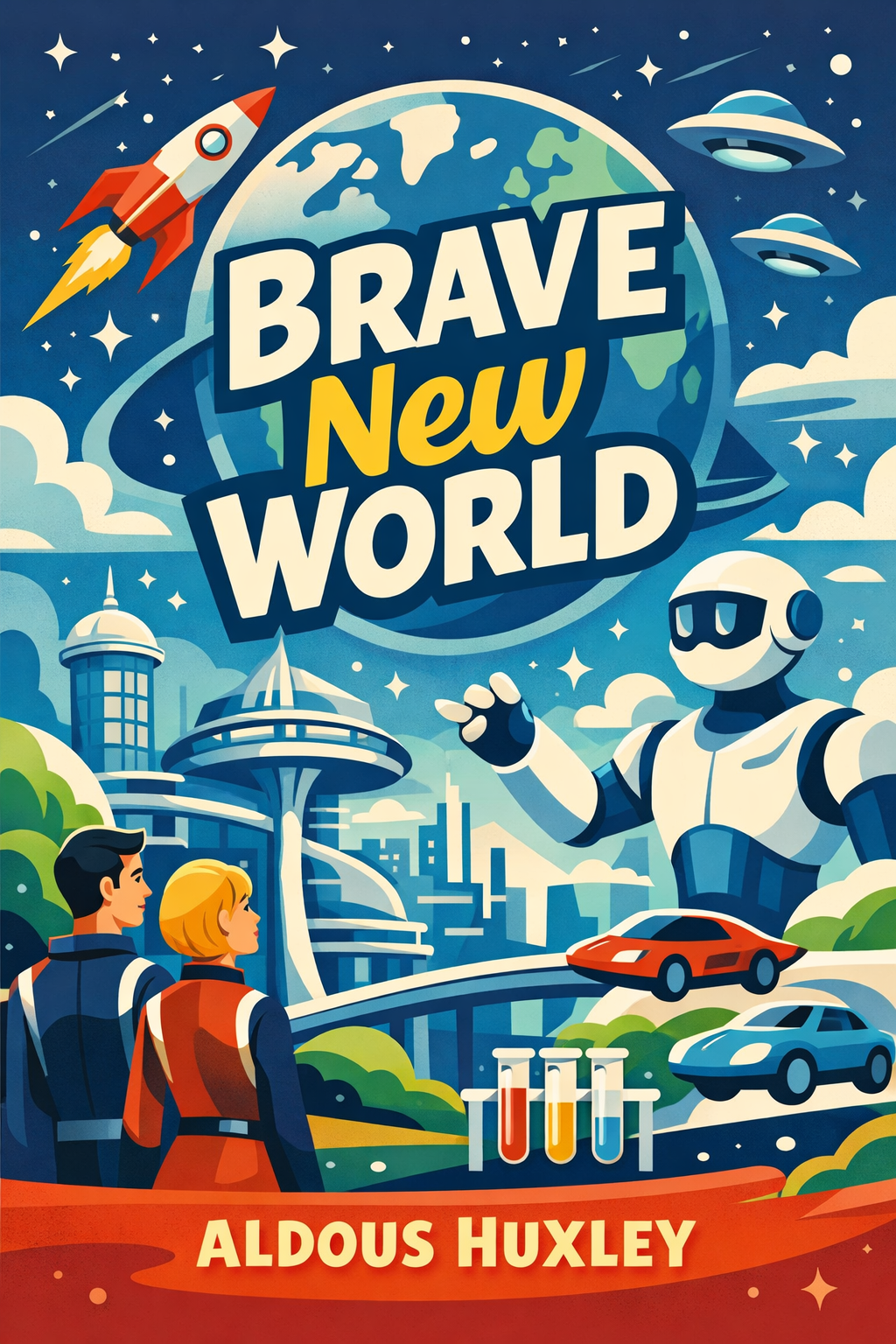
Description
In a world far removed from our own, human suffering and social instability have been seemingly eradicated. This is not achieved through tyranny or deprivation, but through a carefully engineered system of absolute comfort and superficial happiness. The story unfolds in a technologically advanced London, where human beings are no longer born from wombs but decanted and grown in state-run Hatcheries and Conditioning Centres. Here, through a process called Bokanovsky’s Process, a single fertilized egg can be split into dozens of identical twins, creating a standardized workforce. Society is rigidly divided into five castes, from the intellectually superior Alphas who manage the world, down to the mentally stunted Epsilons designed for menial labour. Each person is biologically and psychologically conditioned from conception to be perfectly content with their predetermined role, to consume, to enjoy superficial pleasures, and to avoid anything that might cause deep thought or distress.
The stability of this “World State” is maintained through a trinity of control: genetic engineering, hypnopaedic conditioning, and the free distribution of a pleasure-inducing drug called soma. Citizens are conditioned from childhood to despise nature, avoid solitude, and embrace promiscuous, non-committal sex as a social duty. History, art, literature, and religion—anything that might inspire individual passion or spiritual yearning—have been abolished or sanitized. The mantra of society is “Community, Identity, Stability,” and any threat to this equilibrium is swiftly removed.
The narrative follows several characters who, in different ways, feel the hollowness beneath the glossy surface. Bernard Marx, an Alpha psychologist, is physically smaller and more introspective than his caste peers, making him an insecure and discontented outsider. He is infatuated with Lenina Crowne, a conventionally beautiful and perfectly conditioned Beta who embodies the state’s values, though she occasionally exhibits a naive curiosity that borders on rebellion. Bernard’s sense of alienation leads him to visit a “Savage Reservation” in New Mexico, one of the few places where people still live through natural birth, age, disease, and practice outdated religions. There, he and Lenina encounter John, a young man born from a woman from the World State who was accidentally left behind years earlier.
John, raised on a tattered copy of Shakespeare’s works, is a true outsider to both worlds. He views the “brave new world” of London not with awe, but with horror and moral revulsion. Brought back to London by Bernard as a curiosity, John, known as “the Savage,” becomes a sensational spectacle. He clashes violently with the society’s core values. He desires genuine love and commitment, repulsed by Lenina’s casual advances. He seeks meaning in suffering, poetry, and spiritual purification, concepts the World State has pharmacologically and psychologically eliminated. His passionate outbursts, quoting Shakespeare, are met with bafflement or condescending amusement by citizens who cannot comprehend his archaic emotions.
John’s most profound confrontation is with Mustapha Mond, one of the ten World Controllers who govern society. In a brilliant philosophical debate, Mond defends the World State’s choices. He argues that they have traded the “highs” of art, science, and religion—which he admits were genuine—for universal happiness and security. He posits that tragedy, instability, and strong emotions are too high a price to pay for truth and beauty. He reveals that he himself once chose to pursue forbidden science but ultimately chose to enforce stability instead. For Mond, the sacrifice of freedom, truth, and God is a necessary cost for a world without war, poverty, or heartbreak. John, however, sees only a world of infantilized slaves, denied the very things that make human life profound.
Unable to reconcile his beliefs with this sanitized hell, John attempts to escape, retreating to an abandoned lighthouse to live in self-imposed exile and purify himself through fasting and self-flagellation. His asceticism, however, becomes just another media spectacle for the sensation-seeking citizens of London. When a crowd arrives to gawk at him, he is driven to a frenzy of despair. Trapped between a world he cannot accept and a wilderness he cannot fully inhabit, and ultimately succumbing to the very temptations of the world he despises, John sees only one final, tragic act of defiance. His story ends not with revolution, but with a personal catastrophe that underscores the total incompatibility of the individual human spirit with a society that has eliminated everything difficult and meaningful in the pursuit of a painless, empty happiness.
The novel presents a chilling vision where the ultimate dystopia is not one of obvious brutality, but of seductive, voluntary servitude. It asks whether a life of guaranteed comfort, devoid of love, family, art, and personal struggle, is a utopia or a nightmare. It challenges the reader to consider what essential elements of humanity—including the right to be unhappy—are worth preserving, even at the cost of perfect societal stability. The horror of this world is that its citizens are not oppressed; they are engineered to love their chains, making rebellion not just futile, but unthinkable.