Description
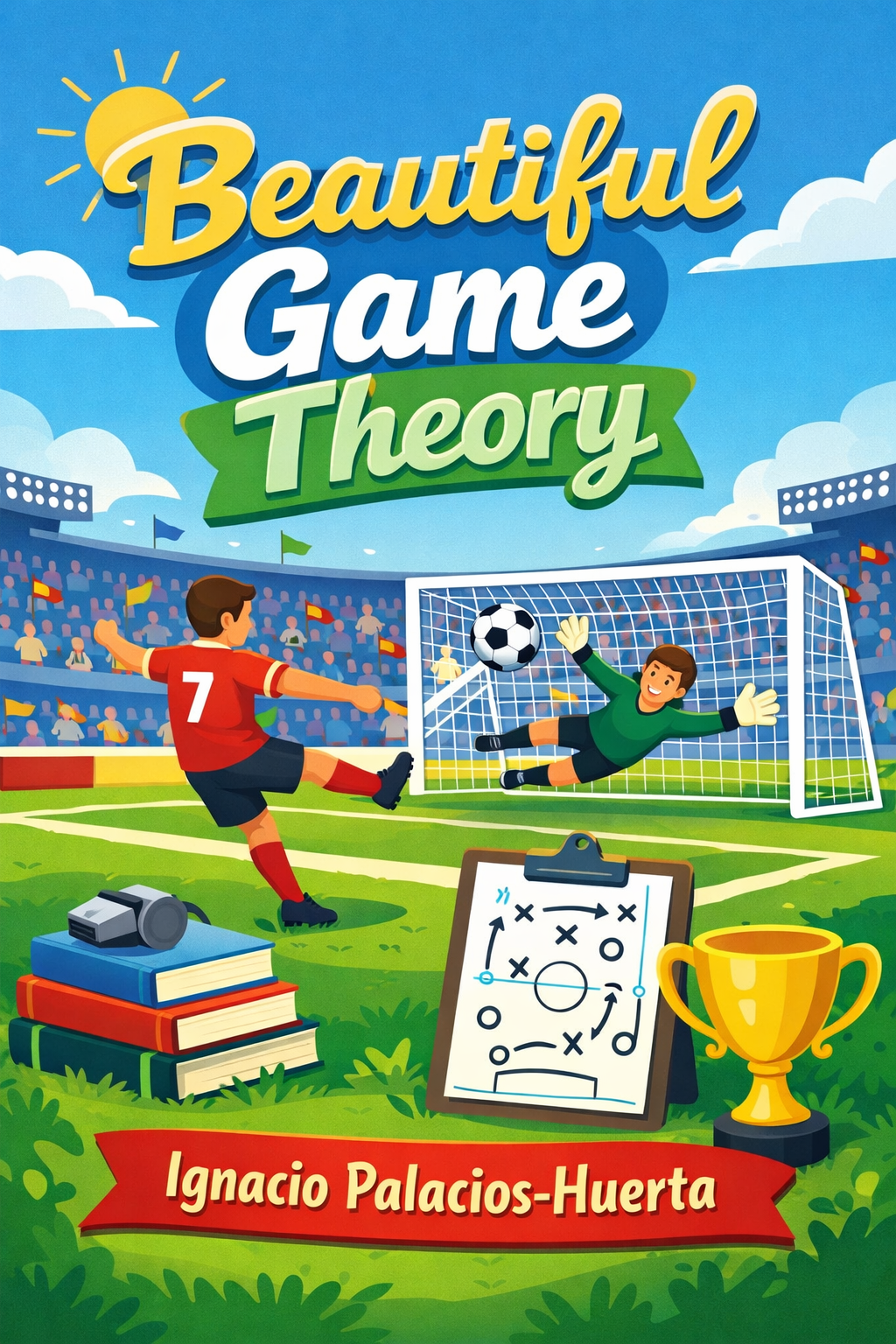
At first glance, the fluid, passionate world of professional soccer seems a universe apart from the dry, rational models of economic theory. Yet in this fascinating work, the author masterfully bridges this divide, demonstrating that the principles of game theory, incentives, and strategic interaction are not just present on the pitch—they are its very foundation. The book argues that soccer, in its purest form, is a continuous, dynamic negotiation, a complex dance of decisions made under intense pressure and imperfect information. Every pass, every tactical shift, and every penalty kick is a data point in a vast, unfolding game of strategy, where players and managers are constantly calculating odds, predicting opponents’ moves, and seeking marginal advantages.
The analysis begins with the most elemental unit of conflict: the one-on-one duel. The author dismantles scenarios like a striker facing a goalkeeper or a winger taking on a defender, showing how these are not mere tests of skill but intricate psychological battles. Using the framework of game theory, the narrative explains why certain moves become predictable and how randomness—like a poorly aimed shot that unpredictably deflects into the net—can be a rational strategic tool. The book compellingly illustrates that the “beautiful” aspect of the game often emerges from this hidden layer of calculation, where spontaneous creativity is underpinned by deep, often instinctive, strategic understanding.
From these micro-interactions, the scope expands to the team as a whole, treated as a single, coordinated economic agent. The author explores the concept of efficiency on the field, asking how a team can optimally allocate its most precious resource: player effort and positioning. This leads to an examination of famous tactical systems, not as cultural artifacts, but as solutions to strategic problems. The catenaccio of Italy, the total football of the Netherlands, and the high-press of modern teams are analyzed as distinct economic equilibriums, each developed to maximize a team’s chances given its specific constraints and the prevailing meta-strategy of the era. The narrative makes clear that a formation is not just a shape on a board; it is a set of enforceable contracts about space, responsibility, and risk-sharing among eleven individuals.
The strategic theater extends beyond the ninety minutes of play. A significant portion of the book is devoted to the transfer market, reconceptualizing it as a stark, efficient auction house where clubs act as firms bidding for human capital. Player valuations, often derided as irrational bubbles, are scrutinized through economic lenses like asset valuation, peak-age curves, and brand equity. The author delves into the principal-agent problems that abound: does a player signing a massive final contract have the same incentives to perform? How do a manager’s short-term needs align with a club’s long-term financial sustainability? This analysis reveals the boardroom as a parallel pitch where different games of strategy and negotiation are constantly in play.
Furthermore, the book tackles the social and psychological dimensions with economic tools. It investigates the role of fame and reputation as currencies, asking how a player’s “brand” affects team dynamics and on-field decisions. The phenomenon of penalty shoot-outs is broken down into a classic game theory matrix, revealing the Nash equilibrium that dictates why players and goalkeepers choose the directions they do, and why the apparent 50-50 chance is clouded by history, pressure, and past behavior. Even fan culture and the immense pressure of home-field advantage are examined as external forces that distort the incentives and calculations of the players, making the game not just a test of physical and tactical skill, but of emotional and psychological management.
In its concluding synthesis, the work achieves something remarkable. It does not reduce soccer’s magic to cold numbers or spoil its joy with jargon. Instead, it provides a new set of spectacles through which to watch the game. The frantic last-minute attack, the deliberate defensive hold, the substitution of a star player—all are illuminated as profound moments of decision science in action. The author leaves us with the powerful idea that understanding the hidden logic of these choices deepens our appreciation for the sport. The beauty and the agony of soccer do not exist in spite of its underlying economics, but are intimately and brilliantly expressed through it. We see that the game is beautiful not merely because of athletic brilliance, but because it is one of the world’s most vivid, public demonstrations of human strategy, cooperation, and competition played out in real time.