Description
At the heart of our daily struggles, from minor misunderstandings to deep-seated conflicts, lies a simple yet profound framework for understanding human psychology. This book introduces the concept of Transactional Analysis, a theory that decodes the complex language of our interactions by breaking them down into manageable units called “transactions.” The core premise is that within each of us reside three distinct ego states: the Parent, the Adult, and the Child. These are not abstract ideas but very real collections of thoughts, feelings, and behaviors learned from our past experiences. The Parent ego state is a recording of all the external instructions and rules we absorbed from authority figures in childhood. The Child ego state contains the internal recordings of our early emotional responses—our spontaneous joys, fears, and needs. The Adult ego state is the computer-like processor that objectively assesses the here and now, gathering data and making decisions based on current reality.
Most of our communication consists of transactions between these ego states. A simple, straightforward conversation where one person’s Adult addresses another’s Adult is considered a complementary transaction, leading to clear and effective communication. Problems arise, however, when transactions become crossed. For example, an Adult question like “Where did you put the report?” might be met with a defensive Child response like “You’re always blaming me!” This crossing of wires is the source of most interpersonal friction and misunderstanding. The book argues that by learning to identify which ego state we are operating from and which one we are addressing in others, we can consciously choose to shift our communication to the Adult state, thereby reducing conflict and fostering healthier dialogue.
The book’s most impactful contribution is its description of four fundamental “life positions” that we adopt in early childhood and which shape our worldview and relationships. These positions are unconscious, overarching beliefs about ourselves and others. The first and most basic position is “I’m Not OK, You’re OK.” This is the universal position of early childhood, where the small, dependent child feels powerless in a world of capable adults. While natural for an infant, carrying this position into adulthood leads to feelings of inadequacy, depression, and a constant need for approval from others.
The second position, “I’m Not OK, You’re Not OK,” is one of despair. It develops when a child’s basic needs for nurturing are not met, leading to a withdrawal from the world. This position can result in apathy, severe depression, or even a giving up on life itself, as the individual sees no hope for themselves or anyone else. The third position, “I’m OK, You’re Not OK,” is a defensive posture. It often arises in children who have been abused or severely neglected. To protect themselves from the pain of feeling “Not OK,” they project the “Not OK” onto others, seeing the world as hostile and themselves as blameless victims. This position is the root of paranoia, prejudice, and a tendency to blame others.
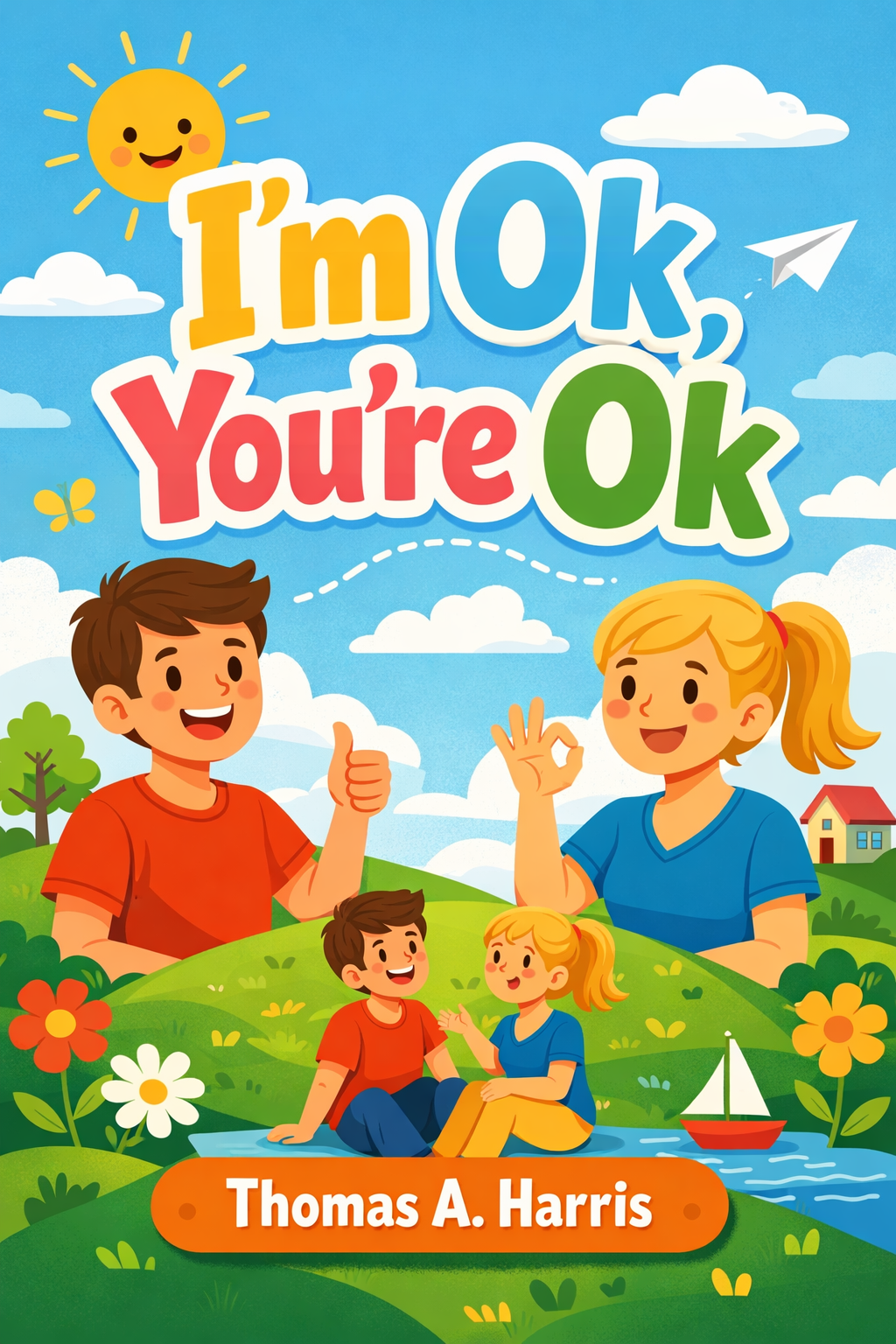
The healthy, goal-oriented position is the fourth: “I’m OK, You’re OK.” This is a conscious, rational decision based on faith and hope. It is not a feeling imprinted from childhood but a chosen attitude. It acknowledges that while we all have our “Not OK” moments and histories, we can choose to affirm our own worth and the worth of others in the present. This position is the only one that allows for genuine, autonomous living and forms the foundation for constructive problem-solving and intimate relationships. The journey of personal growth, therefore, involves moving from the unconscious, childhood-decided positions to a conscious adoption of the “I’m OK, You’re OK” stance.
To make this shift, the book provides practical tools. A key technique is learning to recognize and challenge the internal “tapes” or scripts that play from our Parent and Child ego states. These are the critical voices and the old, emotional reactions that often hijack our Adult reasoning. By practicing “contamination removal,” we learn to quiet the prejudiced Parent and the fearful Child, allowing the clear, data-processing Adult to take the helm. Another vital process is “stroking”—the fundamental unit of social recognition. We all have a hunger for strokes, whether physical or verbal, positive or negative. Understanding this hunger allows us to seek and give positive, unconditional strokes that affirm being, rather than relying on manipulative or negative strokes that reinforce unhealthy patterns.
Ultimately, this work is a pathway to emotional literacy and autonomy. It teaches that we are not doomed to repeat the patterns of our past. While our early childhood decisions powerfully shape us, we have the capacity, through our Adult ego state, to re-examine those decisions and write a new life script. By consistently choosing the “I’m OK, You’re OK” position, engaging our Adult in transactions, and updating our internal dialogues, we can break free from destructive cycles. This approach does not promise a life without problems, but it provides a clear map and a set of tools for navigating life’s challenges with greater awareness, responsibility, and the potential for authentic, fulfilling connections with others. It is an invitation to move from a life of passive reaction to one of active, thoughtful creation.