Description
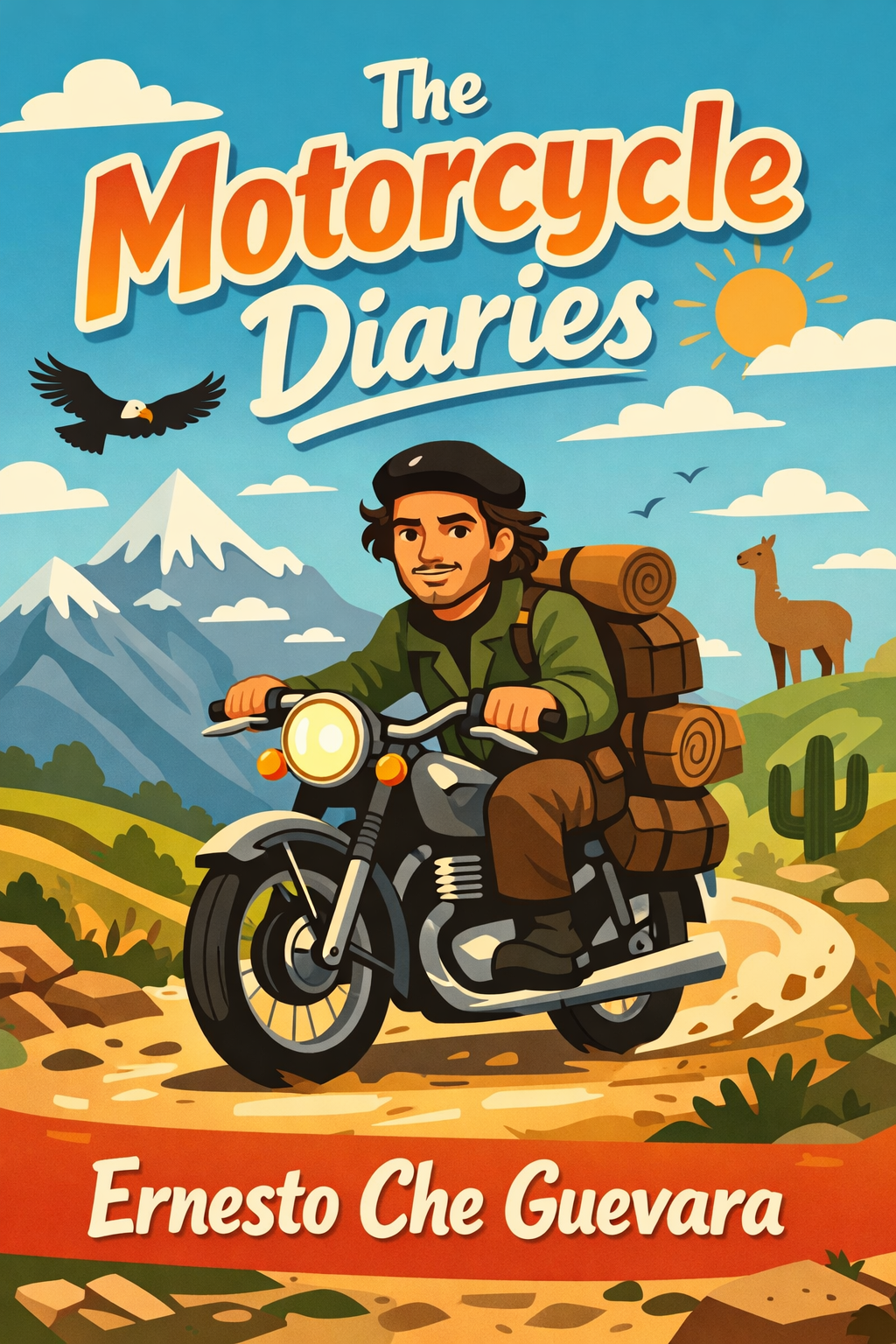
The journey begins not as a political awakening, but as the grand adventure of two friends. Ernesto Guevara, a twenty-three-year-old medical student battling asthma, and his biochemist friend Alberto Granado set out from Buenos Aires on a rickety motorcycle they call “La Poderosa” – The Mighty One. Their initial goal is simple and romantic: to see the continent they call home, to work as volunteer doctors at a leper colony in Peru, and to satisfy a youthful hunger for experience. The early pages are filled with the misadventures of the road – the motorcycle’s frequent breakdowns, nights spent sleeping under the stars, schemes to procure free food and fuel, and the sheer, unadulterated joy of movement and freedom. The landscape of Argentina unfolds before them, vast and beautiful, and their spirits are high with the promise of the unknown.
As they leave the familiar comforts of Argentina and cross into Chile, the tone of the journey begins to subtly shift. The beauty of the land remains, but the conditions of the people living on it start to press in upon the travelers’ consciousness. They take odd jobs, meet fellow wanderers, and rely heavily on the hospitality of strangers, often the poorest of the poor. In the copper mines of Chuquicamata, Chile, Ernesto comes face-to-face with the brutal reality of industrial exploitation. He sees miners, shadows of men, coughing their lungs out in the dusty air, working for a pittance while foreign companies reap enormous profits. The abstract concept of “injustice” acquires a human face, a hacking cough, and exhausted eyes. This encounter plants a seed of deep, simmering anger.
The motorcycle, that symbol of mechanical freedom, finally gives out completely in Chile, and the pair continue their voyage as hitchhikers and stowaways. This loss of their machine seems symbolic, stripping away a layer of insulation and forcing them into even closer contact with the continent’s reality. They travel by foot, by truck, and by raft. In the Peruvian Amazon, they spend several weeks at the San Pablo leper colony. Here, Ernesto’s role as a doctor comes to the fore, but so does his revolutionary spirit. He refuses to wear protective gloves when shaking the patients’ hands, a deliberate act of solidarity that breaks the psychological barrier of fear and stigma. He argues with the nuns who run the place, challenging the rigid, authoritarian structure that separates the “clean” from the “unclean.” His birthday swim across the wide, piranha-infested river that separates the patients from the staff becomes a legendary act of defiance and unity, a physical embodiment of his belief that there should be no division between human beings.
The journey up the Amazon is a descent into a different kind of reality – one of immense natural beauty intertwined with profound human neglect. He witnesses the displacement and cultural erosion of indigenous communities, their connection to the land severed by indifferent governments and commercial interests. The suffering he sees is no longer just individual illness, but a systemic sickness, a colonialism of the body and spirit that stretches back centuries. His medical gaze, trained to diagnose and treat a single patient, begins to widen. He starts to diagnose a continent.
By the time he reaches the ancient Inca city of Machu Picchu in Peru, the transformation is crystallizing. Gazing upon the stonework of a great civilization dismantled by conquest, he muses on the long history of oppression in Latin America. The ruins are not just a tourist spectacle for him; they are a testament to a lost autonomy and a stark contrast to the shantytowns of the oppressed he has been traveling through. The final leg of the trip takes him to a volunteer clinic in Guajira, Colombia, and finally to a migrant shelter in Caracas, Venezuela. He is increasingly weary, physically depleted by asthma and the hardships of the road, but his mind is ablaze with new convictions.
The journey ends in Miami, a brief, jarring interlude in the capitalist heartland before returning to Argentina. The young man who returns is not the same one who left. The carefree adventurer has been replaced by a person burdened with a terrible and clarifying knowledge. He writes that the person who wrote the early, lighthearted notes of this diary died on the road, and that the man who is reorganizing these notes is not that same person. The continent, in all its majestic beauty and horrific inequality, has rewritten him. While he does not articulate a precise political ideology here, the raw material for it is all present: a visceral hatred for exploitation, a profound identification with the suffering poor, and a nascent understanding that healing would require more than medicine; it would require radical change. This is not the story of “Che” the revolutionary icon, but of Ernesto the witness. It is the intimate, poetic, and deeply human record of how a continent can break a man’s heart open and fill it with a new and unshakable purpose.