Description
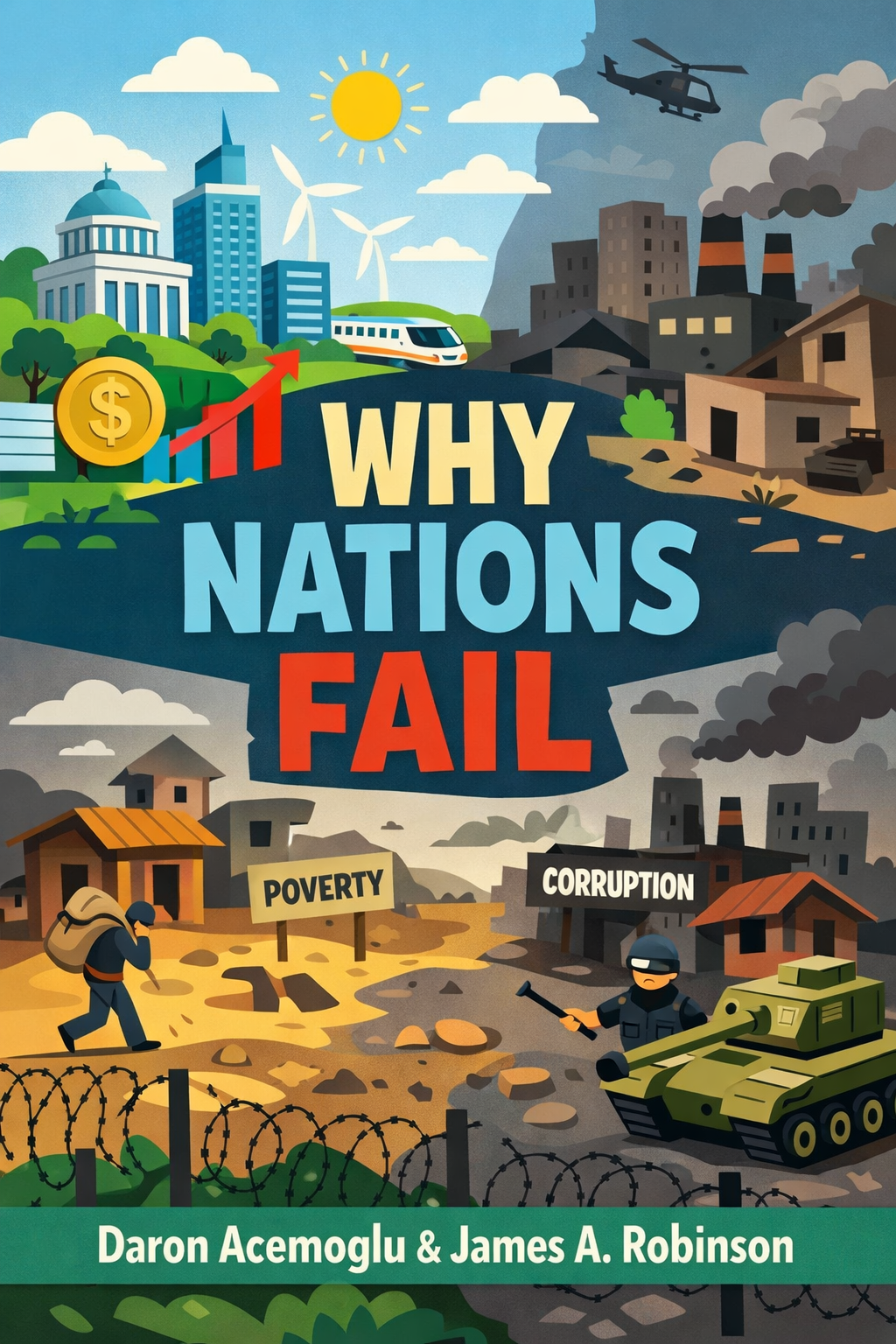
The stark divide between rich and poor nations is not a matter of fate, culture, or geography. It is a story of human-made systems—political and economic institutions—that either unlock a society’s potential or shackle it. This is the core argument presented, which dismantles old theories to reveal a powerful framework for understanding global inequality. The journey of nations is decided at critical historical forks, where choices solidify into enduring structures that shape destinies for centuries.
Consider a town split by a border, like Nogales. The northern side enjoys prosperity, safety, and opportunity, while the southern side faces starkly different realities. This cannot be explained by climate, disease, or a lack of knowledge. The true divider is the institutional environment on each side. Institutions are the rules of the game in a society. Inclusive economic institutions secure private property, uphold law and order, and create a level playing field for innovation and investment. They allow people to pursue their ambitions with the confidence that they will reap the rewards. In contrast, extractive economic institutions are designed to siphon wealth and resources from the many for the benefit of a narrow elite. They stifle initiative, as any surplus is likely to be confiscated, and they concentrate power to maintain this arrangement.
These economic systems do not emerge in a vacuum; they are built upon political foundations. Inclusive political institutions are both pluralistic and centralized. Pluralism means power is broadly distributed among different groups in society, preventing any single faction from monopolizing control. Centralization means the state has the authority to enforce laws and provide public goods across its territory. Together, these features create a system where power is shared and checked, leading to the development of inclusive economic rules for mutual benefit. Extractive political institutions, however, concentrate power in the hands of a few, lacking either pluralism or true centralization. The elite uses this power to create extractive economic institutions for its own gain, often at the expense of the nation’s long-term health.
History shows that nations often start from similar points but drift apart due to institutional drift, accelerated by critical junctures. These are major events or disruptions—like the Black Death, the opening of Atlantic trade routes, or industrialization—that shake up the existing balance of power. How a society responds to these junctures sets it on a lasting path. The devastation of the Black Death in the 14th century, for example, created a severe labor shortage in Europe. In Western Europe, peasants were able to leverage this scarcity to demand better rights and wages, beginning a long erosion of feudal extractive institutions. In Eastern Europe, however, the landed nobility successfully crushed peasant agency, imposing even harsher serfdom. A single catastrophe thus pushed regions onto divergent institutional trajectories.
The rise of England as the first industrial powerhouse is a testament to the power of inclusive institutions forged at a critical juncture. The Glorious Revolution of 1688 was a pivotal moment that curtailed the absolutist power of the monarchy and established the supremacy of a more pluralistic Parliament. This political shift led directly to inclusive economic innovations: the strengthening of property rights, the creation of a central bank to provide credit, and tax reforms that encouraged manufacturing and infrastructure investment. These institutions gave entrepreneurs the security and tools to experiment and invest, unleashing the technological revolution that would transform the world. England’s head start was not due to innate genius or resources, but to a political system that allowed and incentivized broad participation in the economy.
Once established, institutions create powerful feedback loops. Inclusive institutions tend to reinforce themselves in a virtuous cycle. Broad-based prosperity fosters a more educated citizenry and a stronger civil society, which demands further political accountability and economic openness. Extractive institutions, however, spawn vicious cycles. The ruling elite, fearing the creative destruction that true innovation brings—which could destabilize their hold on power—actively stifle progress. They may permit limited economic growth, as seen in the Soviet Union’s early decades or in some modern authoritarian states, but this growth is inherently limited and unsustainable. It relies on mobilizing resources and labor by command, not on fostering genuine innovation. Eventually, it hits a ceiling or collapses, as the system cannot tolerate the independent centers of power and thought that sustained innovation requires.
Breaking free from the grip of extractive institutions is profoundly difficult, but history shows it is not impossible. It requires the convergence of several factors: a broad coalition of diverse groups uniting against the existing order, the presence of some degree of institutional pluralism to build upon, and a willingness to centralize state authority for the common good rather than for extraction. It also often requires another critical juncture—an economic crisis, a military defeat, or a internal rupture within the elite—to create an opening for transformative change. The path is fraught, and reversals are common, but understanding the institutional roots of failure is the first step toward building a foundation for national success. Ultimately, the wealth and poverty of nations are not predetermined. They are the legacy of history’s choices, embodied in the institutions we inherit and the ones we dare to build.