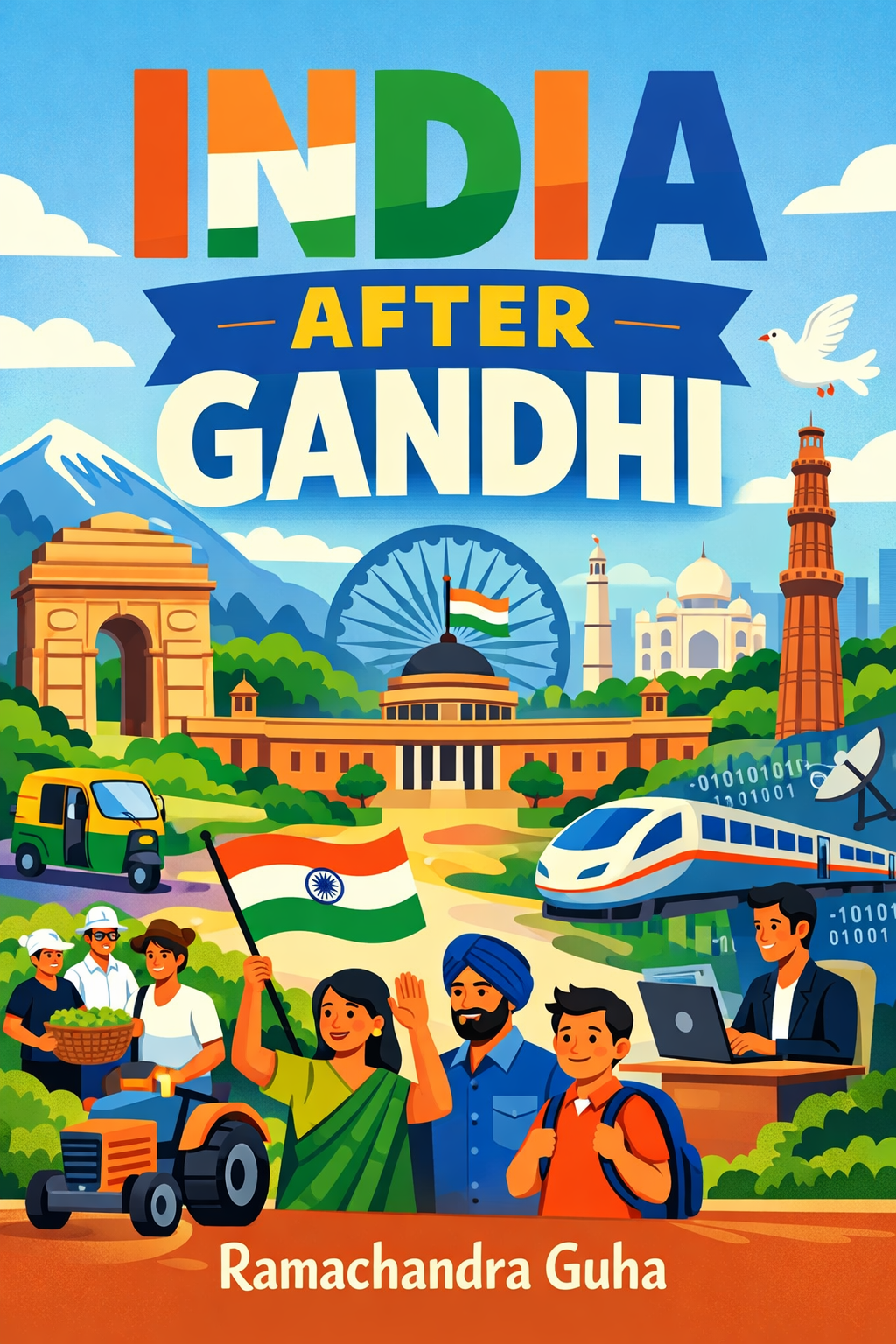
Description
The birth of modern India in 1947 was an act of staggering ambition, defying a chorus of predictions that a nation of such immense diversity could not hold together. Emerging from the trauma of Partition, which saw horrific violence and the largest mass migration in history, the new republic faced a foundational crisis. Its leaders, inheriting a society splintered by religion, language, and caste, embarked on the audacious project of forging a united, secular democracy from hundreds of ancient princely states. This narrative traces the turbulent life of that democracy across decades, a story of survival against formidable odds.
The early years were defined by monumental tasks: absorbing millions of refugees, integrating disparate territories, and crafting a constitution for a billion aspirations. Under Prime Minister Jawaharlal Nehru, India established its parliamentary system and held its first general election, a massive democratic exercise that affirmed the people’s faith in the new experiment. The 1950s offered hope, with nation-building efforts, economic planning, and a prominent role in the non-aligned movement on the global stage. Yet, the conflict with Pakistan over Kashmir became a permanent scar, a source of enduring hostility and repeated wars that would shape the subcontinent’s destiny.
The optimism of the founding era gradually gave way to the complex realities of governing a poor and vast nation. The 1960s brought military humiliation against China and the death of Nehru, ushering in a period of uncertainty. His daughter, Indira Gandhi, would come to dominate the political landscape, centralizing power with a populist touch. The 1970s were a decade of dramatic turns: war with Pakistan leading to the creation of Bangladesh, rising internal dissent, and, most critically, the suspension of democracy itself during the “Emergency” of 1975-77. This twenty-one-month period of authoritarian rule, with press censorship and large-scale arrests, remains the darkest chapter in India’s democratic history, testing its institutions to the breaking point.
Although democracy was restored, the political consensus of the early republic had shattered. The 1980s witnessed the rise of powerful regional parties, the alarming growth of religious nationalism, and tragic sectarian violence, including the assassination of Indira Gandhi and the anti-Sikh riots that followed. Economically, the inward-looking, state-controlled model began to stagnate, creating a crisis that would force a radical change of direction. The transformative shift came in 1991, with historic economic liberalization that dismantled the “License Raj” and unleashed India’s entrepreneurial energy, setting the stage for rapid growth.
Politically, the once-dominant Indian National Congress found itself challenged by the ascent of the Bharatiya Janata Party (BJP), which championed a platform of Hindu nationalism. This culminated in the demolition of the Babri Masjid in 1992, an event that profoundly altered the country’s social fabric. The closing chapters of the story bring us to a India transformed—a nuclear power, an IT giant, and a thriving yet chaotic democracy where coalition politics became the norm. The narrative captures a nation in constant negotiation with itself, grappling with the enduring tensions between unity and diversity, secularism and majoritarianism, poverty and growth. It is a testament to the extraordinary resilience of its people and the democratic idea, which, despite profound shocks and enduring challenges, continues to evolve and endure.