Description
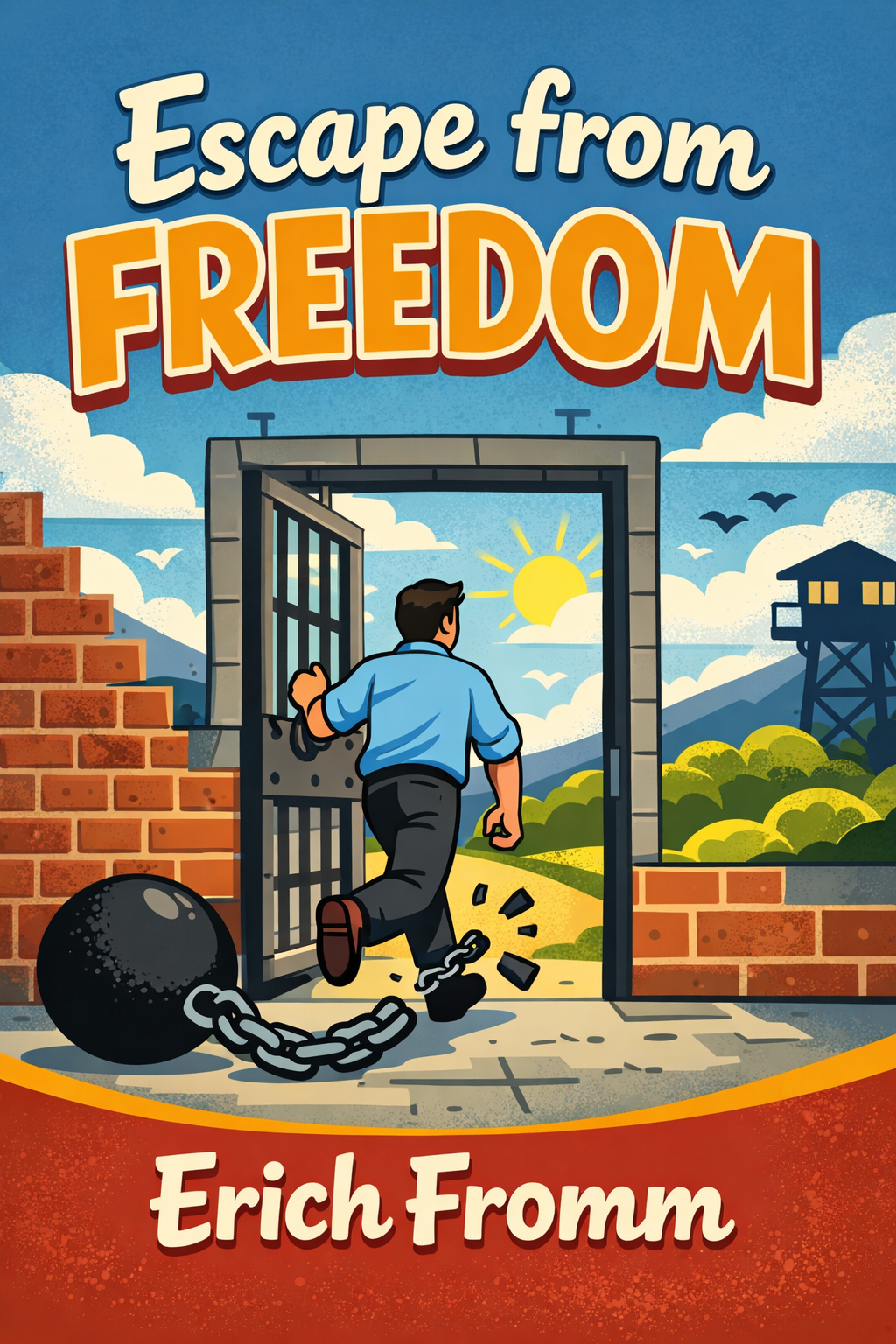
Erich Fromm’s profound work delves into a central paradox of the human condition: our simultaneous desire for and fear of freedom. He argues that as humanity has progressed historically, breaking free from the strictures of medieval society, traditional authority, and predetermined social roles, we have gained an unprecedented degree of individual autonomy. This modern freedom, however, is a double-edged sword. While it liberates us, it also severs the bonds that once provided security, a clear sense of identity, and belonging. The individual is left alone, burdened with the weight of their own choices and the terrifying responsibility of creating meaning in a world that no longer provides it automatically.
This state of isolation, Fromm contends, is psychologically unbearable. The anxiety and doubt generated by this “negative freedom”—freedom *from* old constraints—can become so overwhelming that individuals seek to escape it. He identifies several mechanisms for this escape. One is authoritarianism, where individuals submit to powerful external systems or leaders, surrendering their self to gain a sense of purpose and belonging, or conversely, seek to dominate others to compensate for their own powerlessness. Another is destructiveness, an attempt to eradicate the external world that causes feelings of insignificance. The most common and socially pervasive escape, however, is automaton conformity. Here, the individual relinquishes their unique self entirely, adopting the personality, beliefs, and desires prescribed by their culture and peer group. By becoming exactly like everyone else, the person disappears into the crowd, and the painful differences that cause anxiety vanish.
Fromm does not see these escapes as solutions, but as forms of psychological surrender that ultimately fail to satisfy our fundamental human needs. They are, in essence, a flight from the responsibilities of being truly human. The alternative he proposes is the achievement of “positive freedom”—freedom *to* realize one’s full potential. This positive freedom is not found in further isolation, but through spontaneous connection: to other people in love and productive work, and to the world through creative engagement. It is the full expression of one’s emotional, intellectual, and artistic capacities while remaining linked to others in solidarity, not in submission or uniformity.
The book serves as a powerful lens through which to understand the tumultuous events of Fromm’s own time, particularly the rise of fascism and totalitarian systems. He interprets these movements not as mere political phenomena, but as mass psychological escapes from the freedoms and insecurities of modern life. People, disoriented and atomized by economic crisis and social change, flocked to ideologies that promised certainty, community, and a clear enemy, trading their liberty for a feeling of strength and belonging.
Ultimately, *Escape from Freedom* is a timeless inquiry into the challenges of selfhood. Fromm insists that freedom is not a static possession but a continuous, active process of becoming. The path forward lies not in retreating to the safety of the herd or the strongman, but in cultivating the courage to endure uncertainty, to think independently, and to love productively. True liberation is found not in escaping from freedom, but in embracing it fully—by using our autonomy to build authentic connections and create a self that is both uniquely individual and integrally part of humanity.