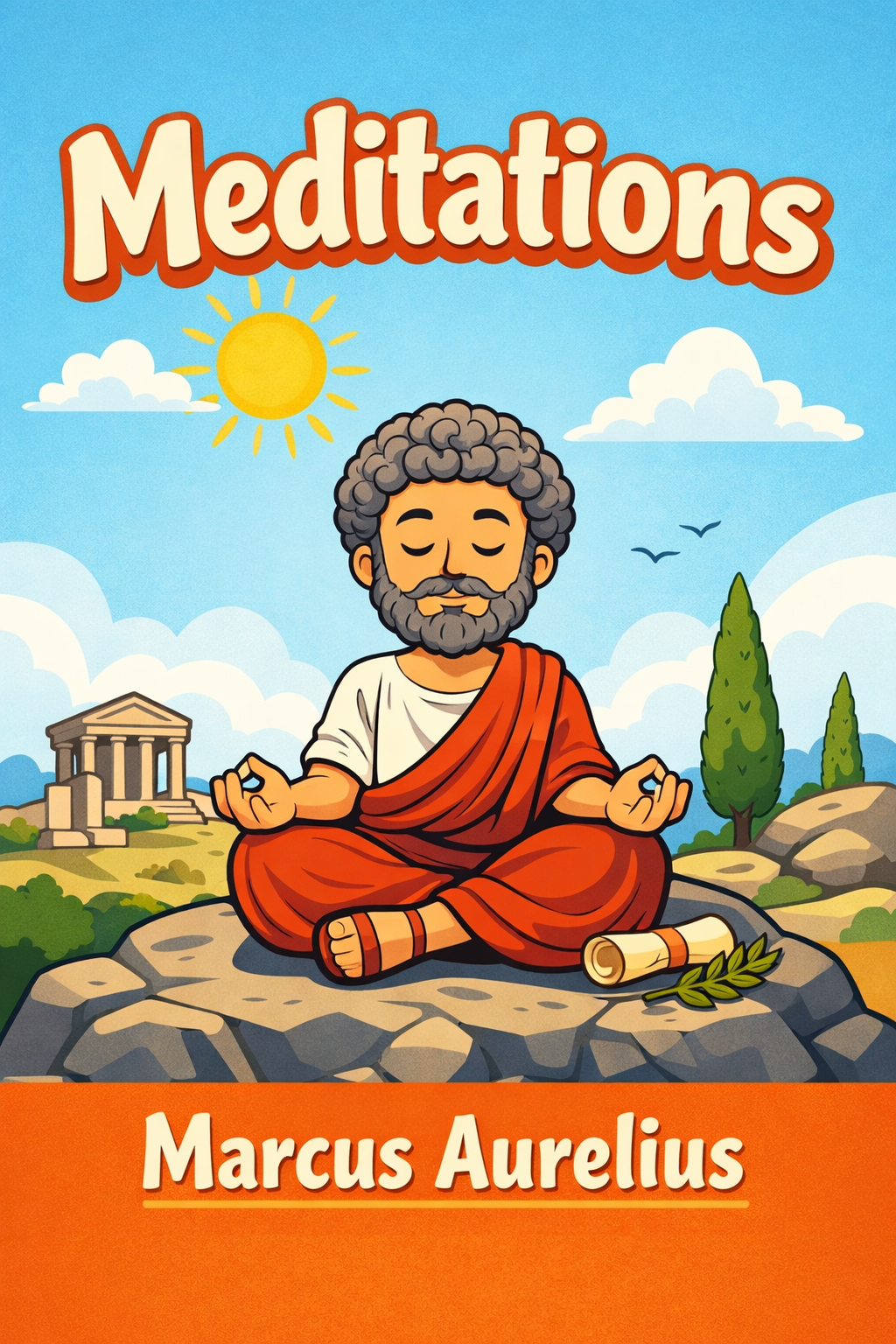
Description
“Meditations” offers an intimate glimpse into the mind of Marcus Aurelius, a Roman Emperor who ruled at the height of the empire’s power. This is not a formal treatise but a collection of personal notes, written primarily for himself during military campaigns and the burdens of state. Within these pages, he grapples with fundamental questions of how to live a good life, how to maintain one’s character in the face of adversity, and how to understand one’s place in the vast cosmos. The core of his thought is rooted in Stoic philosophy, which provides him a sturdy framework for navigating the immense pressures of leadership and personal loss. The book’s enduring power lies in its raw honesty and practical wisdom, applicable not to an abstract ideal, but to the daily struggles of a man bearing the weight of the world.
Central to Aurelius’s worldview is the concept of a universal reason, or Logos, that permeates and orders all of existence. He sees this rational principle as the connective tissue of the universe, governing nature, society, and human destiny. From this perspective, everything that occurs is part of an interconnected, purposeful whole. This is not a call to passive resignation, but to active understanding. By recognizing that events unfold according to a natural order, one can cease railing against circumstance. For Aurelius, this meant accepting his duties as emperor, the betrayals of colleagues, and the profound grief of losing many of his children, not as personal attacks or random misfortunes, but as threads in a larger tapestry. This acceptance is the foundation for inner stability, allowing him to perform his role with equanimity.
From this understanding of a rational universe flows a specific attitude toward mortality. Aurelius confronts death with a stark, almost scientific, clarity. He observes that death is a natural process, as integral to life as birth or growth. All things—empires, individuals, mountains—are in a constant state of change and dissolution, their components recycling back into the universe to form new things. To fear death, therefore, is to misunderstand nature itself. He constantly reminds himself that his time is brief and that even the most remembered historical figures are now dust. This meditation is not morbid, but liberating. It serves as a powerful impetus to value the present moment, to focus on living virtuously *now*, and to shed trivial concerns. The shortness of life makes complaining and procrastination not just vices, but profound wastes of a precious, finite resource.
The practical application of this philosophy is a relentless focus on reason and self-discipline. Aurelius warns against the tyranny of unchecked emotions—anger, lust, fear, and envy—which he sees as clouds that distort our perception of reality. When we react from raw emotion, we surrender our capacity for rational judgment, which is our highest human faculty. For an emperor, this was a matter of statecraft; a decision made in anger could lead to war, while one made in calm reason could secure peace. For any individual, it is the path to personal integrity. He advocates for a mind that acts as a fortified citadel, observing sensations and emotions without being commanded by them. True harm, he argues, comes not from external events—insults, losses, even pain—but from our own judgments about those events. By choosing our response, we retain control over our inner world, regardless of external chaos.
Ultimately, “Meditations” is a guide to ethical living and duty. Aurelius defines himself not by his title, but by his role as a rational, social being. His purpose is to act justly, to contribute to the common good, and to treat others with fairness and kindness, not because they deserve it, but because it is the right action for a creature endowed with reason. He sees himself as part of a larger human community and the even vaster community of all rational beings. This sense of connectedness dissolves petty grievances and fuels a deep-seated resilience. The book concludes not with grand answers, but with the quiet, persistent commitment to wake up each day and choose virtue, to meet obstacles with courage, to accept people as they are, and to do the work that is before you, all while keeping a mind aligned with the rational order of nature. It is a testament to the strength that can be forged not in spite of difficulty, but through a philosophical embrace of it.