Description
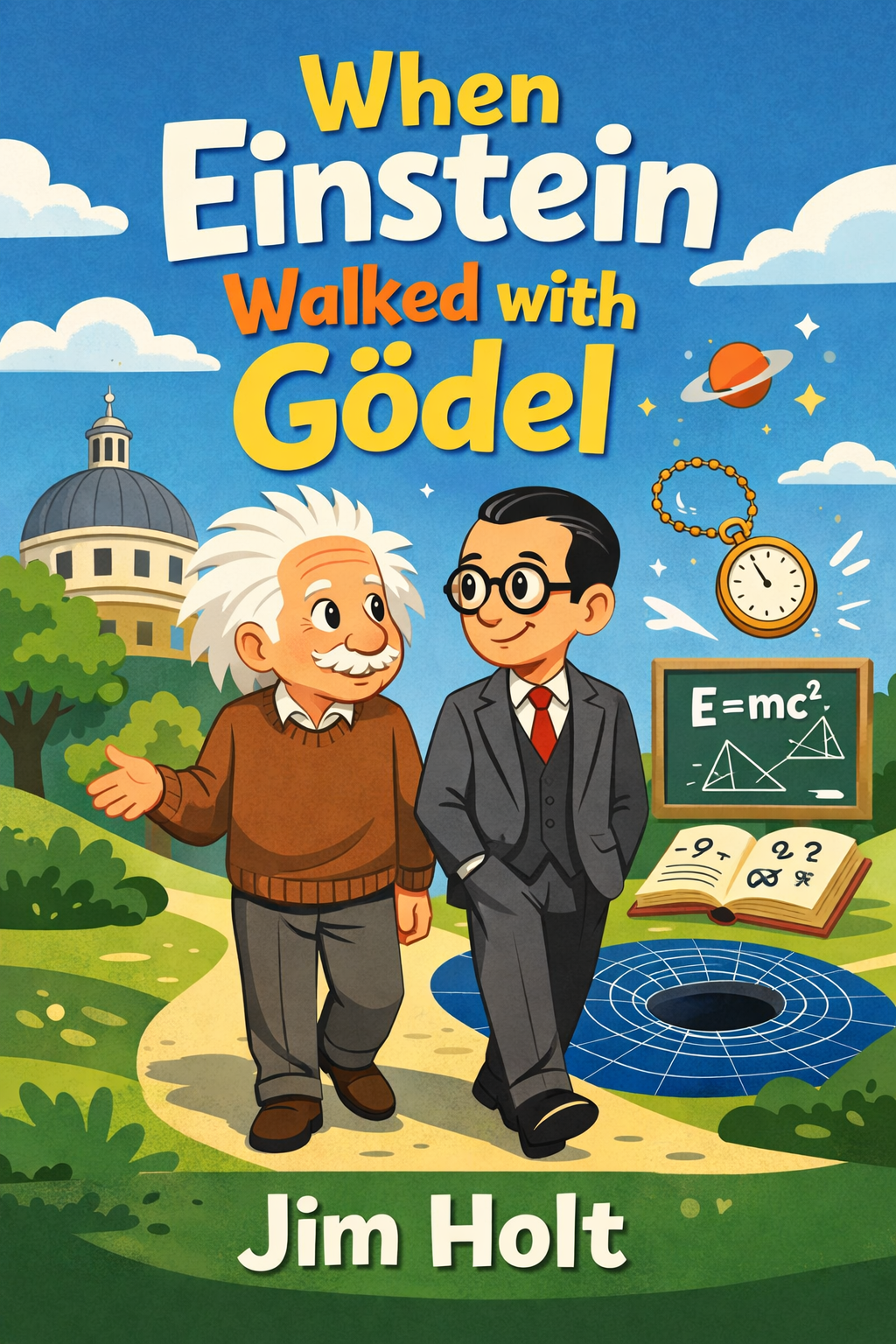
In the quiet, leafy lanes of Princeton, New Jersey, an elderly Albert Einstein found an unexpected companion for his daily walks. This was not another physicist, but the brilliant and troubled logician Kurt Gödel. Their friendship, a meeting of two radically different personalities united by a shared skepticism of mainstream quantum theory, serves as a poignant entry point into a world where abstract thought collides with profound reality. This narrative explores not just their bond, but the wider tapestry of revolutionary ideas that reshaped our understanding of everything from the fabric of the cosmos to the nature of mathematics itself. It is a story about the human quest for truth, the beauty of pure thought, and the often dramatic lives of those who dare to peer into the universe’s deepest mysteries.
Einstein, by then a figure of fading influence in the scientific community, had long been unsettled by the implications of quantum mechanics, famously dismissing its probabilistic nature with the phrase “God does not play dice.” Gödel, the younger man, was a titan of logic who had shattered the dream of a complete and consistent mathematical system with his incompleteness theorems. Where Einstein was jovial and social, Gödel was paranoid, reclusive, and lived on an eccentric diet. Yet together, they pondered the nature of reality, believing mathematics was not merely a game of symbols but a window into the world’s true structure. Gödel took Einstein’s own work to a startling conclusion. By solving Einstein’s equations for general relativity in a novel way, he conceived of a rotating universe in which time travel became a mathematical possibility. For Gödel, this meant time itself, as we understand it, might be an illusion—a philosophical ghost in the machinery of physics.
This exploration of fundamental limits extends into the heart of mathematics. While many consider math a difficult, alien language, we all possess an innate “number sense,” a neurological ability to estimate quantities that forms the foundation for all higher calculation. From this basic intuition springs the vast, elegant edifice of pure mathematics, a pursuit often driven more by aesthetics than immediate utility. Mathematicians speak of “beautiful” proofs and “elegant” solutions, guided by an intuitive sense of harmony. This is epitomized by the enduring mystery of prime numbers, the atoms of arithmetic. Their seemingly random distribution across the number line is believed to follow a hidden pattern, described by the Riemann hypothesis. This unproven conjecture is so deeply trusted for its beauty and explanatory power that it underpins much of modern number theory, standing as one of the great intellectual challenges, with a million-dollar prize for its solution.
The concept of infinity, too, reveals itself to be far stranger than a single, vast idea. Through ingenious reasoning, mathematicians like Georg Cantor showed that infinities come in different sizes; some are genuinely “larger” than others. The infinity of all counting numbers is smaller than the infinity of all points on a line, a revelation that was mathematically irrefutable yet so disturbing to some of Cantor’s contemporaries that it contributed to his mental decline. This journey through abstraction finds a tragic, concrete end in the story of Alan Turing, the father of computer science. Having laid the logical groundwork for the digital age and played a crucial role in deciphering Nazi codes during World War II, Turing was later persecuted for his homosexuality. His death from cyanide poisoning, ruled a suicide but shrouded in ambiguity, remains a somber reminder of the complex interplay between genius, society, and personal tragedy.
Looking outward to the cosmos, modern physics offers grand, if speculative, visions of unity and finality. String theory proposes that the fundamental constituents of reality are not particles but unimaginably tiny, vibrating strings, with their harmonies determining all forces and matter. This elegant idea requires extra, hidden dimensions of space, but it promises a “theory of everything.” Yet it remains, for now, experimentally unverified—a magnificent castle in the air. Meanwhile, cosmology paints a definitive, if bleak, portrait of our universe’s ultimate fate. Current evidence suggests a cold, dark end in an ever-expanding void, where galaxies drift apart beyond sight and all energy dissipates. This cosmic conclusion, drawn from the very laws of physics inspired by minds like Einstein’s, brings a profound finality to the human story of inquiry.
Ultimately, this is a chronicle of the passion that drives individuals to spend their lives contemplating the infinite and the infinitesimal. It reveals how the pursuit of abstract truth—whether in the logical labyrinths of Gödel, the numerical patterns of the primes, or the cosmic visions of Einstein—is a deeply human endeavor, fraught with brilliance, beauty, controversy, and sometimes, profound personal cost. The walks in Princeton were more than a pastime; they were a symbol of the enduring dialogue between logic and reality, a conversation that continues to define our quest to understand our place in a vast and mysterious universe.