Description
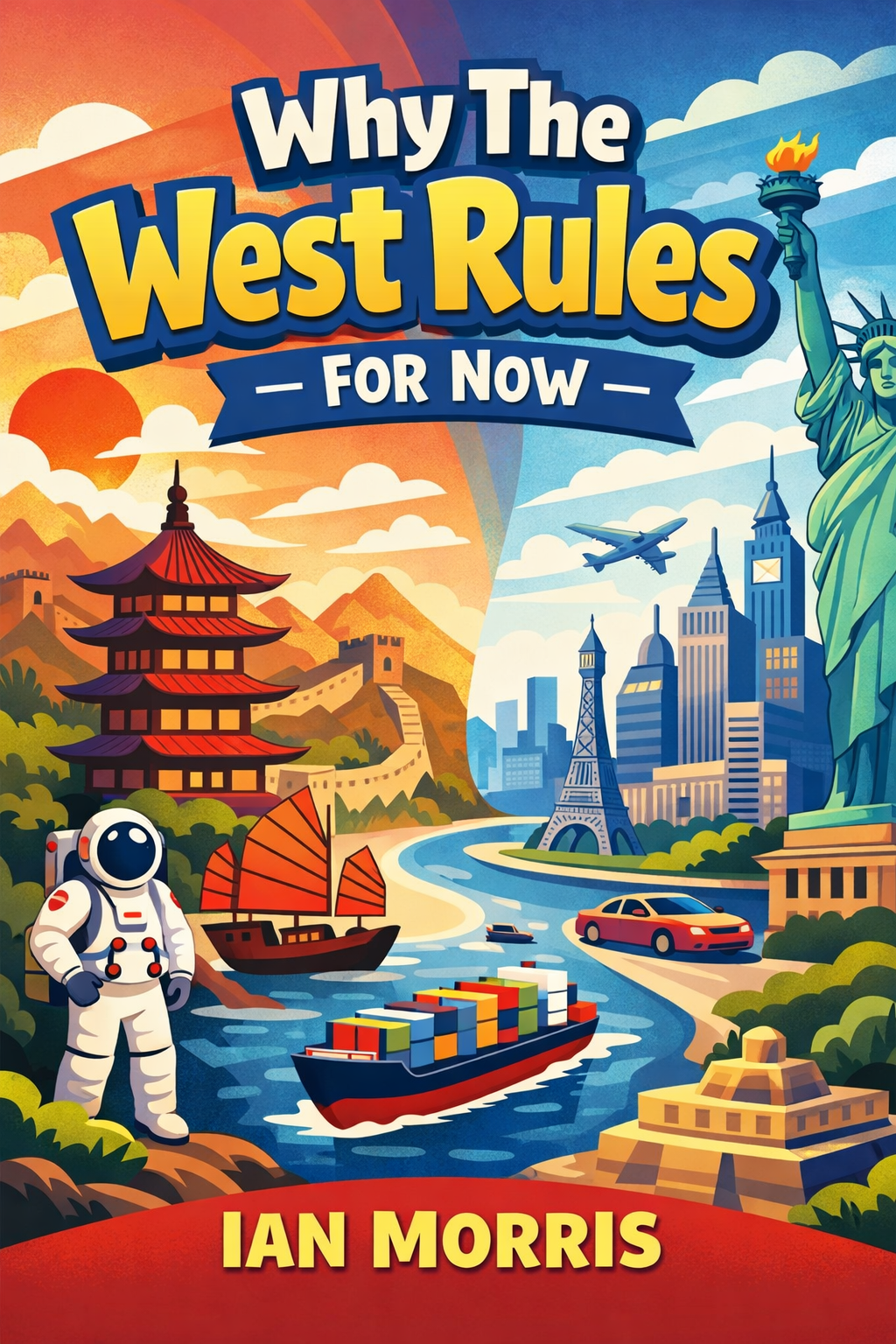
The question of why Western nations have dominated the globe for the past few centuries is one of history’s greatest puzzles. This book dismantles simplistic answers, whether they claim inherent racial superiority, cultural destiny, or mere historical accident. Instead, it presents a grand narrative spanning fifteen thousand years, arguing that the rise and fall of East and West follow a discernible pattern driven by geography, social development, and the relentless pressure of what the author calls the “five horsemen of the apocalypse”: climate change, famine, state collapse, migration, and disease. The story is not one of permanent Western destiny, but of a temporary lead that is already beginning to wane.
To tell this story, we must first define what we mean by “East” and “West.” The narrative follows two cores: the West, originating in the Fertile Crescent of the Middle East, and the East, originating between the Yellow and Yangtze Rivers in China. The key to comparing them is a measurable concept called social development—a society’s ability to master its environment through energy capture, urban organization, information processing, and warmaking capacity. When these metrics are plotted on a graph from ancient times to the present, a striking pattern emerges: the developmental lines of East and West run remarkably parallel for millennia, with the lead shifting back and forth, rather than one surging permanently ahead.
The West’s initial, modest head start was a gift of geography, not intellect or culture. As the last Ice Age retreated, the “Hilly Flanks” region of Southwest Asia possessed an unparalleled concentration of easily domesticable plants and animals, like wheat, barley, sheep, and goats. This allowed agriculture and settled societies to emerge there roughly two thousand years earlier than in China, where the domestication of rice and millet was a more complex process. This geographical lottery set the clock ticking earlier in the West. For thousands of years, Western social development scores led, with civilizations like Mesopotamia and Egypt laying foundations. However, the East was never stagnant; it was developing along a similar trajectory, just from a later starting point.
A major turning point came around 1200 BCE with the catastrophic Late Bronze Age collapse in the Mediterranean. A perfect storm of the five horsemen—drought, famine, invasion, and systemic failure—shattered powerful kingdoms from Greece to Egypt. This crisis acted as a massive brake on Western development, allowing the East to close the gap significantly. By the first millennium BCE, both cores were constructing similar “high-end” states: centralized, bureaucratic empires like the Assyrian in the West and the Zhou in the East. This parallel evolution continued with the rise of the twin giants of classical antiquity: the Roman Empire in the West and the Han Dynasty in the East. These empires mirrored each other in astonishing ways, with literate elites, vast trade networks, and powerful armies. Their downfalls in the early centuries CE were also eerily similar, undone by internal strains and relentless pressure from nomadic peoples on their frontiers.
For centuries after these collapses, the East began to pull ahead. By 1100 CE, under the brilliant Song Dynasty, China reached a peak of social development unmatched anywhere in the world. It was a time of remarkable innovation in technology, finance, and administration. The West, meanwhile, was fragmented and less developed. Yet, the Song’s very success contained the seeds of a paradox. Its advanced, centralized system may have been less adaptable to sudden shock. When the Mongol invasions arrived in the thirteenth century, followed by the plague, the Eastern core was hit with devastating force, stalling its progress.
This opened a window for the West. The key was not any innate superiority, but the opening of new Atlantic and Indian Ocean trade routes after 1500. Europe, once a peripheral backwater, now found itself at the center of a new global network. The competitive, fragmented nature of European states, constantly at war, drove a frantic and often brutal search for military and economic advantage. This “killer app” of competition, combined with the windfall of American resources, propelled Western development forward. The culmination was the Industrial Revolution in eighteenth-century Britain, which finally broke the ancient ceiling on energy capture by harnessing the power of fossil fuels. This was the moment the West’s lead transformed into overwhelming dominance.
The twentieth century, despite its apocalyptic wars, represented the high-water mark of Western rule. The United States emerged as a superpower, and Western technology and culture spread across the planet. However, the same forces of development are now working in the East’s favor. The pattern of catch-up is reasserting itself. As the East rapidly industrializes, it is climbing the same developmental curve the West once did, but at a much faster pace. The book suggests that, if current trends continue, the East will regain the lead in social development by the early twenty-first century. This is not a forecast of inevitable victory, but a recognition of a recurring historical rhythm. The final unknown is whether humanity as a whole can manage this coming shift peacefully, or whether the five horsemen will once again ride, challenging both East and West in an interconnected world. The story is not of eternal rule, but of a constant, dynamic chase.