Description
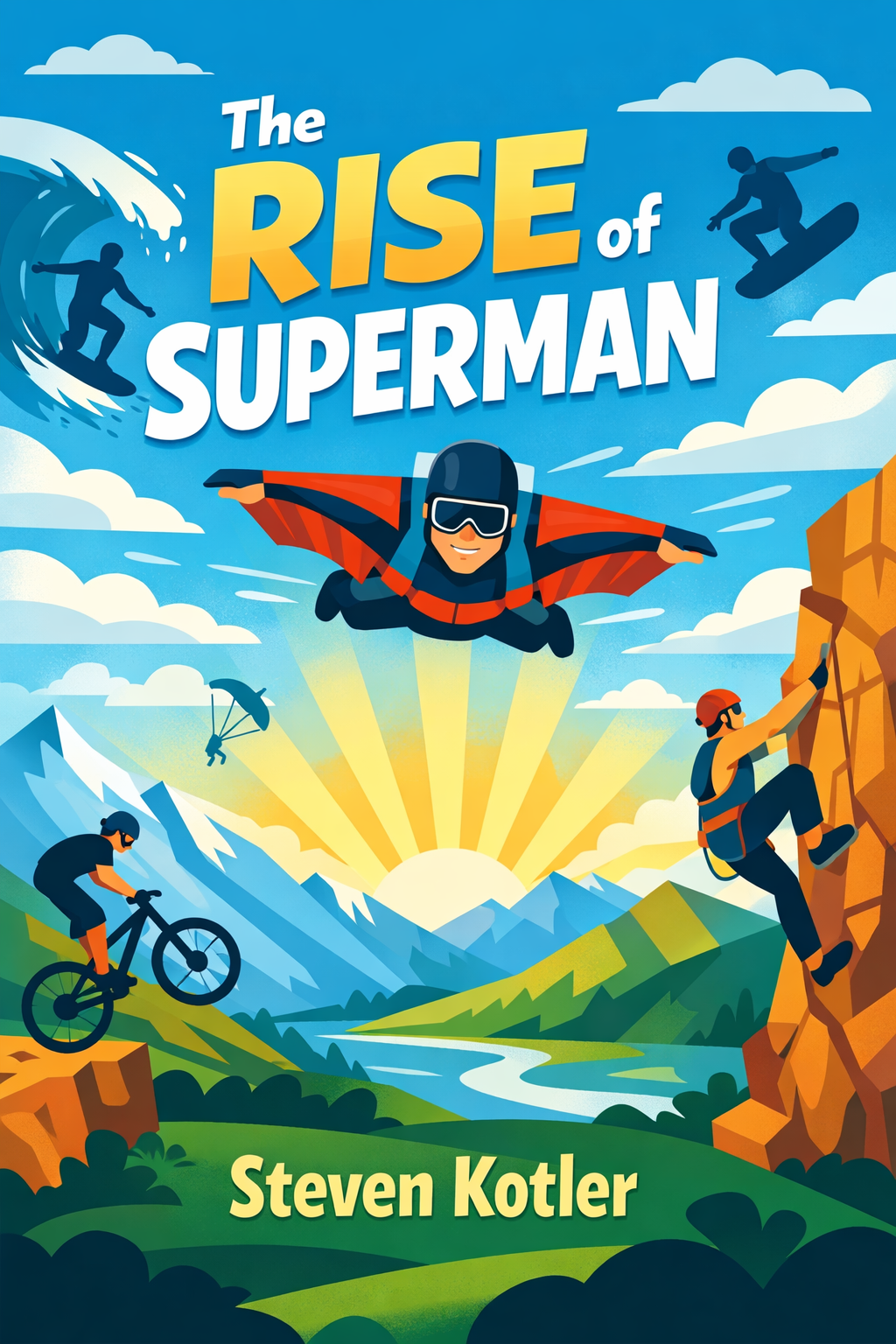
The book opens with a compelling question: how do extreme athletes consistently perform at the very edge of human possibility, executing maneuvers that defy logic and often cheat death? The answer is not superhuman genetics, but a superior ability to enter a state of consciousness known as flow, or “the zone.” This state represents the pinnacle of human performance, where action and awareness merge, time distorts, and individuals operate at their absolute best. The author uses the breathtaking and often perilous world of extreme sports as a living laboratory to dissect this phenomenon, arguing that the principles discovered there apply to anyone seeking to elevate their performance in any field.
Flow is described as more than just intense concentration; it is a profoundly spiritual and transformative experience. When a surfer like Laird Hamilton rode the legendary “Millennium Wave,” his survival depended on an instantaneous, creative maneuver—placing his hands on the opposite side of his board—a solution that arose directly from the flow state. Similarly, climbers like Dean Potter describe being guided by an internal “Voice,” a subconscious intuition that allows for hundreds of perfect, unroped moves up a deadly face. In flow, the sense of a separate self dissolves. Athletes report becoming one with the wave, the rock, or the sky, a state of ego loss where they are no longer performing an activity but are the activity itself.
This transcendent experience has a concrete biological basis. Entering flow triggers a powerful neurochemical cocktail. Dopamine sharpens focus and fuels exploratory drive. Norepinephrine increases heart rate, respiration, and attention, locking the mind onto the present task. Anandamide, known as the “bliss molecule,” boosts creative, lateral thinking and reduces fear, enabling risky, novel solutions. Endorphins, vastly more potent than morphine, mask pain and allow the body to push past normal limits. Finally, serotonin provides the peaceful, satisfied afterglow that makes the experience addictive. This chemistry doesn’t just make flow feel good; it actively enhances physical and cognitive capabilities.
Remarkably, peak performance is achieved not by the brain working harder, but by parts of it temporarily powering down. During flow, the brain undergoes “transient hypofrontality,” where sections of the prefrontal cortex—the seat of self-criticism, timekeeping, and analytical deliberation—go quiet. The inner voice of doubt silences. The spatial awareness that separates self from environment diminishes, creating that feeling of unity. This neurological simplification is a superpower: without the delay of self-conscious analysis, action becomes instantaneous and unfiltered. In a life-or-death situation on a mountain, there is no time for second-guessing; flow enables the body to act on pure, creative instinct.
Cultivating this state requires specific conditions. The activity must be intrinsically rewarding; the joy is in the doing, not just the outcome. One must achieve complete absorption in the present moment, where all distractions fade. Crucially, the challenge at hand must be perfectly balanced with one’s skill level—specifically, about four percent beyond current ability. This sweet spot is neither boringly easy nor paralyzingly hard. To stay in flow, immediate and clear goals are essential. For a runner, the macro-goal might be a marathon, but the flow-sustaining goal is the next lamppost, the next breath, the next perfect stride.
Underpinning the ability to seek these challenges is a critical mental framework: the growth mindset. Believing that talent is fixed and innate creates a ceiling on potential. Those with a “fixed mindset” see elite performers as genetically gifted aliens. In contrast, a “growth mindset” understands that skill is built through dedication and deliberate practice. This belief system is fundamental because it empowers individuals to embrace challenges, persist through setbacks, and view effort as the path to mastery. Research cited shows that even among top-tier performers, like elite race car drivers, those with a growth mindset access flow more readily and consistently outperform their fixed-mindset peers.
While personal mindset is key, the journey is not a solitary one. The most powerful catalyst for entering flow regularly is a passionate community. Surrounding oneself with others who share a deep commitment creates an environment rich in collective knowledge, immediate feedback, and friendly rivalry. This social layer raises the baseline of what is considered possible, constantly resetting the challenge-skills balance. Seeing a peer land a new trick expands the imagination of the entire group, making the impossible seem attainable. The community provides a safe space to take risks, fail, and learn, accelerating the cycle of growth that leads to flow.
The exploration of flow is ultimately an exploration of human potential. As we deepen our understanding of the mind’s mechanics, we move closer to deliberately accessing our optimal states. The book posits that the incredible feats of today’s extreme athletes are not an end point, but a signpost. By demystifying the flow state, it suggests that this heightened capacity for performance, creativity, and fulfillment is accessible to all. The final implication is one of boundless possibility: as we continue to push the envelope, guided by neuroscience and mindset, the only limit to human achievement is the one we set for ourselves.