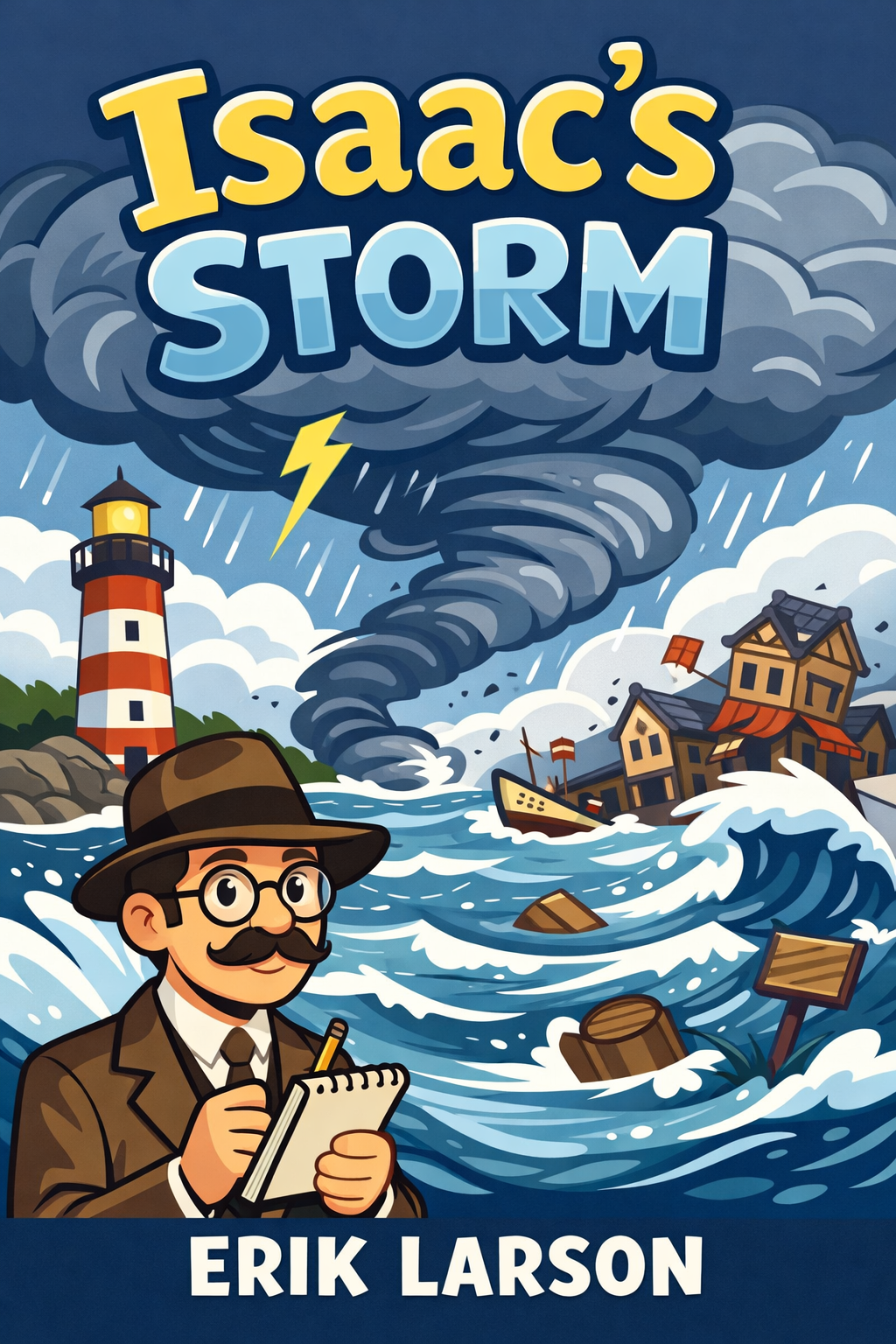
Description
Isaac’s Storm by Erik Larson chronicles the devastating hurricane that struck Galveston, Texas, in 1900, weaving together the history of weather forecasting, the biography of a pivotal meteorologist, and the raw human drama of America’s deadliest natural disaster. At the heart of the narrative is Isaac Cline, a dedicated and confident official of the U.S. Weather Bureau, whose steadfast belief in the safety of his city blinded him and others to the looming threat. The book is a meticulous reconstruction of a city’s golden age, its utter destruction in a single day, and the profound lessons buried in the wreckage.
The story begins by establishing Galveston at the turn of the century as a thriving, cosmopolitan port, a city brimming with wealth and ambition, seemingly destined for greatness. Into this bustling community comes Isaac Cline, a man of science and order, who represents the modern promise of prediction and control. His rise within the fledgling Weather Bureau is marked by competence and a deep-seated faith in the prevailing scientific wisdom of the era. This wisdom, which Cline himself publicly championed in the local newspaper, held that a major hurricane could not and would not strike Galveston Island due to geographic and meteorological conditions. This belief, presented as fact, lulled the city into a false sense of security, creating a cultural and institutional blind spot that would have fatal consequences.
Larson meticulously details the atmospheric and bureaucratic conditions that allowed the storm to approach virtually undetected. A critical subplot involves the political machinations of the Weather Bureau in Washington, which, in a bid to centralize authority and bolster its own damaged credibility, severed communication with Cuban meteorologists. These forecasters, with their extensive experience in tracking Caribbean hurricanes, were silenced just as they began to identify the ominous system forming in their waters. This act of arrogance, mirroring Isaac Cline’s own, ensured that crucial early warnings were never received. As the storm churned through the Gulf of Mexico, the Galveston office, relying on incomplete and misinterpreted data, issued only routine advisories for heavy rain and wind.
The narrative’s power shifts from the clinical world of barometric readings and telegrams to the visceral, terrifying experience of the storm itself. Larson draws from survivor accounts to paint a harrowing portrait of September 8, 1900. He describes the initial curiosity as tides rose, turning to unease, then to disbelief, and finally to sheer terror as a monstrous surge of water inundated the low-lying island. The city, built on sand, was utterly defenseless. Winds estimated at over 140 miles per hour shredded buildings, while a storm surge of fifteen feet or more scoured the landscape, carrying entire neighborhoods out to sea. Families were faced with impossible choices, clinging to disintegrating rooftops or watching loved ones swept away by the torrent. The storm’s fury was indiscriminate, claiming the lives of an estimated 8,000 people in a matter of hours.
In the aftermath, Isaac Cline is portrayed as a tragic figure, a man who lost his pregnant wife in the flood and was left to confront the ruin of his city and the collapse of his professional certainty. The book follows the grim recovery, the mass burials at sea, and the city’s agonizing rebirth, which included the monumental engineering feat of raising the entire grade of the city and constructing a massive seawall. Yet, Galveston’s destiny was permanently altered; its commercial primacy was lost to Houston, and a shadow of the disaster lingered forever.
Ultimately, Isaac’s Storm is more than a disaster chronicle. It is a profound meditation on hubris. It explores the dangerous intersection of human confidence, institutional fragility, and the immense, unpredictable power of nature. Larson presents the hurricane not merely as a meteorological event, but as a tragic collision between the era’s belief in human mastery and the immutable forces of the natural world. The storm laid bare the limits of knowledge and the catastrophic cost of mistaking confidence for comprehension, leaving a legacy written not just in the reconstructed city, but in the sobered soul of American meteorology.