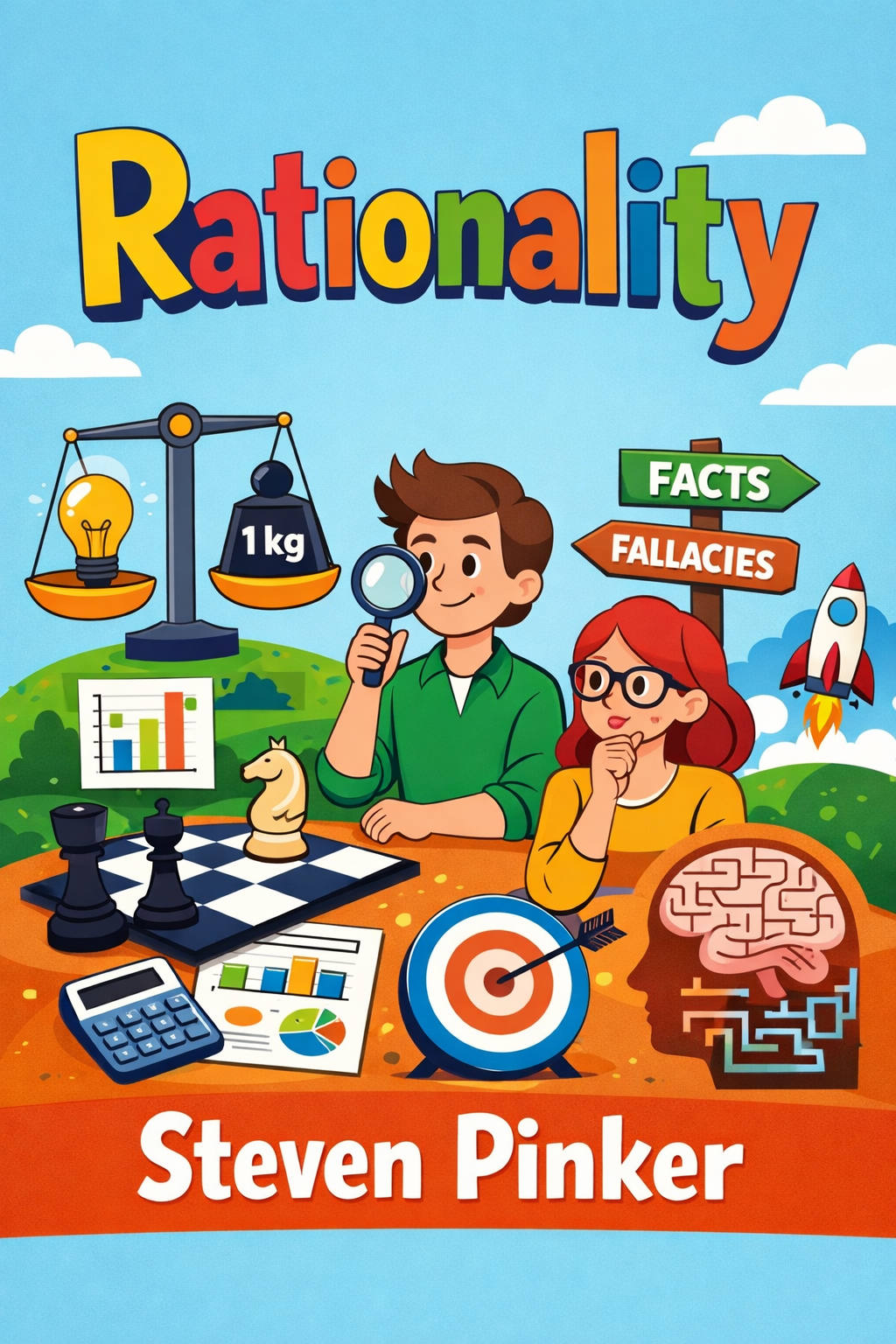
Description
Rationality is not an abstract philosophical concept but a practical toolkit we use to navigate the world. At its core, it is the art of using knowledge to achieve our goals. Unlike simple objects drawn directly to a magnet, humans can creatively overcome obstacles. If one path is blocked, we find another. This flexibility in method, while keeping our ultimate aims fixed, is the essence of rational action. It transforms reason from a mere mental exercise into a powerful instrument for change, responsible for humanity’s greatest achievements, from medical breakthroughs to space exploration.
Our goals themselves, however, do not spring from reason alone. They emerge from our passions—our desires, emotions, and drives. Reason does not dictate what we should want, but it becomes indispensable when our wants conflict. We naturally seek pleasure, health, success, and connection, but these aims often clash. Rationality provides the framework to weigh these competing passions against one another, considering their long-term consequences. It allows us to see that prioritizing health over fleeting indulgence, or cooperation over ruthless ambition, typically yields greater satisfaction for our future selves. In this way, reason acts as a wise advisor to our desires, helping us prioritize and build a coherent life from our many wants.
Sometimes, the most rational strategy involves limiting our own options or knowledge. The ancient story of Odysseus tying himself to the mast to resist the Sirens’ song is a profound lesson in self-constraint. Recognizing the limits of our willpower, we can make rational pre-commitments. We automate savings, avoid grocery shopping while hungry, or use apps to limit social media use. Similarly, strategic ignorance can be a shield. Choosing not to learn about an untreatable genetic fate, or designing scientific studies so researchers don’t know which subjects received a treatment, are rational decisions to prevent bias, coercion, or unnecessary distress. Rationality, therefore, understands human psychology and wisely builds guardrails against our own predictable frailties.
To understand the world beyond our internal conflicts, we turn to science, which is rationality applied systematically to reality. It moves beyond unfalsifiable logic games to empirical investigation. The parable of scholars debating how many teeth are in a horse’s mouth by consulting ancient texts, rather than simply looking at a horse, highlights the shift from dogma to evidence. Science is a disciplined search for evidence that could potentially disprove our ideas. This commitment to falsifiability is what separates genuine inquiry from pseudoscience and superstition. It is a humbling process, always open to being corrected by new data, and it is this very humility that gives it such formidable power to reveal objective truths about our universe.
Since no single individual can claim perfect objectivity, we construct institutions to collectively approach rationality. These systems—from legal courts and peer-reviewed journals to democratic processes and markets—are designed to counteract individual bias and partiality. They operate on the foundational premise that while objective truth exists, none of us possesses it fully. By pooling perspectives, subjecting claims to scrutiny, and following fair procedures, these institutions help societies make decisions that are less capricious and more reasoned than any one person could manage alone. They are the scaffolding that supports rational collective life.
This institutional approach extends to managing shared resources, known as the commons. When individuals act solely in their short-term self-interest, common goods like fisheries, clean air, or public trust are depleted. Rationality shows that sustainable systems often require agreed-upon rules and, sometimes, gentle paternalism. Policies that automatically enroll people in retirement savings plans or punish polluters are not insults to freedom but rational designs to protect individuals from their own short-sightedness and to ensure the long-term health of the community for everyone’s benefit.
Ultimately, rationality provides a compelling foundation for our most important moral ideas. The principle of treating others as we wish to be treated, or considering the interests of all people equally, is not just a sentimental urge. It is a rational conclusion that follows from recognizing our shared humanity and capacity for suffering. When we reason impartially, setting aside our specific biases and vantage points, the ethical demand for fairness and compassion emerges naturally. Thus, rationality is far more than cold calculation; it is the very ground upon which we can build a wiser, more just, and more flourishing world for all.
Book Title: Rationality