Description
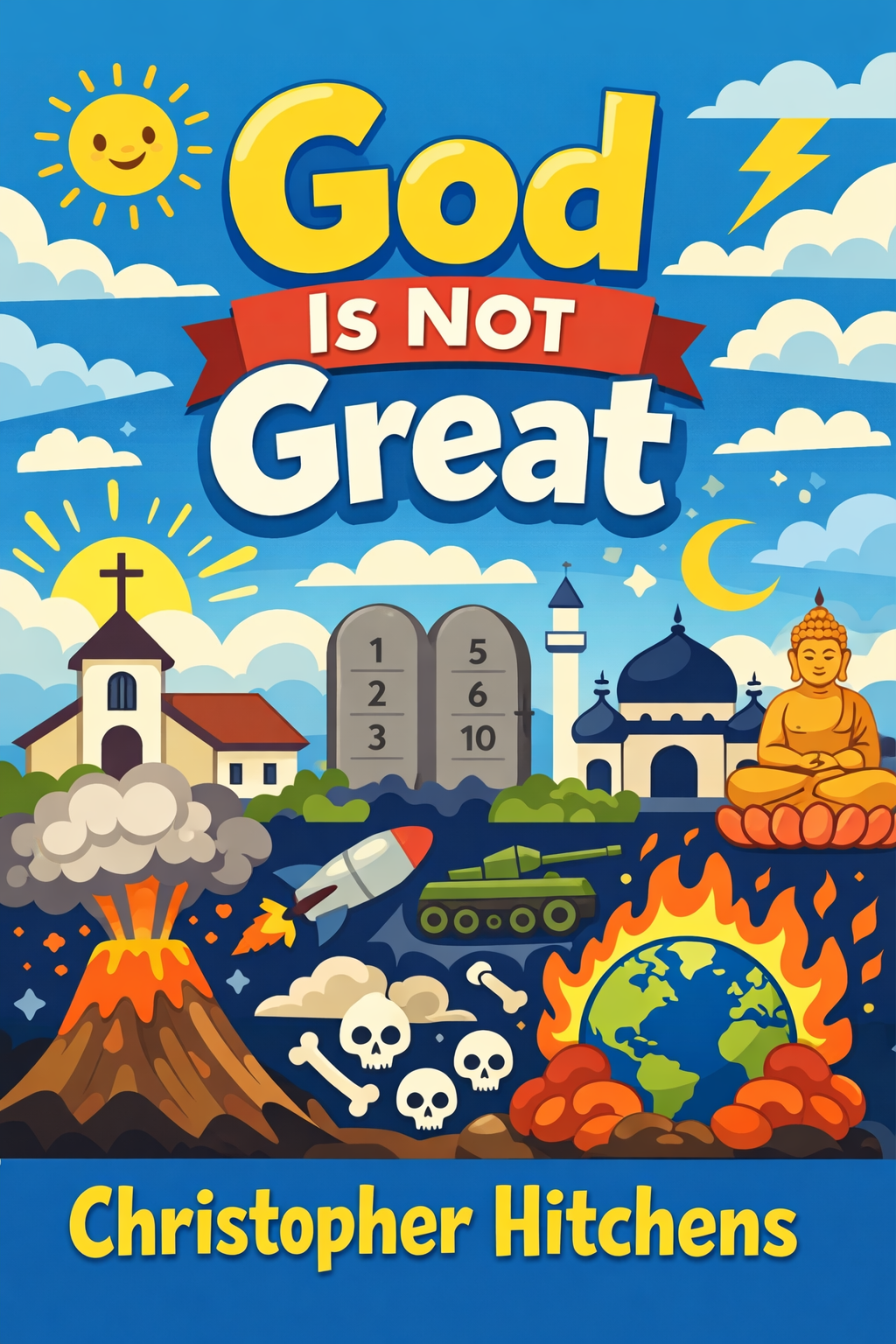
Christopher Hitchens presents a forceful and erudite argument against organized religion, framing it not as a source of comfort or morality, but as a deeply harmful and fraudulent human invention. The central thesis is that religious belief is not merely incorrect, but actively dangerous—a “poison” that corrupts human decency, stifles intellectual inquiry, and justifies violence and oppression. The work systematically dismantles religion’s foundational claims, its moral authority, and its societal impact, advocating instead for a worldview grounded in secular humanism, scientific skepticism, and free thought.
The book begins by challenging the divine origin of sacred texts. Hitchens meticulously points out historical inaccuracies, contradictions, and the politically motivated editing processes that shaped canons like the Bible. The discovery of alternative texts like the Gospel of Judas demonstrates how religious orthodoxy was constructed by men selecting narratives that served institutional power, not divine truth. These scriptures, often based on unreliable oral traditions, are presented not as timeless revelations but as flawed, culturally bound documents. This establishes a core theme: far from a creator fashioning humanity, it is humanity that has, in its own image and for its own purposes, fashioned its gods.
The concept of the miraculous is next subjected to skeptical scrutiny. Hitchens argues that what were once deemed miracles are either cheap parlor tricks, misunderstandings of natural phenomena, or events confined to a distant, less scientifically literate past. The diminishing scale of modern “miracles”—finding faces in toast or statues that weep—betrays how scientific enlightenment has pushed the divine to the fringes, reducing omnipotence to trivialities. This leads to a critical examination of religion’s moral standing. Far from being the bedrock of ethics, Hitchens contends that religious doctrines have sanctified some of history’s greatest atrocities: genocide, slavery, rape, and the murder of non-believers. He highlights the immoral absurdity of commandments that demand resistance to human biology itself, and the psychological tyranny of threatening eternal torture for finite, often thought-based, transgressions.
This tyranny is expanded upon through a powerful analogy: religious belief is inherently totalitarian. It demands absolute submission to an invisible dictator whose arbitrary laws must be obeyed without question. Theocracies are the purest manifestation of this, policing every aspect of life, but even individual faith involves a willing surrender of autonomy and critical judgment. The believer invites constant surveillance and accepts the ultimate punishment—unending torment—for dissent. This totalitarian impulse is vividly illustrated in religion’s treatment of children, whom it indoctrinates through fear and subjects to physically harmful rituals like circumcision, practices society tolerates only under the shield of faith. What would otherwise be condemned as child abuse or psychological terror is excused as religious tradition.
Hitchens further argues that religion is constitutionally incapable of tolerance. Its claim to possess absolute truth necessitates the suppression of competing ideas. This inherent insecurity fuels endless conflict, from sectarian wars to the persecution of heretics and blasphemers, as seen in the fatwa against Salman Rushdie. Religion may promise peace in the afterlife, but it demands power and obedience in this one. Against this backdrop of repression, the book celebrates the courageous lineage of freethinkers, skeptics, and scientists who, often at great personal risk, pursued knowledge and expanded human understanding. Their perseverance, from the Enlightenment forward, gradually eroded religious dogma’s grip on explanation, offering evidence-based understanding of the cosmos, life, and ourselves.
The fundamental incompatibility between religion and science is presented as irreconcilable. Religion insists on fixed, revealed truths that are immune to evidence, while science proceeds through doubt, testing, and revision. This clash is not a dialogue between equal ways of knowing but a struggle between inquiry and obedience. In conclusion, Hitchens issues a clarion call for resistance. Religion, he asserts, will always seek to impose itself on society and must be actively opposed through reason, satire, and the defense of secular values. The alternative to religious absolutism is not a moral vacuum but a richer, more compassionate, and truly enlightened humanism that draws its ethics from our shared humanity and capacity for reason, not from ancient and authoritarian dictates.