Description
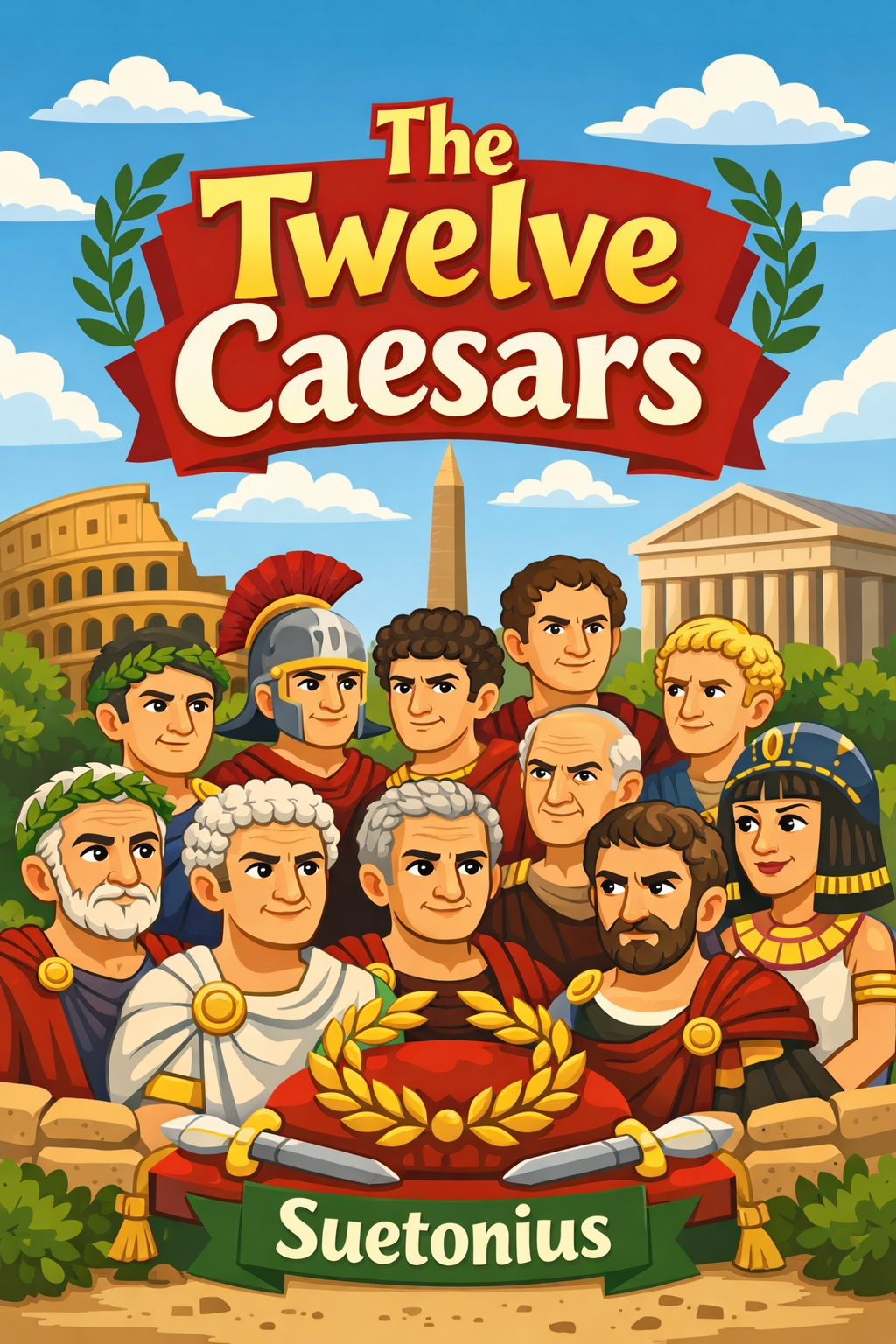
The story of Rome’s transformation from a wounded republic into a sprawling empire is told through the lives of the men who wielded its ultimate power. Beginning with the brilliant and ruthless Julius Caesar, whose ambition shattered ancient political norms, the narrative charts the volatile dynasty he inadvertently founded. This is a chronicle of absolute power, examining how it was seized, exercised, lost, and often abused across a century of dramatic history. Through the eyes of the ancient historian Suetonius, we gain intimate access to the triumphs, vices, and personal quirks of these legendary figures, moving from the calculated statesmanship of Augustus to the notorious depravity of Caligula and Nero, and finally to the more stable but no less dramatic Flavian dynasty.
Julius Caesar emerges not merely as a historical figure but as a force of nature. His early life, marked by political terror and piracy, forged a relentless and charismatic leader. His military genius was matched by a profound understanding of populist politics, allowing him to rally both the legions and the common people of Rome. His crossing of the Rubicon was a point of no return, plunging the republic into civil war and culminating in his dictatorship. His assassination on the Ides of March, rather than restoring the old order, created a vacuum that ignited a fresh struggle for supremacy. This power vacuum set the stage for his adopted heir, Octavian, a master of political strategy who outmaneuvered all rivals, including the formidable Mark Antony and Cleopatra. After decades of conflict, Octavian, now renamed Augustus, established a lasting peace, the Pax Romana, masking his autocratic rule beneath a facade of republican restoration and personal modesty.
Augustus’s reign presents a fascinating paradox. As the son of a deified father, he held unparalleled power, yet Suetonius paints him as a man of surprising frugality and simple tastes, living in a modest home and preferring plain food. This cultivated image of the humble first citizen was central to his success. His death brought his stepson Tiberius to power, a capable but increasingly reclusive and paranoid ruler. The true rupture in the imperial narrative, however, comes with Caligula. Initially welcomed as the beloved son of the popular hero Germanicus, Caligula’s early promise devolved into a terrifying spectacle of caprice and cruelty. His reign became a lesson in the corrupting potential of unchecked authority, featuring acts of symbolic tyranny, such as appointing his horse to high office, and genuine terror, which ultimately led to his assassination by his own guards.
The aftermath of Caligula’s murder produced one of history’s most unlikely emperors: Claudius. Often dismissed as a stammering, frail scholar, he was discovered hiding in the palace and proclaimed emperor by the praetorian guard. Against all expectations, Claudius proved an able administrator, overseeing the conquest of Britain and significant legal reforms. His personal life, however, was dominated by powerful and manipulative wives, and he was eventually poisoned, likely by his last wife, Agrippina, to secure the succession for her son, Nero. Nero’s reign began under wise guidance but soon spiraled into a notorious obsession with artistic fame and public performance, which scandalized the Roman elite. His extravagance, the great fire of Rome, and his brutal persecution of Christians cemented his reputation as a tyrant. His final, chaotic flight from a growing rebellion ended in a desperate suicide.
The year following Nero’s death, 69 CE, became the “Year of the Four Emperors,” a brutal civil war that laid bare the secret of imperial power: it rested not with the Senate or people, but with the legions. Galba, Otho, and Vitellius each briefly seized the throne through military support, only to be violently overthrown. Stability was finally restored by Vespasian, a pragmatic general from a non-aristocratic background. His rule brought fiscal responsibility, major construction projects like the Colosseum, and a return to traditional values. He was succeeded by his popular son, Titus, whose brief reign was marked by the catastrophic eruption of Vesuvius and the opening of the Colosseum. The Flavian dynasty ended with Titus’s brother, Domitian, who began as an efficient ruler but grew into a suspicious autocrat, instigating a reign of terror that ended with his assassination in the palace.
This sweeping journey from Caesar to Domitian reveals the fragile nature of the imperial system. It was a personal autocracy, its stability dependent on the character, health, and military support of a single man. The narratives of these twelve lives—filled with grandeur, reform, madness, and violence—collectively explain how the Roman Empire was forged, sustained, and repeatedly shaken by the very individuals who claimed to rule it. Their stories are a timeless study of power in its most concentrated and dangerous form.