Description
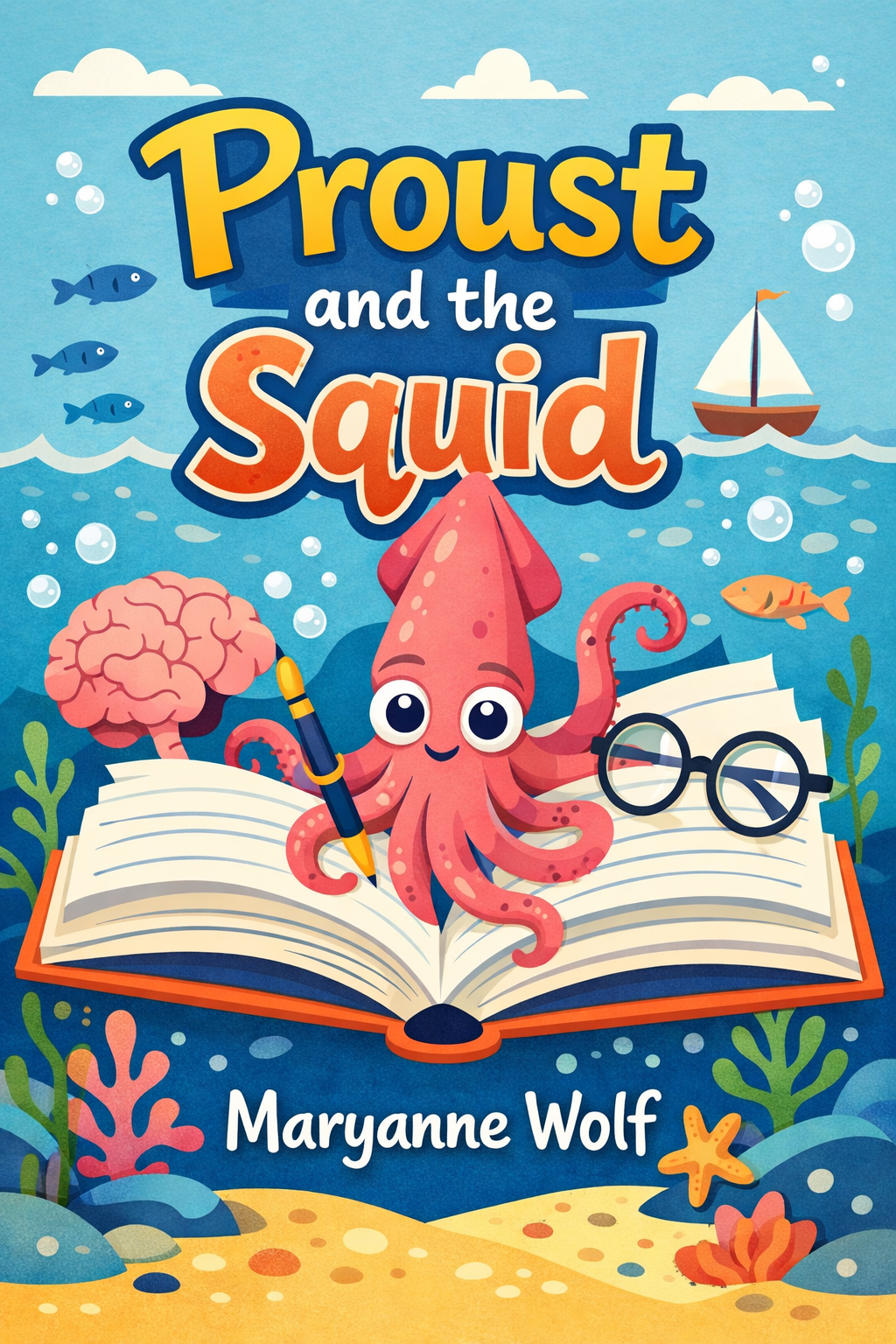
The act of reading feels effortless, a silent conversation between mind and page. Yet this simple skill is one of humanity’s most profound inventions, a cultural and neurological miracle. “Proust and the Squid” explores this miracle, weaving together history, neuroscience, and psychology to reveal how the human brain—a structure not born to read—adapted itself to literacy. This journey begins not with a child’s first book, but in the deep past, when our ancestors first made marks to hold meaning.
The invention of writing demanded a corresponding invention within us. Our brains, marvels of neural plasticity, physically rearranged themselves to meet the challenge. New pathways formed, connecting regions for vision, language, and association. Where once we saw only abstract lines, we learned to decode symbols at lightning speed. This neural remodeling laid the groundwork for increasingly complex writing systems, from early pictograms to the sophisticated scripts of the Sumerians and Egyptians. These systems were powerful but cumbersome, requiring years to master and limiting literacy to a scribal elite. A revolutionary leap came with the alphabet. By breaking language into a small set of sounds, each represented by a letter, the ancient Greeks created an elegantly efficient system. This democratizing tool made literacy more accessible and, in doing so, unlocked new potentials for recorded thought, philosophy, and complex literature, fundamentally altering the trajectory of Western culture.
This historical capacity for adaptation is mirrored in the development of every child. The foundation for reading is laid astonishingly early, long before formal instruction. An infant’s brain is primed for language, and the simple act of being read to shapes its architecture. Hearing stories builds vocabulary, syntax, and narrative understanding. It forges the crucial neural connections between the visual processing areas that will recognize letters and the language centers that give them meaning. Children then progress through recognizable stages, from pre-readers playfully connecting sounds and symbols to novice readers decoding simple words, gradually building fluency until reading becomes an automatic, expert skill. This journey is not merely academic; it is deeply personal. Through stories, children learn to see the world through others’ eyes, developing empathy and imagination alongside literacy.
However, this elegant process does not unfold seamlessly for everyone. Dyslexia represents a different pathway in the brain’s organization for reading. It is not a sign of low intelligence or laziness, but a distinct neurological structure that makes the phonological processing essential for alphabetic decoding exceptionally difficult. The very neural plasticity that allows most brains to adapt to reading can, in dyslexia, create a circuit that is less efficient for rapid word recognition. Yet this different wiring may come with compensatory strengths. The brain’s need to find alternative routes can enhance abilities in areas like spatial reasoning, big-picture thinking, and creative problem-solving. Historical and contemporary figures with dyslexia, from Leonardo da Vinci to modern entrepreneurs, often exhibit remarkable talents in these domains, suggesting that the dyslexic brain is not deficient but differently organized—a variation that has contributed richly to human innovation.
Ultimately, reading is more than a skill; it is a cornerstone of individual and cultural development. It allows us to stand on the shoulders of giants, to access the accumulated knowledge, poetry, and wisdom of centuries. In a world of rapid technological change, preserving this deep, reflective literacy is paramount. The book argues that understanding the science and story of reading is essential to nurturing it in every generation, ensuring that all brains, regardless of their learning path, are given the opportunity to unlock the transformative power of the written word. The tale of reading is, at its heart, the tale of what makes us human: our relentless drive to communicate, to understand, and to connect across time and space through the simple, staggering magic of symbols on a page.