Description
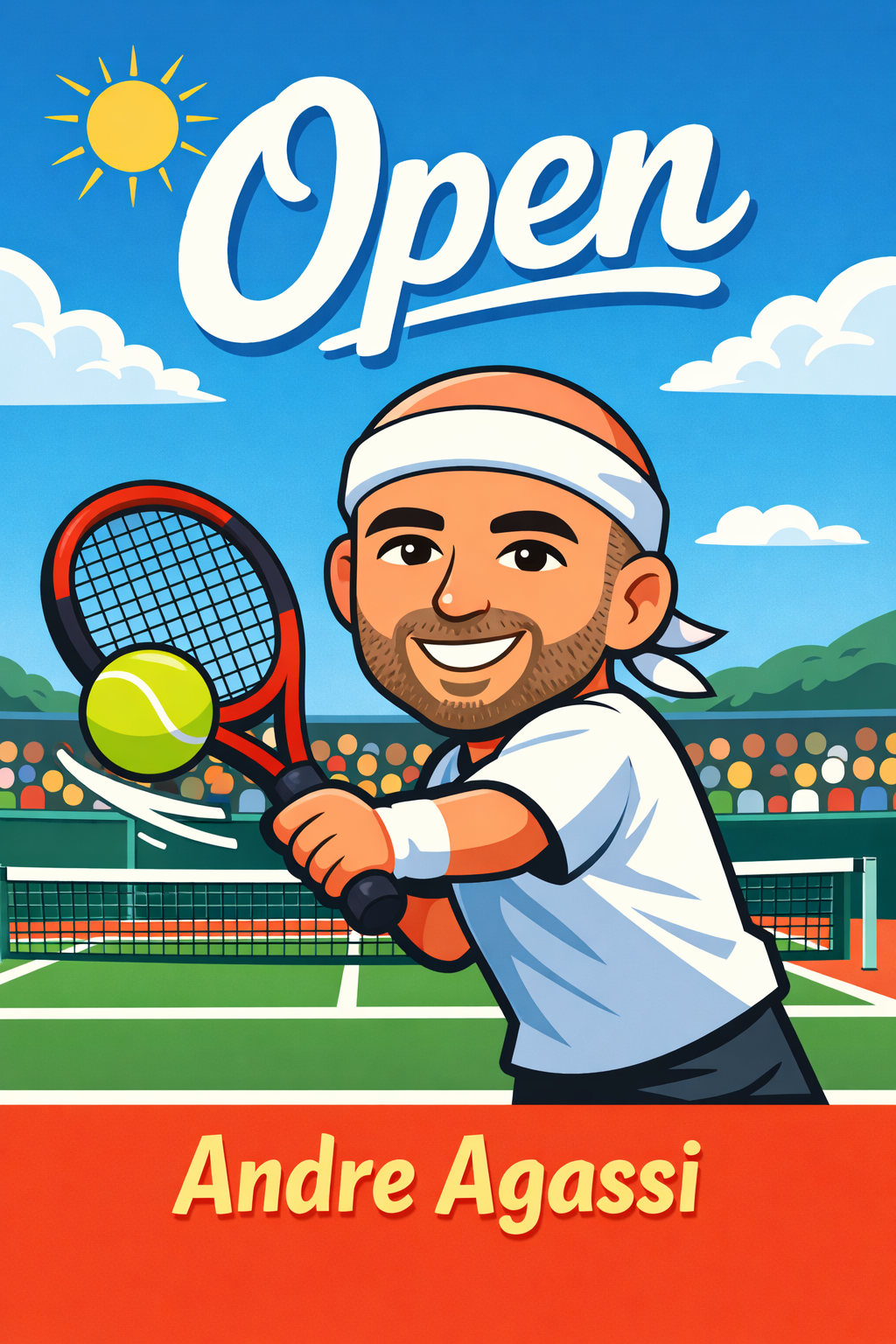
From the outside, Andre Agassi’s life appeared to be a storybook tale of sporting glory. He was the flamboyant champion from Las Vegas with the killer forehand and the rebellious style, a man who seemed to live and breathe tennis on his way to becoming one of the greatest players ever. But the truth, as revealed in his own words, is a far more complex and human narrative of a boy who never chose his path, a man who despised his own talent, and a soul in constant search of an identity separate from the roar of the crowd.
His journey begins not with love for the game, but with fear and compulsion. From the age of seven, his childhood was sacrificed at the altar of his father’s unfulfilled Olympic dreams. Forced to hit thousands of balls daily from a homemade ball machine he called “the dragon,” Agassi developed a deep-seated hatred for tennis. This foundation of coercion, coupled with his father’s intimidating presence, created a profound internal conflict that would define his life. He was a prodigy built not on passion, but on obedience and raw, unchanneled talent.
His rebellion against this controlled life manifested early. Sent to a strict tennis academy as a teenager, he found the environment oppressive and militaristic. In response, he adopted the trappings of rebellion—experimenting with substances, sporting outrageous hairstyles, and flouting dress codes—all in a desperate attempt to assert some control over his own existence. This external flair, however, masked a deep insecurity and confusion. When he turned professional, he was thrust into the global spotlight with immense skill but no sense of self. He was a walking contradiction: a shy young man performing in garish outfits, a poet at heart trapped in an athlete’s body, a champion who felt like a fraud because he felt no joy in his own victories. The stinging criticism that he was merely “a haircut and a forehand” cut deep because, in his darkest moments, he feared it was true.
Salvation, when it came, arrived not through trophies, but through people who saw the man behind the athlete. Gil Reyes, a strength trainer with a giant’s build and a father’s heart, provided not just physical conditioning but a sanctuary of unconditional support. In Reyes’s home, Agassi found a family that asked for nothing but his well-being. Simultaneously, a spiritual advisor named J.P. helped him begin the arduous task of untangling the knots of his upbringing, teaching him that his worth was not contingent on perfection or victory. These relationships became the bedrock of his stability, allowing him to build the resilience needed for the mental battles on court.
His professional breakthrough, the 1992 Wimbledon title, was an irony he alone could fully appreciate. He won the sport’s most prestigious tournament on his least-favorite surface, finally earning the respect of a skeptical press corps. This victory also led him to Brad Gilbert, a coach who revolutionized his approach by focusing on strategic, intelligent play rather than just raw power. Yet, even as his career ascended, his personal life spiraled. A highly publicized marriage to actress Brooke Shields was fraught with misunderstanding and loneliness, highlighting how ill-equipped he was for genuine intimacy. His body began to betray him with severe back pain, and the emptiness of his achievements became unbearable. He descended into a period of deep despair, experimenting with crystal meth and watching his ranking plummet, a very public unraveling of a man who felt he had nothing left to lose.
The turning point was not another trophy, but a purpose. The founding of a charter school for at-risk children in Las Vegas gave him a mission that finally felt authentically his own. For the first time, he was building something not for his father or for fame, but from his own heart. This newfound meaning coincided with a personal renaissance. A genuine, quiet love blossomed with fellow tennis champion Steffi Graf, a partnership built on mutual understanding and a shared life away from the spotlight. With this foundation of love and purpose, he staged one of the most remarkable comebacks in sports history, returning to world number one in his thirties, now playing with a clarity and gratitude that had once been impossible.
His final years on the tour were his most peaceful. He played not out of hatred or obligation, but with a profound appreciation for the craft and the opportunity to provide for his school and his growing family with Graf. The love of his wife and children framed his farewell, allowing him to leave the sport on his own terms. In the end, Andre Agassi’s story transcends tennis. It is a universal memoir about the weight of expectations, the struggle for self-discovery, and the hard-won realization that our greatest victories are often not the ones the world applauds, but the private battles we win to finally become the authors of our own lives.