Description
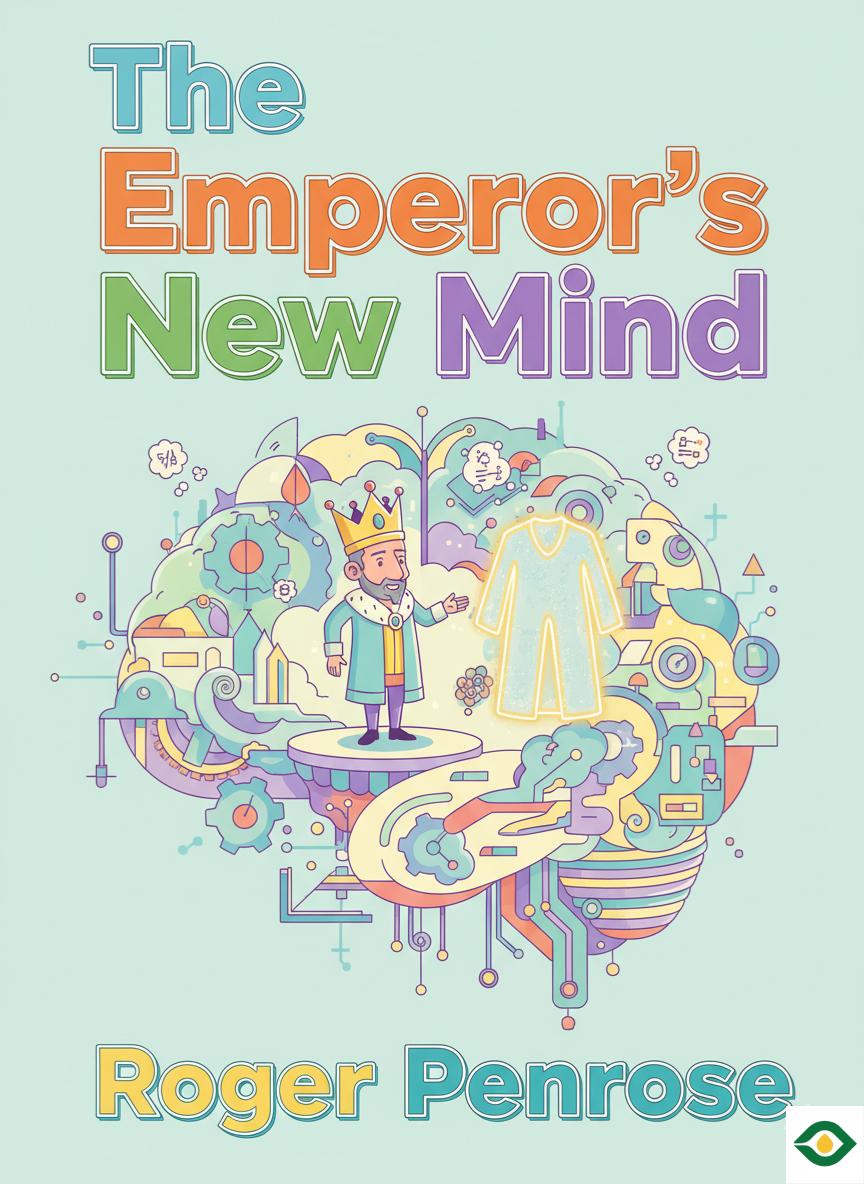
Can a machine ever truly think or feel? Will computers one day possess a mind, a consciousness, just like we do? This question lies at the heart of the debate around artificial intelligence. Proponents of “strong AI” believe that the answer is yes. They argue that if a computer can behave intelligently, it must be intelligent. From this perspective, the human mind is nothing more than an incredibly complex biological computer, and consciousness is simply the result of its programming. However, a deeper exploration into the worlds of mathematics, physics, and neuroscience suggests a far more mysterious and fascinating picture. It points to the idea that our minds are fundamentally non-computable, and consciousness is not an algorithm that can be coded.
To understand why, we first have to understand what a computer actually is. At its core, any modern computer is a version of a hypothetical device imagined by Alan Turing. This “Turing machine” operates based on a strict set of rules, an algorithm, to solve problems step-by-step. If a problem can be solved with an algorithm, it is considered “computable.” Our smartphones, laptops, and the most advanced supercomputers all function on this principle. They follow instructions flawlessly. But is that the same as understanding? The argument against strong AI begins with the idea that not everything in the universe, including the human mind, can be broken down into a simple, rule-based algorithm.
This journey into the non-computable nature of reality begins in the abstract realm of mathematics. Is math something we invent, or something we discover? The Platonist view, which this argument favors, holds that mathematical truths exist in an external reality, independent of us. We don’t create them; we find them. A stunning example is the Mandelbrot set, an infinitely complex and beautiful shape that emerges from a very simple equation. Its discoverers didn’t design its endless intricacies; they simply stumbled upon a hidden jewel of the mathematical universe. This suggests that there are truths and complexities out there that exist beyond our logical constructions.
The brilliant logician Kurt Gödel provided further evidence for this. He proved that within any formal mathematical system, there will always be statements that are true but cannot be proven using the system’s own rules. This “incompleteness theorem” shows that human insight can grasp truths in a way that purely logical, step-by-step systems cannot. We can “see” that something is true without needing an algorithmic proof. This hints that our consciousness operates on a level that transcends simple computation. It is this ability to access a “God-given” truth that separates genuine understanding from mechanical processing.
For centuries, our view of the physical world seemed to support a machine-like universe. The classical physics of Galileo, Newton, and Einstein painted a picture of a deterministic reality. With a few elegant laws, they showed that the universe operated like a grand clockwork mechanism. If you knew the position and momentum of every particle at one moment, you could predict the entire future with perfect accuracy. In such a universe, free will is an illusion, and the brain is just a complex piece of machinery whose actions are entirely predetermined. This deterministic worldview makes the idea of a thinking machine seem perfectly plausible.
However, in the early twentieth century, this clockwork picture was shattered. The discovery of quantum mechanics revealed that the world at the subatomic level is anything but predictable. It is a world of uncertainty, probability, and profound strangeness. In the quantum realm, particles like electrons can exist in multiple places at once. The famous double-slit experiment showed that a single particle can behave like a wave, seemingly passing through two different slits simultaneously and interfering with itself. The very act of observing a quantum system seems to force it to “choose” a single state out of many coexisting possibilities. This discovery replaced the deterministic certainty of classical physics with fundamental indeterminism and mystery.
The clash between the predictable macro-world and the probabilistic quantum world is one of the biggest puzzles in science, famously illustrated by the thought experiment of Schrödinger’s cat. A cat in a box is both dead and alive until we open the box and look. In the real world, of course, a cat is either one or the other. We still don’t fully understand how the definite reality we experience emerges from the fuzzy, superpositioned quantum reality underneath. This unresolved gap is crucial, because it leaves open the possibility that complex processes, like consciousness, are directly influenced by the strange rules of the quantum world.
When we examine the brain, we find an organ that looks far more like a chaotic, evolving ecosystem than an engineered computer circuit. It contains billions of neurons, each connected to thousands of others in a complex, seemingly random web. These connections are not fixed; they constantly change and adapt based on our thoughts and experiences, a quality known as plasticity. A computer processes information in a linear, logical fashion, but the brain performs countless operations in parallel, somehow weaving them together into the single, unified experience we call consciousness. How this “oneness” arises from such immense and distributed activity is a complete mystery.
Here, we can finally connect the dots between the quantum world and the mind. What if consciousness is not a product of classical, algorithmic computation but is instead a quantum phenomenon? Perhaps the neurons in our brain are sensitive enough to be triggered by single quantum events. If so, our thinking process might involve holding multiple, competing ideas or possibilities in a state of quantum superposition, much like Schrödinger’s cat. The moment of conscious decision, or the flash of insight, could be the mental equivalent of “opening the box”—the moment where these quantum possibilities collapse into a single, definite thought.
This theory would explain why human thought feels so different from a computer’s processing. It accounts for intuition, creativity, and our ability to grasp non-computable mathematical truths. It suggests that consciousness is an active process of bringing reality into focus, not just passively processing information. While we may one day build quantum computers that can perform parallel calculations, there is no reason to believe they will ever achieve the unified, subjective “oneness” of a conscious mind. True intelligence is tied to understanding, and understanding, it seems, is a miracle woven into the quantum fabric of the universe itself.