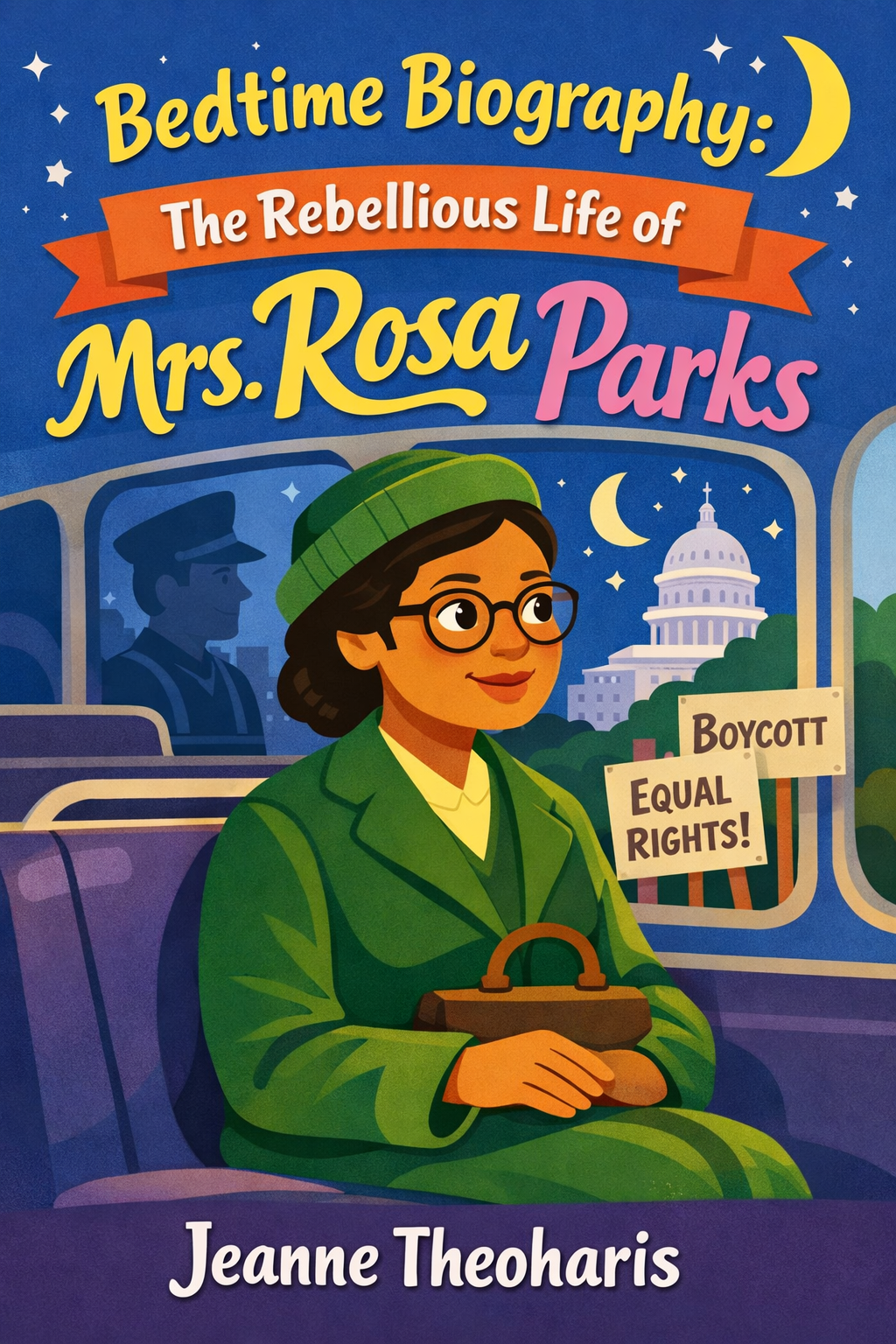
Description
The story most people know about Rosa Parks is simple: a tired seamstress who, after a long day of work, refused to give up her bus seat to a white man. This single act of defiance is often seen as the spark that ignited the civil rights movement. While that moment was undeniably pivotal, the true story of Mrs. Rosa Parks is that of a lifelong, determined activist whose entire life was a rebellion against injustice. She wasn’t just tired that day; she was fed up with a system that treated her and her community as less than human.
Born Rosa Louise McCauley in Alabama in 1913, she learned about the harsh realities of racism from a very young age. Her grandparents had been enslaved, and her grandfather, in particular, instilled in her a deep-seated intolerance for bigotry. He taught her not to accept disrespect, a lesson that shaped her character. While Rosa was a quiet and shy child, she had a fiery spirit. When a white boy pushed her off the sidewalk, she pushed him right back, unafraid of the consequences. Her mother, a teacher, raised her to believe she was not inferior to anyone. These early experiences forged a quiet strength and a clear understanding that silence in the face of oppression was not an option.
As a young woman, Rosa’s path toward organized activism became clearer when she met Raymond Parks. He was more than just the man she would marry; he was the first true activist she had ever known. A member of the NAACP, Raymond used his barbershop as a space for political discussion and debate. He was outspoken and unafraid, showing Rosa the power of community and collective action. Through him, she became involved in the fight to save the Scottsboro Boys, nine Black teenagers falsely accused of a crime. This experience opened her eyes to the dangerous but necessary world of civil rights work. She saw activists gathering around kitchen tables covered in pistols for protection, and she knew the risks were real. Despite the danger, she officially joined the NAACP and began her formal journey as a community organizer.
Life in Montgomery, Alabama, was defined by the daily humiliation of segregation, and nowhere was this clearer than on the city buses. Black passengers were forced to pay at the front, exit the bus, and re-enter through the back door—and it wasn’t uncommon for the bus to drive off before they could get back on. They were confined to the back seats and could be forced to stand up for a white passenger at any moment. Rosa Parks was not the first to challenge this system. Others, like 15-year-old Claudette Colvin, had refused to give up their seats months earlier. Rosa knew these stories and even supported Colvin personally. She was deeply involved in the NAACP Youth Council, always looking for ways to empower the next generation to fight back. Her famous act was not a random impulse; it was a calculated decision made by a seasoned activist who knew the landscape of the struggle intimately.
On December 1, 1955, when Rosa Parks refused to stand, she wasn’t thinking about her sore feet. She was thinking about Emmett Till, a 14-year-old boy who had been brutally murdered in Mississippi just a few months earlier for allegedly offending a white woman. The acquittal of his murderers left her and the Black community heartbroken and enraged. That feeling of deep injustice is what fueled her quiet “no.” Her arrest was calm and without fanfare. But behind the scenes, the network of activists she had worked with for years sprang into action. E. D. Nixon, a local NAACP leader, and Jo Ann Robinson of the Women’s Political Council saw her as the ideal person to rally behind. Within days, they had organized a city-wide bus boycott.
The Montgomery Bus Boycott was a stunning success, showcasing the power of collective action. The city’s Black community, unified in a way Rosa had long dreamed of, refused to ride the buses for 381 days. They organized carpools, walked for miles, and stood together in solidarity. The boycott launched a young, eloquent pastor named Martin Luther King Jr. into the national spotlight. But this victory came at a great personal cost. The Parks family endured constant death threats. Their phone rang day and night with hateful messages. Raymond fell into a deep depression, and Rosa developed chronic health problems from the stress. The fight was not just public; it was a grueling private war. Finally, after more than a year, the Supreme Court ruled that segregation on public buses was unconstitutional.
Though they had won the battle, the war was far from over. The Parks family was blacklisted in Montgomery. Unable to find work and facing continued threats, they were forced to move north to Detroit. But the North was no paradise. They encountered a different kind of racism in the form of housing discrimination and limited job opportunities. For years, they struggled financially, living in a small apartment in project housing. Rosa’s health worsened, but her spirit never broke. She eventually found work with Congressman John Conyers, where she spent years serving her new community and continuing her fight for equality.
Rosa Parks never stopped being an activist. She attended the 1963 March on Washington, supported the more radical Black Power movement, and advocated for prison reform. She understood that the struggle for civil rights was connected to a global fight for human rights, from opposing apartheid in South Africa to empowering youth in her own community. In 1987, she co-founded the Rosa and Raymond Parks Institute for Self Development to continue her work of inspiring young people. In her later years, she was recognized with the nation’s highest honors, including the Presidential Medal of Freedom. When she met Nelson Mandela, he greeted her by name, recognizing a fellow warrior in the long fight for freedom. Her life serves as a powerful reminder that real change is made not by a single act, but by a lifetime of unwavering dedication.