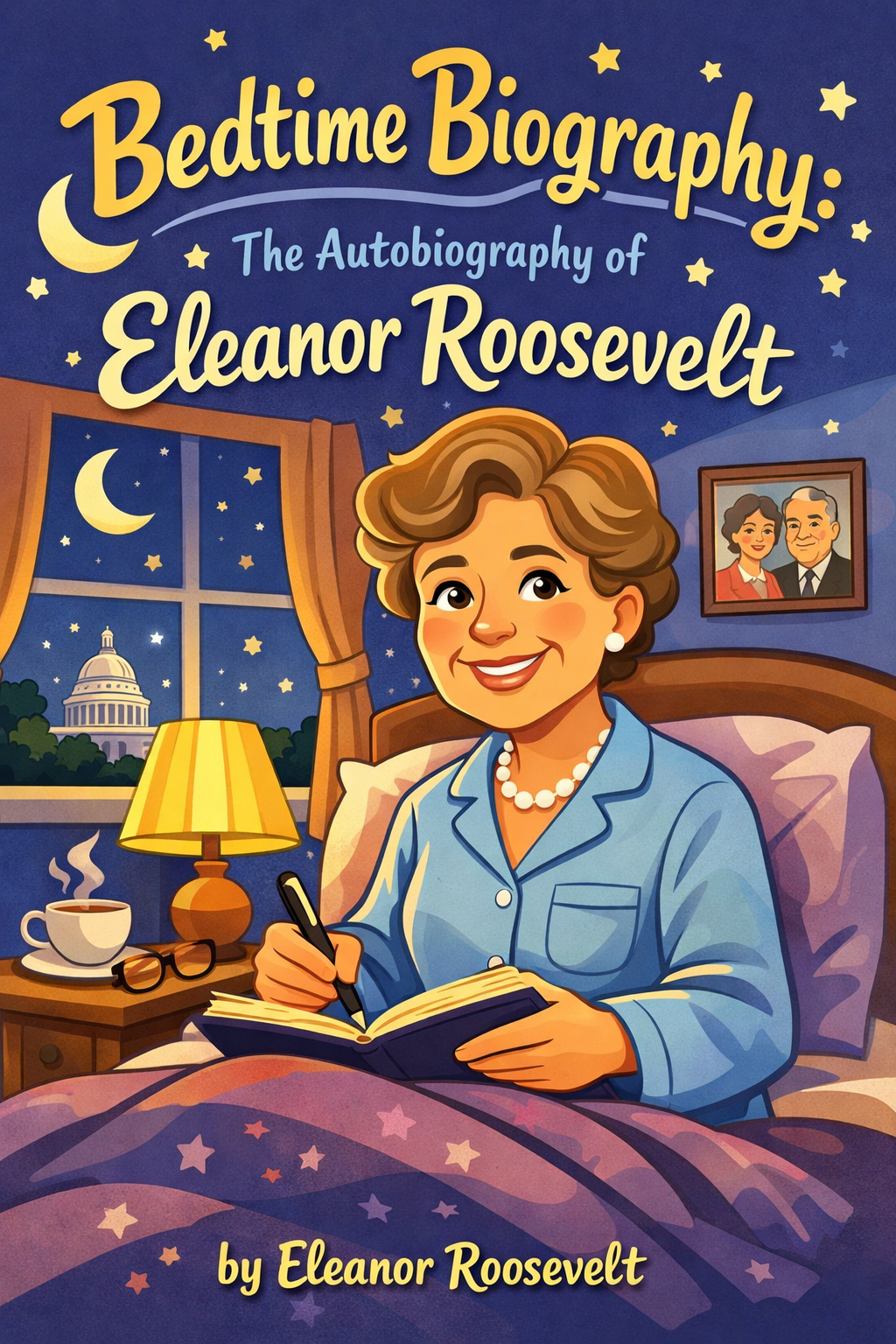
Description
Eleanor Roosevelt’s life was never ordinary. She was born into one of New York’s wealthiest families in 1884, yet she spent much of her childhood feeling lonely and unwanted. Her mother criticized her appearance, calling her old-fashioned and plain, while her father, though loving, struggled with alcoholism and died when she was just ten. By that age, Eleanor was an orphan. These early hardships shaped her view of the world and planted a deep sense of empathy for others who suffered.
As a girl, Eleanor was serious, thoughtful, and very curious. She loved books and often read secretly in bed before sunrise. Her father once showed her the lives of poor children on the streets, boys who had no one to care for them. That memory stayed with her forever. It became one of the sparks behind her lifelong desire to help those who had little.
At the age of 15, Eleanor was sent to school in England, where she met a remarkable teacher named Marie Souvestre. This headmistress encouraged Eleanor to think critically, discuss politics, and imagine a role for herself beyond marriage and high society. The experience changed her, giving her confidence and a wider vision of the world.
When she returned to New York, her grandmother expected her to join the social scene, attend parties, and prepare for marriage. Eleanor never enjoyed the endless dances and dinners, but soon she met her distant cousin, Franklin Delano Roosevelt. He was charming, ambitious, and full of energy. They married in 1905 when Eleanor was just 20 years old. President Theodore Roosevelt, her uncle, walked her down the aisle.
Marriage brought joys and sorrows. Eleanor gave birth to six children, though one died in infancy. Like many women of her class at the time, she allowed nannies to care for her children, something she later regretted deeply. Still, she grew into her role as a mother while supporting Franklin’s rising political career. At first, she imagined her own role was only to be a loyal wife, but history had other plans for her.
When the First World War began, Franklin worked in Washington as assistant secretary of the navy. Eleanor joined the war effort, volunteering with the Red Cross and visiting hospitals filled with wounded soldiers. She worked long hours, doing real labor, not just symbolic charity. The experience showed her that she could make a difference, that she was capable of more than hosting dinners. It gave her confidence to step into public life.
Then, in 1921, tragedy struck again. Franklin was stricken with polio, which left him unable to walk. Eleanor devoted herself to his care, but she also discovered her own independence. While Franklin struggled to continue in politics, she began to speak, organize, and advocate. She worked with women’s groups, labor unions, and charities. She saw the struggles of workers, immigrants, and families during hard times, and she became their champion.
By the late 1920s, she was heavily involved in politics herself. She drove voters to the polls, spoke at events, and even started programs to give jobs to unemployed youth. She helped run a school for girls and supported labor rights. These were not symbolic efforts; she invested her time, money, and energy directly into improving lives.
When Franklin was elected president in 1932, Eleanor moved into the White House reluctantly. She feared losing her independence. Instead, she redefined what it meant to be a First Lady. She did not stay in the background. She traveled, inspected hospitals and prisons, met with workers, and reported back to her husband. She hosted press conferences for women reporters, wrote a daily newspaper column called My Day, and used her platform to push for fairness and justice.
Eleanor also took bold stands on race. At a time when segregation and prejudice were deeply rooted in American life, she openly supported anti-lynching laws and welcomed African American visitors to the White House. She risked political backlash, but she chose principle over popularity.
During the Great Depression and the Second World War, she became a tireless public figure. She traveled across the country and even into war zones, meeting soldiers and families, offering comfort and strength. She carried her own revolver instead of relying on Secret Service protection, and she drove her own car. She was determined to remain approachable and independent.
When Franklin died in 1945, many thought Eleanor would retire quietly. Instead, her influence grew. President Truman appointed her as a delegate to the new United Nations. At first, she doubted herself, but soon she became one of the most respected voices there. She played a central role in drafting the Universal Declaration of Human Rights in 1948, one of the most important international documents of the modern world. It declared that every person, no matter their race, gender, or religion, was entitled to dignity, freedom, and justice.
Eleanor chaired the commission that wrote it, and her persistence, fairness, and courage were critical. She held informal meetings, built friendships across nations, and outmaneuvered opponents with her intelligence and passion. Her work earned her the nickname “First Lady of the World.”
Even after leaving the UN, she continued to travel, write, and speak. She met with world leaders, encouraged young nations, and always sought peace. She believed in cooperation, tolerance, and respect as the only true foundations for progress.
Eleanor Roosevelt died in 1963, but her legacy endures. She turned personal pain into public service, loneliness into empathy, and privilege into responsibility. She showed that one person, guided by compassion and courage, could help light the way for millions.
Her story is one of resilience, hope, and an unshakable belief in human dignity. Eleanor never let bitterness take root. Instead, she chose action over despair, kindness over judgment, and courage over fear. That is why she remains one of the most admired figures of the twentieth century, and why her life still inspires those who believe the world can be made better, one small act at a time.