Description
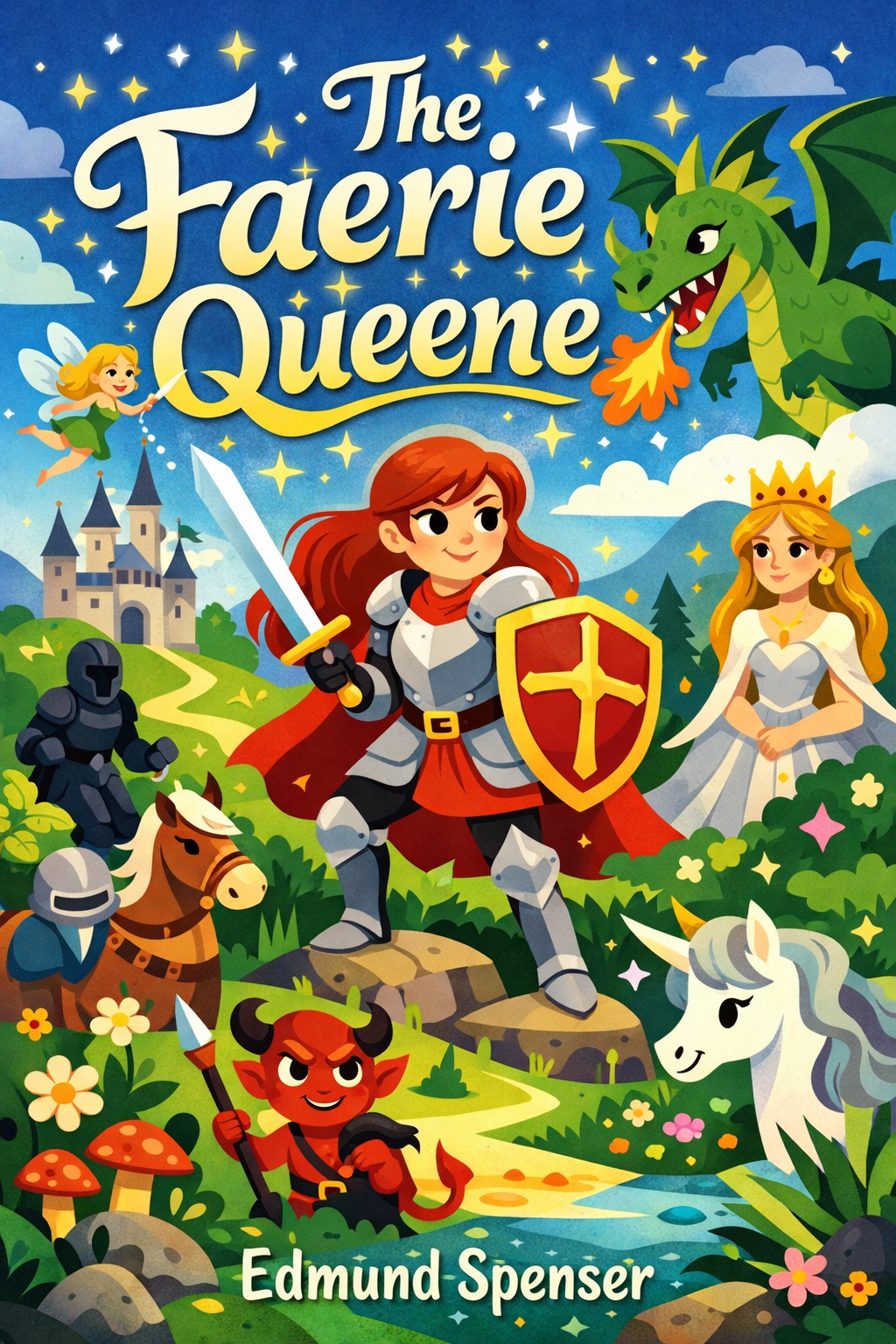
Edmund Spenser’s The Faerie Queene is one of the greatest poems of the English Renaissance. It was written during the reign of Queen Elizabeth I, and it is both a tale of adventure and a lesson in virtue. Instead of telling one straight story, Spenser divides the poem into several books, each one focused on a different knight who represents a particular virtue. These knights live in a magical land full of monsters, wizards, temptresses, and enchanted castles. Their journeys are not just about winning battles, but also about proving their character, making choices, and resisting temptation.
The first major figure is Redcrosse, the Knight of Holiness. He begins his quest to defeat a dragon that terrorizes the kingdom of a princess named Una. Early on, he shows courage when he slays a monstrous creature called Error. But his path is quickly twisted by the tricks of Archimago, a sorcerer who uses illusions to make Redcrosse believe Una is unfaithful. Distrusting her, Redcrosse abandons his true ally and falls under the sway of Duessa, another deceiver. She leads him into the House of Pride, a dangerous place ruled by Queen Lucifera. There, Redcrosse nearly loses himself to arrogance and false beauty. He is only freed when Una, aided by Prince Arthur, rescues him. After recovering in the House of Holiness, Redcrosse finds the strength to face the dragon. In a battle that lasts three days, he nearly dies but finally triumphs. His reward is Una’s hand in marriage, and his victory symbolizes the triumph of holiness over sin.
The second knight is Guyon, the Knight of Temperance. His quest is to destroy the temptress Acrasia, who lures men to ruin in her beautiful Bower of Bliss. Alongside a wise Palmer who guides him, Guyon faces trials that test his self-control. Archimago tries to stir up violence between Guyon and Redcrosse, but the truth comes out just in time. Lady Phaedria tempts him with a lazy paradise, but he resists. The greedy figure Mammon offers him wealth and power, but Guyon walks away. Even when knocked unconscious and left vulnerable, he survives because Prince Arthur intervenes. At last, Guyon reaches Acrasia’s palace, where pleasure and luxury threaten to undo him. But with discipline and restraint, he captures Acrasia and destroys her dangerous garden, proving that temperance can defeat excess.
The third knight is Britomart, a rare woman warrior in a world of men. She represents chastity, but in Spenser’s vision, chastity does not mean rejection of love. It means pure and faithful love. Britomart is destined to marry Arthegall, the knight of justice, and from their line will come great rulers, including Elizabeth I herself. Britomart’s journey is filled with challenges: she defeats arrogant knights, resists temptations, and even frees Lady Amoret from the cruel sorcerer Busirane. Britomart shows that chastity can be active and heroic, not just passive. Her strength and courage make her one of the poem’s most admired figures.
The fourth book turns to the theme of friendship and love. Britomart continues her travels, now joined by Amoret. Their bond represents noble friendship. At the same time, false versions of love appear everywhere. A false Florimell, created by sorcery, tricks knights into fighting over her. At a great tournament, knights joust for honor and love, but their jealousies reveal the dangers of vanity and rivalry. Meanwhile, another story unfolds with Belphoebe and Timias. At first, Belphoebe misjudges Timias, but when she later heals him, love grows between them. This shows how true love can change and improve people.
The fifth book focuses on Arthegall, the Knight of Justice. He is aided by his iron companion Talus, who carries out punishment without hesitation. Together, they travel across the land, correcting wrongs and defeating oppressors. Arthegall restores order at a bridge guarded by a greedy knight, defeats a giant who argues for equality in a way that threatens natural order, and confronts a fierce Amazon named Radigund. But Arthegall’s sense of justice is not always simple. When captured by Radigund, his judgment is clouded by her beauty, and he becomes entangled in her court. This shows how even justice can be distracted or weakened by human weakness. Still, Arthegall continues his quest to uphold fairness and righteousness.
The sixth book follows Calidore, the Knight of Courtesy. His mission is to subdue the Blatant Beast, a terrifying monster that represents slander and destructive gossip. Calidore’s journey is not only about hunting this beast but also about showing kindness, respect, and humility. He meets Tristram, a young prince, and later falls in love with the shepherdess Pastorella. Calidore proves that true courtesy is not just for the noble but must be shown to everyone, even the humble. Though he defeats many enemies and even rescues captives, the Blatant Beast continues to roam, reminding us that slander and cruelty of speech can never be fully destroyed.
Throughout all these books, Prince Arthur appears again and again. He represents the perfect Christian hero and unites the stories together. His role is to aid the knights at their weakest moments, reminding readers that grace and divine help are necessary to achieve virtue.
What makes The Faerie Queene special is its use of allegory. Every character, event, and place means more than it first appears. The knights are not just fighters; they stand for virtues like holiness, temperance, chastity, justice, and courtesy. Their enemies symbolize vices like pride, lust, deception, and greed. Even the settings – castles, dungeons, forests, and enchanted gardens – stand for moral and spiritual challenges.
At the same time, the poem also reflects the politics of Spenser’s age. Redcrosse, for example, is a symbol of St. George, patron saint of England, and represents the English Protestant faith. Duessa and Archimago stand for false religion and corruption. Britomart’s prophecy of descendants connects directly to Elizabeth I and the Tudor dynasty. In this way, the poem praises Elizabeth as the true Faerie Queene, a ruler who embodies virtue and protects her land.
Yet for modern readers, The Faerie Queene is more than political history. It is a vast, imaginative work full of knights, battles, romance, and moral lessons. It shows how human beings are constantly tested: by lies, by desire, by anger, by pride. To live well, one must hold fast to virtue and resist the many traps of vice. Each knight stumbles at times but learns through struggle. Their victories show that virtue is not easy but possible with courage, patience, and faith.
In the end, Spenser leaves the poem unfinished. Only six books were completed, though he planned twelve. But even in this half-completed form, The Faerie Queene remains a rich world where readers can explore the timeless battles of good and evil, truth and falsehood, love and corruption. It is both an adventure story and a moral map, teaching through wonder, beauty, and the power of imagination.